
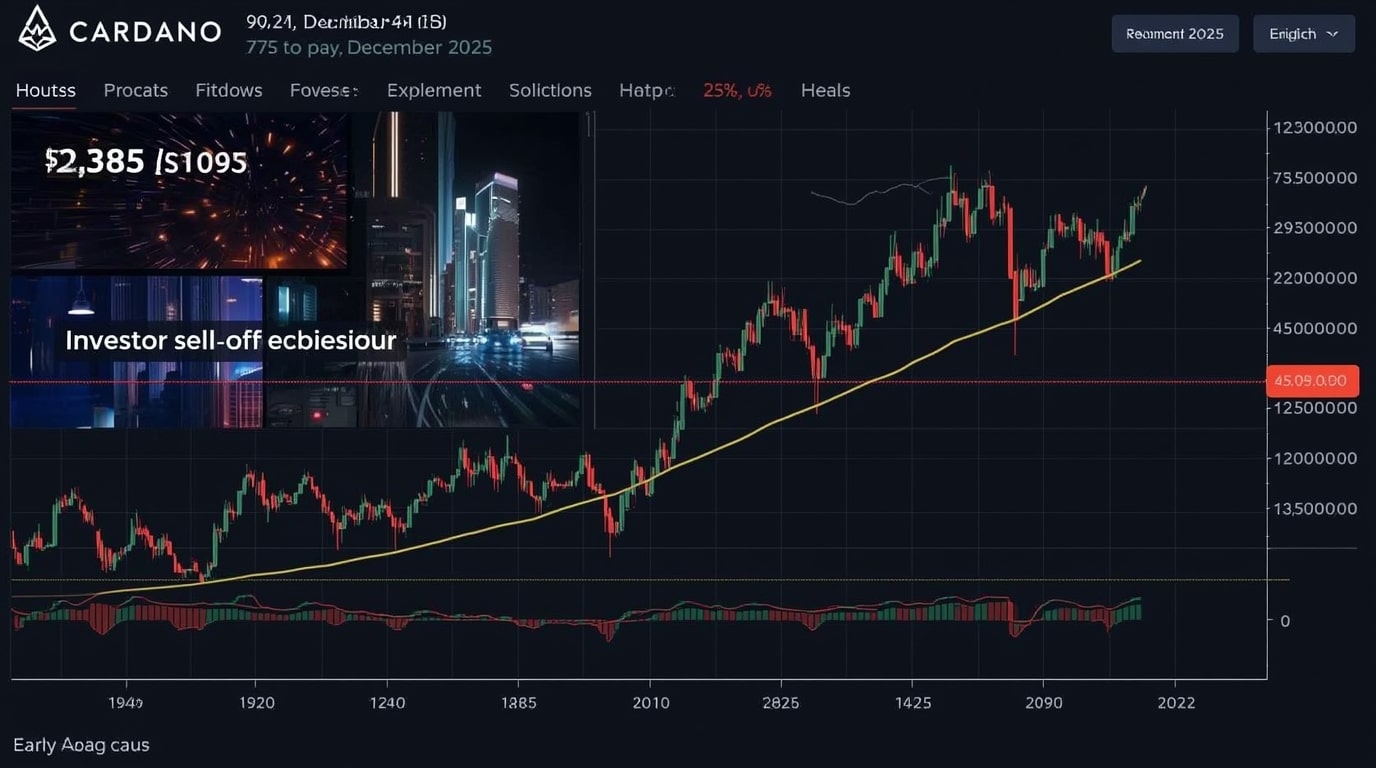
Cardano ADA Plunges 7% as December 2025 Opens: DeFi Liquidity Surge, Investor Exodus Fears, and Explosive Price Predictions

With the cryptocurrency market opening in December 2025 with a bad taste, Cardano (ADA) has suffered a heavy blow, falling more than 7% to trade in the range of $0.385 as the rest of the Bitcoin-related markets decline and bearish sentiment mounts. It is a drop that overturned gains made since the end of November, despite its promising ecosystem upgrades, such as a liquidity fund of $30m to rejuvenate DeFi on the network.
As big money quietly sells and coins of lower age flood markets, ADA is vulnerable to the lowest annual close in its history, but there are some positive reports that it will see a challenging 2,478 per cent jump to its first digits by 2026. With a regulatory environment of regulatory uncertainties and competitive smart contract battles, the adaptability of Cardano via innovation makes it a high-stakes bet among shrewd traders who are looking for a rebound.
Cardano’s Sharp Price Decline Amid Broader Market Woes
The dawn of December 2, 2025, saw Cardano at around $0.385, a decline of 7.2% on the close of the previous day at $0.415, which indicated increased volatility due to macroeconomic indicators such as possible increases in the interest rates of the Bank of Japan.
This fall follows a 31% monthly fall, which has taken ADA down to the areas of major support at $0.40, which have heightened the risk of going down even more since Bitcoin dominance retests the ascending channels. Even though trading volume has been soaring to more than 1 billion in the past 24 hours, as the 9.1% daily loss is very high, the altcoin follows Ethereum and Solana with a 3-5% daily loss.
The panic selling was further compounded by the reappearance of dormant ADA coins, some of which had not been used since 2017 on exchanges, an indication of a possible long-term holder capitulation. Bearish divergence can be observed on-chain, with the Relative Strength Index (RSI) showing no change in the 35 area, indicating oversold conditions, but the Moving Average Convergence Divergence (MACD) is weakening, and the histogram bars are negatively contracting.
Short interest has been increasing, and open interest in ADA futures has risen 12% week-to-week, betting that it will test below $0.35 in case it cannot break resistance at $0.40. Nevertheless, Cardano has a strong market cap of $13.7 billion, which puts it seventh among the smart contract platforms, pointing to the underlying strength of the platform amidst the meme-driven hype.
Ecosystem Boost: Liquidity Fund -30M To Revival in DeFi
During the price subversion, the Cardano development team is doubling utility with a historic 30 million program to fully inject real liquidity into its DeFi ecosystem, which will roll out entirely in early 2026. It will be a Cardano Treasury-led fund and strategic partner fund that seeks to mobilise passive ADA holdings into active yield-generating assets to alleviate the network’s traditional low liquidity pools that have limited total value locked (TVL) to less than $500 million.
The program would lead to an increase of 300% of TVL in six months by incentivising staking and lending protocols and would help the organic growth of decentralised exchanges and lending platforms.
Alongside this, there is the prospective introduction of the Midnight sidechain, a privacy-oriented layer, which is expected to empower Cardano with interoperability with zero-knowledge proofs, and could trigger the adoption of Cardano by enterprises in regulated industries, such as supply chain finance.
Scalability improvements have been proven by recent stress tests of the Plomin Hard Fork, which can now take transaction throughput to 1,000 per second without affecting security. Community sentiment on sites such as X demonstrates the underestimation of Cardano, and users indicate that the market cap of $13.7 billion compares to the $69.7 billion of Solana despite some similarities in the tech stack. Such movements are indicative of a strategic shift of hype to infrastructure, making ADA a long-term competitor during a post-halving bull run.
Competitive and Regulatory Forces Strengthen around ADA
The decline of Cardano is not the only symptom of increasing regulatory attention to the networks of proof-of-stake, with SEC filings in the United States exploring the possibility of staking incomes as a security.
Europe MiCA compliance dates are impending, and platforms will be compelled to delist non-compliant tokens; however, Cardano has an academic edge, based on peer-reviewed research, over faster, but less secure competitors like Solana. The competition is intense: The layer-2 boom of Ethereum has drained the liquidity of DeFi, and Tron and BNB Chain control the low-fee segments with $26 billion and $112 billion market valuations, respectively.
Betting on bearishness is increasing, and the Fear/Greed Index of altcoins stood at 28, which indicates high caution since ADA is likely to be the bear market of 2025. Whale activity is expected to record the net outflow of 150 million ADA to cold storage in the last week, but contrarian analysts observe a buildup at the bottom of 0.38, which indicates a bullish wedge formation that would restart the cycle when broken. Facing the risk of falling to $65,000, any sell-off to below that may send ADA to $0.30, but strong on-chain indicators, such as 70% staking participation, may act as a safeguard against complete meltdown.
Analyst Bottoms: Bearish Dips to 2,478% Moonshot
The future of the Cardano price portrays a divisive outlook in the year 2025 and after. The short-term projections are hesitant: the maximum decrease of -0.24% to $0.38 on December 4, and possible lows of 0.3817 in case of bearish movements.
Nonetheless, a recovery to $0.42 is possible as long as inflows of liquidity become a reality and the upper limit is set at 0.511 at the end of the month. The averages are within the range of $0.945 in the full-year 2025, and the optimistic assumptions are 1.376 or even 2.05 during DeFi catalysts.
The actual hype is building up to 2026, when a major community analyst predicts a super bull year of 2026, where ADA would be up 2,478% to $10 due to Midnight privacy features and worldwide adoption. Conservative projections set 2026 at the lowest of $0.513, with an increase to 0.6973 in favourable projections, on the basis of 5 per cent per annum growth at present levels.
It is projected to be between $3.33 $10.25 by 2030, depending on whether Cardano can get 10% of the smart contract market share via sustainable scaling. These projections are based on macroeconomic tailwinds such as the decreasing inflation and how Cardano can translate the treasury funds into actual TVL growth.
Cardano: Fascist Road Ahead or Slump Further?
As December 2025 approaches, it is like Cardano is on the brink of danger and success. The $30 million Liquidity surge and Midnight launch may jumpstart a DeFi boom, attracting institutional capital and rocketing ADA to $0.75 by year-end in case sentiment reverses. However, now that large investors are out and bearish constructions in place, any downfall below $0.38 could welcome a fall below $0.30 and a test of 70% of the staked supply of the network.
Bitcoin traders would be interested in watching the Bitcoin $85,000 perch and ADA $0.40 resistance; when the market closes above it on a daily basis, the wedge breakout may begin, and the market may hit the target of 0.6973 relatively quickly.
In a research-focused ecosystem, where recklessness is putting money in the wrong place, the under-1-perch scream of Cardano is an opportunity knocking for those who bought it on the premise of peer-reviewed ascent to supremacy. Should it revert to $1 this month or stick at the base to trigger an explosion in 2026, ADA will be part of the intellectual elite of blockchain, who will redefine smart contracts in the next decade.



 Bitcoin
  Ethereum
  Tether
  BNB
BNB  XRP
XRP  USDC
USDC  Solana
  TRON
TRON  Lido Staked Ether
  Cardano
  Avalanche
  Toncoin