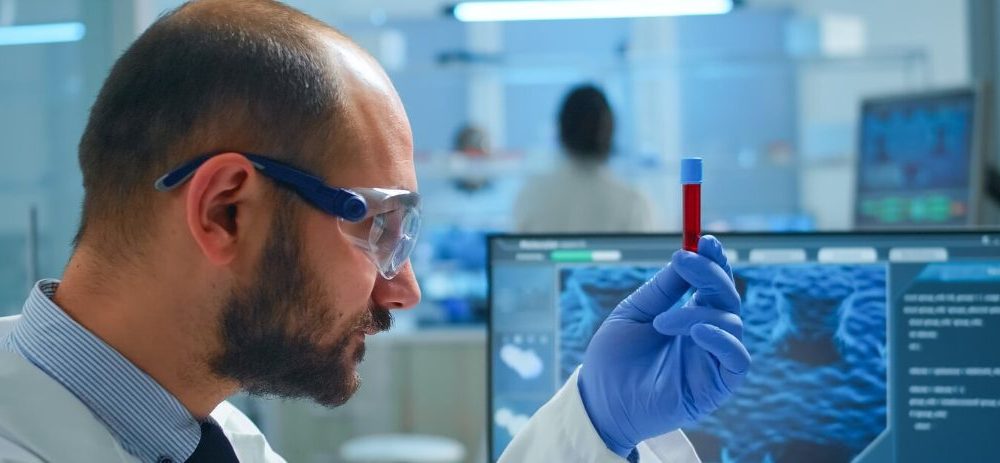

Trays of blood samples slide under digital microscopes on a gloomy Cambridge morning in a lab that has a slight odor of disinfectant and warmed plastic. Scientists no longer congregate around eyepieces. Rather, they observe screens, which are grids of cells that resemble tiny moons orbiting the earth, while an AI system silently determines which ones are important. It feels more like air traffic control than medicine.
A generative artificial intelligence system created by a UK research team can analyze blood cell morphology as accurately as skilled haematologists. In addition to classifying cells, the CytoDiffusion tool models their entire range of appearances, spotting uncommon anomalies that could indicate illnesses like leukemia. It outperformed human experts in tests by a small margin and, more significantly, indicated when it was unsure, a feature that doctors covertly acknowledge people find difficult to maintain after extended shifts.
| Category | Details |
|---|---|
| Field | Synthetic & Lab-Grown Blood Research |
| Key Innovation | AI-assisted blood cell analysis & synthetic cell generation |
| Notable System | CytoDiffusion generative AI framework |
| Lead Academic Contributor | Prof. Parashkev Nachev, UCL Queen Square Institute of Neurology |
| Partner Institutions | University College London, University of Cambridge, Queen Mary University of London |
| Core Capability | Detect abnormal blood cells & generate synthetic blood cell images |
| Clinical Significance | Potential improvements in leukaemia diagnosis & transfusion medicine |
| First Human Trial | Lab-grown red blood cell transfusion in UK, 2022 |
| Potential Uses | Trauma care, rare blood types, emergency medicine |
| Reference | https://www.nature.com |
This “metacognitive” awareness, or a machine realizing its own limitations, is perceived as potentially being just as valuable as accuracy.
Synthetic blood cell images that are identical to real ones can also be created using the same generative technique. In one test, seasoned haematologists were unable to distinguish between real samples and AI-generated cells. Researchers reported feeling both triumphant and uneasy at that moment. What else might machines soon be able to replicate if experts are unable to distinguish between the two?
This ability might be more than just diagnostic. It might be the first obvious step toward producing synthetic blood on a larger scale.
It is not an abstract motivation. Lack of blood is still a major issue worldwide. The WHO reports that while the majority of donations take place in affluent nations, chronic scarcity is a problem in rural South Asia and sub-Saharan Africa. The lack of compatible blood can mean the difference between life and death in maternity units and trauma wards in a matter of minutes.
It’s difficult to ignore how reliant on volunteer donors and chilled logistics modern medicine still is while watching this play out.
A different future is offered by lab-grown blood. Using hematopoietic stem cells, scientists create red blood cells, directing their growth with growth factors until they develop into cells that can carry oxygen. Weeks pass during the process. It is delicate, expensive, and still far from industrial scale. However, the promise is remarkable: engineered cells might be modified to eliminate group markers or even customized for uncommon blood types, enabling universal transfusions.
According to Cambridge transfusion expert Cedric Ghevaert, lab-grown platelets may perform better than donated ones in trauma situations, more successfully halting active bleeding. Despite a sharp decline in the last ten years, production costs are still high.
In the meantime, synthetic blood, which takes a completely different approach, aims to replicate oxygen transport without the use of human cells. Military research programs have looked into oxygen-carrying alternatives that are safe for use on the battlefield, don’t require refrigeration, and work for all patients. It’s unclear if these alternatives will be secure enough for general civilian use.
Another innovation in the Cambridge labs could speed up production. Researchers discovered that the expulsion of the nucleus, the last maturation stage in the development of red blood cells, is triggered by the molecular signal CXCL12. Efficiency is significantly increased when this step is timed correctly. Although it sounds technical, the implication is straightforward: quicker manufacturing follows faster maturation.
Scaling is still the impending problem, though. It takes industrial precision and clear regulations to produce enough blood for hospitals. The question of whether lab-grown blood should be regulated as medicine or as cell therapy is still up for debate, and the decision will have a significant impact on approval costs and timelines.
It appears that investors think the regulatory haze will eventually clear. Research on AI-driven diagnostics and synthetic blood is still receiving funding from health trusts, foundations, and international research projects. The reasoning is simple: as populations age and surgical care grows, there will only be a greater need for blood. However, biological advancement is rarely linear.
Today’s AI systems that identify aberrant cells cannot take the place of physicians. As assistants, they prioritize regular samples and draw attention to irregularities. The final decision is still made by doctors, but the process is changing. Once a standard practice in hematology training, late-night slide reviews could soon be relics of the past.
That change is a little unsettling. Decades of expertise are being reframed—not erased, but redistributed—between machine pattern recognition and human judgment.
The impression of medicine at a pivotal moment is conveyed by standing in these labs; it is subtly significant rather than dramatic or cinematic. Researchers are edging closer to a supply of life’s most vital fluid that isn’t dependent on random donations, while algorithms are learning the subtle language of blood and stem cells are being trained into efficiency.
It’s still unclear if synthetic blood will become commonplace in ten years or if it will continue to be a specialized tool. Timelines are generally resisted by biology. However, the direction seems clear.
At a speed that no human could match, rows of digital cells keep scrolling across the monitors, each one being categorized, compared, and interpreted. The winter light goes out early. Inside, the work goes on, methodical, cautious, and with the glimmering hope that blood might one day be produced with the same level of dependability as medicine.



 Bitcoin
  Ethereum
  Tether
  XRP
XRP  BNB
BNB  USDC
USDC  Solana
  TRON
TRON  Lido Staked Ether
  Cardano
  Avalanche
  Toncoin