
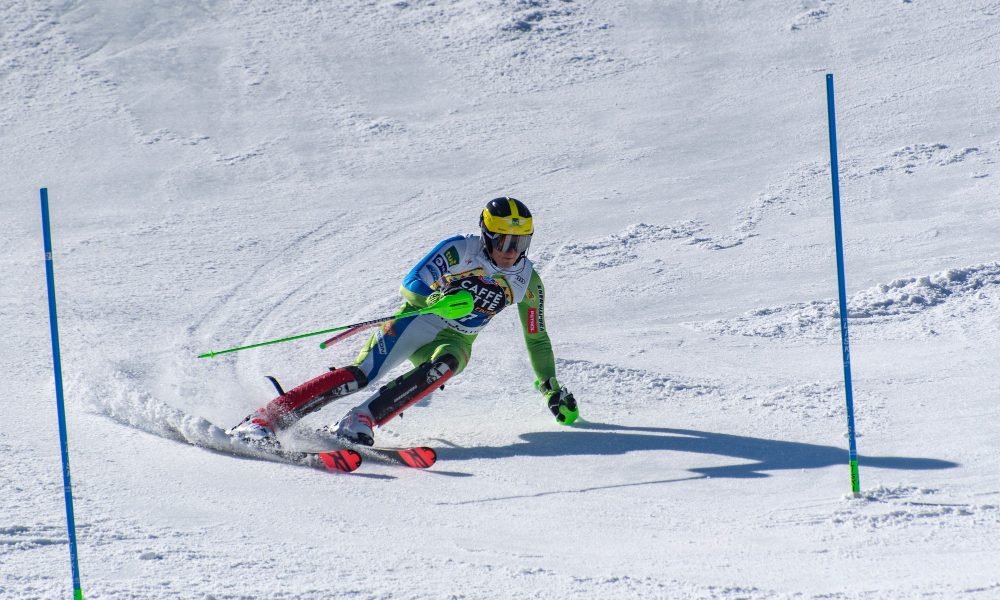
She did not just recover from the setback. She flew away from them.
Eileen Gu demonstrated something unrelated to gravity during a highly stressful qualification round at the 2026 Winter Olympics in Livigno. She recovered, recalculated, and carved out a second run that felt shockingly effective in its control and ambition after an unusual tumble during her first slopestyle run. Her run, which culminated in a flawless corked 900, guaranteed her a spot in the finals and served as a reminder to all onlookers of why she is still a formidable force in freestyle skiing.
| Attribute | Details |
|---|---|
| Name | Eileen Feng Gu (Gu Ailing) |
| Date of Birth | September 3, 2003 |
| Age | 22 |
| Nationality | American-born, competes for China |
| Sport | Freestyle Skiing (Halfpipe, Slopestyle, Big Air) |
| Olympic Medals | 2 Golds (Big Air, Halfpipe), 1 Silver (Slopestyle) – 2022 Beijing Games |
| Education | Stanford University |
| Other Roles | Fashion model (IMG), Brand ambassador (Red Bull, TCL, Louis Vuitton) |
| Recent Highlight | Qualified for 2026 Slopestyle Finals in Milan after strong second run |
| External Link | Olympics Profile |
Gu’s resume already reads like a completed career at the young age of 22. Big air, gold. Halfpipe gold. In slopestyle, silver. More than medals, though, what makes her so captivating is her inability to choose between different fields, whether it be academia, fashion, or skiing. She is constructing bridges between disciplines rather than just crossing them.
Growing up in San Francisco, Gu’s journey was never typical. She made a very personal and well watched decision in 2019 when she chose to fight for China and embrace her mother’s Chinese ancestry. However, the decision was based on a vision of increased cultural interaction and youth empowerment through athletics, despite the fact that it was politically divisive. Speaking Mandarin fluently and remarkably adept at juggling multiple identities, she has made advantage of her position to promote representation as well as performance.
Gu’s off-slope presence has significantly improved over the last few years. She has forged strategic alliances with companies that embody aspirational identity and athletic prowess. She has created an exceptionally multifaceted image of athletic celebrity, from modeling for Louis Vuitton to being in Time’s 100 Most Influential. Her Instagram is as likely to display a textbook on physics as it is a high-end coat.
Gu focused on her studies at Stanford during the pandemic, when access to training was restricted and injuries halted progress. She described it as a period of “disconnection from the snow.” However, rather than throwing her off course, that distance appears to have sparked a change in viewpoint. She has achieved a far more sustainable balance by putting intellectual growth and athletics first than most professional athletes ever try.
Gu has displayed a fresh zest in recent days as Milan has turned into a canvas for Olympic aspirations. Joyful, less calculating. It was very evident what she was trying to say when she wrote, “Coming into my second Olympics as the same person in many ways, and also changed in some others.” Regaining victory wasn’t the only goal here. Regaining the enjoyment of the sport itself was the goal.
When she described skiing as something she was “infatuated” with once more rather than as a means to an end, I recall observing how her tone softened.
She provides an incredibly powerful counter-narrative to conventional sporting icons for young girls in China and abroad. She is a poet of motion and a force to be reckoned with. An artist and a strategist. Determined to finish with intent, but not scared to frontload with a mistake. She is very dependable under pressure because of that alone.
Gu’s work is very inventive because of how well she integrates her personalities. In the lived-in style of someone who no longer feels the need to justify herself, rather than in a performative fashion. Studying in California, modeling in Paris, and skiing in China are all tributaries of the same waterway, not distinct channels.
The athletes of the future might not question whether they should prioritize their studies, athletics, or expectations, expression, or both. Instead, they can use Gu as proof that the most resilient routes are rarely the most direct. She decided to prioritize her midterms above several competitions. Her readiness to talk candidly about pressure, motivation, and injuries. These choices are influencing a future in which adaptability is a benefit rather than a trade-off.
Gu has established herself as an anchor for broader discussions about identity, opportunity, and self-determination in addition to being a successful athlete through measured risk and constant performance.
Nevertheless, she maintains a remarkable humility in her manner despite her expanding list of accolades and endorsements. Maybe it’s because she understands that the stakes are higher than just medals these days. They are frequently gendered, cultural, and generational. Gu is showing what it looks like to define success according to your own standards, which goes beyond performance.
She has become extremely versatile—a rare combination of sport, intelligence, and cultural fluency—by utilizing her distinct upbringing, rigorous training, and intellectual curiosity.
Perfection is not what she is aiming for. She is requesting advancement.
Additionally, progress is wearing a green helmet for this Olympic season.



 Bitcoin
  Ethereum
  Tether
  BNB
BNB  XRP
XRP  USDC
USDC  Solana
  TRON
TRON  Lido Staked Ether
  Cardano
  Avalanche
  Toncoin