
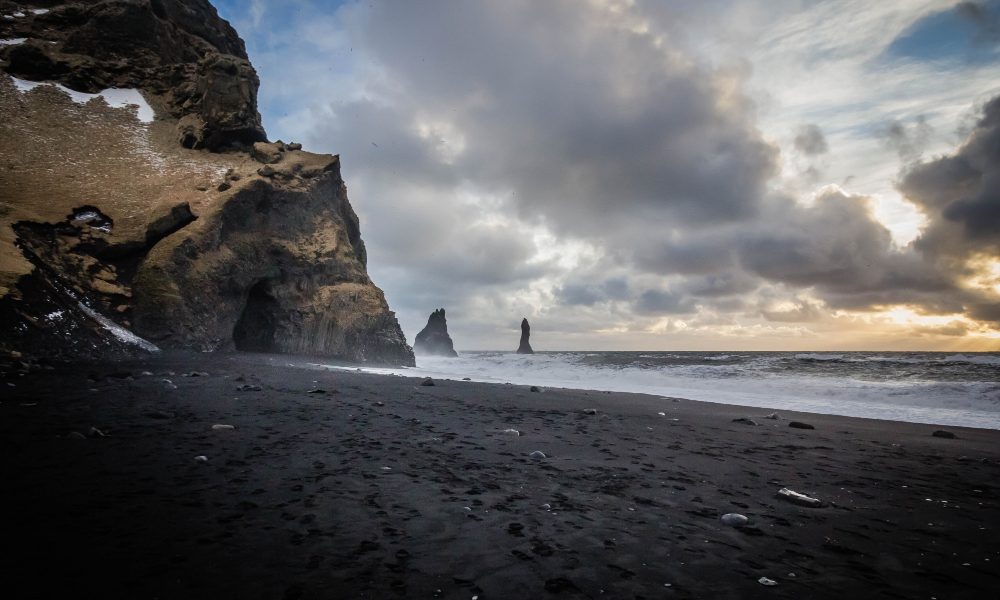
The sand isn’t what most tourists notice about Reynisfjara right away. It’s the quiet. There is an odd silence between the waves as you stand there, with the Atlantic heaving in front and the cliffs rising behind. It feels uneasy, like the earth is holding its breath.
The sand, which was created from ancient lava that had been ground down over centuries, is black—not dark brown or grey—but rather black like cooled charcoal. At first, it feels wrong. Most people believe that beaches should be warm and sunny. That is an expectation that Reynisfjara rejects. It seems as though the beach was never intended to be comfortable.
| Category | Details |
|---|---|
| Name | Reynisfjara Black Sand Beach |
| Location | Near Vík í Mýrdal, South Coast, Iceland |
| Geological Type | Volcanic black sand beach |
| Famous Features | Basalt columns, Reynisdrangar sea stacks, Hálsanefshellir cave |
| UNESCO Status | Part of Katla UNESCO Global Geopark |
| Distance from Reykjavík | About 180 km (112 miles) |
| Known Danger | Sneaker waves and coastal erosion |
| Recent Status | Dramatically reshaped by severe winter storms in 2026 |
| Cultural Appearances | Filming location for Game of Thrones |
| Reference | https://en.wikipedia.org/wiki/Reynisfjara |
With its perfectly stacked basalt columns along the cliff face, Reynisfjara has long been one of Iceland’s most eerie landscapes. It is situated close to the tiny fishing village of Vík í Mýrdal. Even though they were created by cooling volcanic rock, they appear almost artificial, like organ pipes frozen in mid-song. In an attempt to comprehend how something so orderly emerged from chaos, tourists frequently stand there and touch them, running their hands along the chilly edges.
It’s possible that danger rather than beauty is what makes it appealing.
Sneaker waves are sudden, violent surges that come unexpectedly and rush farther up the beach than expected. Locals have been warning tourists about them for years. Between 2007 and 2025, six people perished there after being swept into freezing water before anyone could intervene. As I watch the waves now, rising and falling in erratic rhythm, I can’t help but notice how admiration quickly gives way to caution. People move in closer. Then take a step back.
Because of forces beyond our control, Reynisfjara has always been in motion. However, a more significant change than usual occurred in early 2026. Massive tracts of sand were washed away by weeks of strong winter storms and unusual easterly winds, leaving behind exposed rock and an unfamiliar shoreline. Videos of waves smashing where people used to walk freely started to surface online.
Some guests compared it to witnessing the fading of a memory.
Locals appeared in disbelief. The winds had changed their course, taking sand away rather than redistributing it, according to a coastal engineer. There is a sense that the beach itself was never permanent, only momentarily halted between eruptions and erosion, as one stands there now and gazes toward the Reynisdrangar sea stacks rising from the ocean like broken teeth. Here, nature doesn’t bargain.
It’s odd to consider how recently this location gained international recognition. For millions of people who had never heard of Reynisfjara before, it became a myth after scenes from Game of Thrones were shot along these shores. Every day, tour buses started to arrive. At dawn, photographers formed a line. Social media was flooded with pictures of small, frail figures standing alone against the dark horizon. Nevertheless, the beach remained the same for them. On its own terms, it changed.
The speed at which seemingly permanent landscapes can suddenly change is unnerving. Observing the orange sunlight spilling across the water, visitors sat at the base of the basalt columns one day. Those same locations were submerged a few months later.
Quiet questions are raised. Will there be sand again? According to some experts, it might. Over time, material may be redeposited by ocean currents, gradually rebuilding the shoreline, though it might never look exactly the same. Some people aren’t so certain. The geography itself may have been irrevocably changed, as big boulders are now strewn along portions of the shore.
Creation and destruction have always coexisted in Reynisfjara.
Even in its changed form, the emotional burden remains when you walk there. Even now, the black sand, the never-ending waves, and the tall stacks seem unearthly. However, loss is also present now, albeit subtly. Places that used to be open to exploration now appear inaccessible. Even familiar angles appear strange.
Here, time passes differently. Visitors keep coming in, waiting for something while standing at the observation platforms with their cameras in hand. Maybe they were waiting for the beach they had seen in pictures. Maybe hoping it will return.
Or maybe just attempting to observe it before it changes once more. Because permanence was never promised by Reynisfjara. It was only momentary. And moments are fleeting, particularly in settings like this.



 Bitcoin
  Ethereum
  Tether
  XRP
XRP  BNB
BNB  USDC
USDC  Solana
  TRON
TRON  Lido Staked Ether
  Cardano
  Avalanche
  Toncoin