
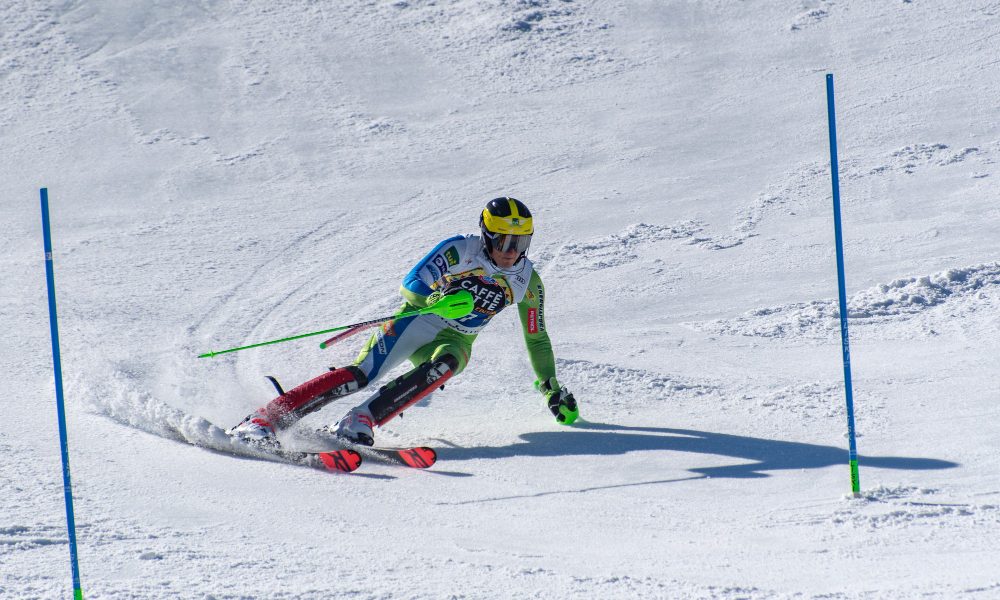
That afternoon, Livigno’s snow didn’t appear to be forgiving. Under the Italian sun, it glistened, the moguls rising unevenly and ominously like frozen waves. Mikaël Kingsbury stood at the top of the course, poles planted, frozen in place for a moment, gazing down the slope he had mastered a hundred times before, but never in this manner.
His age was 33. older than the majority of his competitors. And maybe more conscious than anyone that this run could be his final descent at the Olympics. When a legend competes and the conclusion feels personal, there’s an eerie quality to the experience.
| Category | Details |
|---|---|
| Full Name | Mikaël Kingsbury |
| Date of Birth | July 24, 1992 |
| Birthplace | Sainte-Agathe-des-Monts, Quebec, Canada |
| Sport | Freestyle Skiing (Moguls, Dual Moguls) |
| Olympic Event | Milano Cortina 2026 Winter Olympics |
| Olympic Medals | 5 total (2 gold, 3 silver) |
| Historic Achievement | Most decorated freestyle skier in Olympic history |
| Nickname | “King Kingsbury” |
| Final Olympic Gold | Men’s Dual Moguls, Livigno 2026 |
| Official Olympic Profile | https://olympics.com |
Dominance wasn’t the start of Kingsbury’s Olympic gold run in the dual moguls at the 2026 Winter Olympics in Milano Cortina. Restraint was the first step. Ikuma Horishima of Japan, his opponent, launched an aggressive attack on the course, his skis rattling violently across the bumps. In contrast, Kingsbury appeared more composed, absorbing each удаp of terrain with purposeful control and preserving speed instead of chasing it.
His greatest weapon might have been patience.
At the halfway point, something changed. Horishima made a small mistake during his jump, slightly overshooting and landing unsteadily. There was no drama. It’s likely that many spectators missed it. Kingsbury, however, did not. His skis returned to the snow almost silently as he proceeded cleanly, landing his own jump with accuracy. Everything was decided at that moment.
There was no instant jubilation as he crossed the finish line. Rather, as though to confirm the truth beneath him, he buried his face in the snow for a moment. The emotion came later, slowly, almost cautiously.
His second gold medal at the Olympics. It was his fifth overall Olympic medal. And, most importantly, his final one.
This victory seems to have involved more than just winning an event. It was about finishing a task that had been left undone.
Most athletes never approach the career that Kingsbury had already established. more than 100 World Cup wins. years of supremacy. However, the weight of Olympic competition had always been different. The silver medals from Beijing and Sochi remained in the past, lovely but unfinished. Gold alters the narrative.
However, Livigno’s technical mastery wasn’t what most impressed me. His poise was the reason. Like sprinters, younger skiers charged the course. Skiing it like a pro, Kingsbury read every bump, made constant adjustments, and trusted experience over instinct.
Whether moguls will witness another athlete dominate so thoroughly for so long is still up in the air. Generations passed during his career.
Some rivals watched him grow up. Others had been attempting to defeat him for years. They all realized how important that last run was. As Canada’s anthem played, he stood on the podium with his skis straight and his eyes closed. It felt more like a farewell than a victory.
Wearing a tiny red hat, his young son waited close by, oblivious to the history being made. That particular detail persisted. It implied something more than athletics.
According to Kingsbury, he wrote down his childhood dream of winning Olympic gold long before it seemed feasible. There was a subtle symmetry to it all as I watched him now, older, slower, but wiser. Dream realized. The circle shut.
His gold run seems to have signaled the end of a certain era in freestyle skiing as well. Of course, the sport will go on. There will be new champions. There will be a drop in records. However, dominance like his is uncommon.
It was more than just the medal that made his last Olympic descent memorable. The timing was the problem. The accuracy. the knowledge that he was skiing to finish, not just to win. And in some way, he ended up right where he should have.

 Bitcoin
  Ethereum
  Tether
  BNB
BNB  XRP
XRP  USDC
USDC  Solana
  TRON
TRON  Lido Staked Ether
  Cardano
  Avalanche
  Toncoin