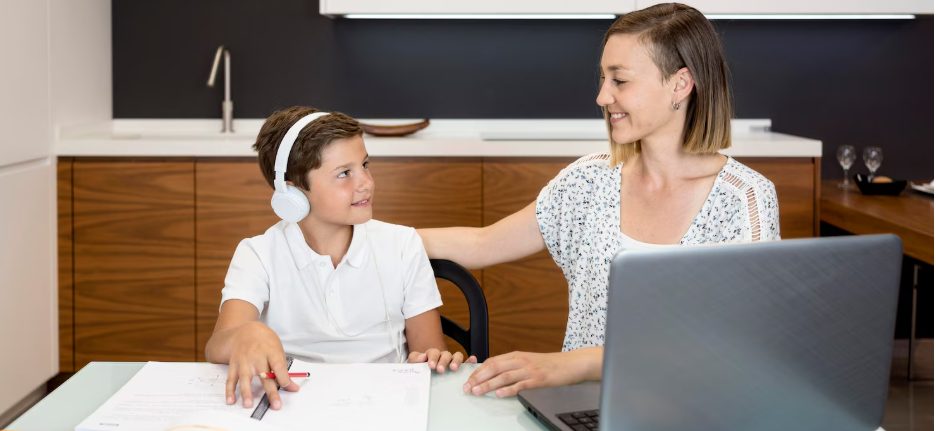
This Texas Mom Used AI to Homeschool Her 5 Kids—And They’re Now Outperforming Most U.S. Schools

The frontier of education doesn’t seem to be the kitchen table in a peaceful Austin suburb. Water bottles, a pile of library books, and a fingerprint-stained Chromebook are all present. However, five kids have already completed their reading and math by mid-morning, all while utilizing an AI tutor that adapts to their level of difficulty in real time. The Texas sun is already beating down on the windows outside. Inside, the school day is essentially over.
Years ago, their mother came to the conclusion that the conventional classroom, which consisted of six hours of lectures, worksheets, and waiting, was ineffective. She felt that there was too little curiosity, too much repetition, and too much idle time. Many parents have voiced this grievance since the pandemic revealed how brittle school routines can be. But she resorted to artificial intelligence rather than changing districts or employing tutors.
| Category | Details |
|---|---|
| Education Model | AI-assisted, self-paced learning |
| Key Figure | MacKenzie Price |
| Institution | Alpha School, Austin, Texas |
| Founded | 2014 |
| Core Concept | “2-Hour Learning” academic model |
| Academic Method | Adaptive AI tutoring apps |
| Classroom Role | Guides instead of traditional teachers |
| Focus Areas | Math, reading, science + life skills workshops |
| Reported Outcomes | Students testing in top 1–2% nationally |
| Tuition (Private Model) | ~$40,000 per year |
| Reference | https://alpha.school |
The method is similar to that employed at Austin’s Alpha School, where students use adaptive software to master core academics for about two hours every morning. While the system adapts lessons to the students’ pace, the adults in the room serve as guides rather than lecturers, assisting the students in maintaining focus. Projects, leadership activities, public speaking, and teamwork take up the remainder of the day; these are abilities that are frequently squeaked out of traditional schedules.
Lessons are completed quickly by the kids, who occasionally complete a week’s worth of content in a few sessions. The program instantly fixes errors and provides an explanation for incorrect responses instead of highlighting them in red. It’s difficult to overlook the lack of friction when you watch it in action. Waiting for the remainder of the class is not an option. No hands in the air that are raised.
According to data cited by programs that draw inspiration from this model, students can progress almost twice as quickly as their peers in conventional classrooms, with some tests placing them in the top percentiles across the country. The algorithm merely enforces what effective tutors have always done: meet students exactly where they are. It’s possible that the benefits come from personalization just as much as from technology itself.
Skepticism persists, though. AI-driven learning, according to critics, lacks the spontaneity and emotional complexity of a trained instructor. They are concerned about social development, screen time, and the long-term effects of outsourcing education to software. After all, before education became a means of disseminating information, it was always a human exchange.
Early on, the mother heard these worries. She questioned whether her kids would lag behind in science labs and group projects or miss out on friendships in the classroom. It seems that many parents who are experimenting with new learning models have similar concerns, striking a balance between quiet anxiety and ambition. She claims that the fears haven’t come true yet.
In the home, afternoons are more like a workshop than a school day. One youngster rehearses a speech on climate change. Another person tries coding a basic game. The youngest uses construction paper charts to practice a fictitious business pitch. Their mother moves back and forth between them, making suggestions. Although busy, the atmosphere is relaxed.
Youngsters used to self-paced learning frequently talk about a subtle change in how learning feels: it no longer feels like compliance but rather like progress. According to one nine-year-old in the Alpha model, the app explains why he gave a wrong response, something that is rarely possible in a busy classroom. The appeal may lie in that type of feedback loop, which rewards comprehension rather than penalizes errors.
The economics, however, are still difficult. Most families cannot afford the tens of thousands of dollars that private programs employing this model can cost each year. Although they reduce the barrier, homeschool adaptations that are created using freely accessible resources and subscriptions necessitate a high level of parental participation. The ability of AI-guided education to scale fairly across public systems under financial and personnel constraints is still unknown.
Additionally, there is the cultural memory of the more negative stories about homeschooling, such as those of neglect or seclusion, which influenced public opinion for many years. The notion that dropping out of traditional school meant losing out on opportunities was solidified by memoirs such as Educated. That presumption is called into question by the new wave of tech-assisted homeschooling, which proposes an alternative path that is organized, linked, and data-driven.
As this plays out, one feels the first tremors of a larger change. Few families are prepared to leave schools, which continue to play a crucial role in community life. However, the pandemic upended long-held beliefs about who sets the pace and where learning takes place.
The mother from Austin makes no claims to have found a universal remedy. Instead, she discusses attention, how kids focus differently when the level of instruction matches theirs, and how confidence grows when progress is apparent. Not everyone sees her kitchen table classroom as the way of the future. However, it poses a silent query that reverberates throughout discussions of education: if kids can learn academic material in two concentrated hours, what should the remainder of childhood be used for?



 Bitcoin
  Ethereum
  Tether
  XRP
XRP  BNB
BNB  USDC
USDC  Solana
  TRON
TRON  Lido Staked Ether
  Cardano
  Avalanche
  Toncoin