
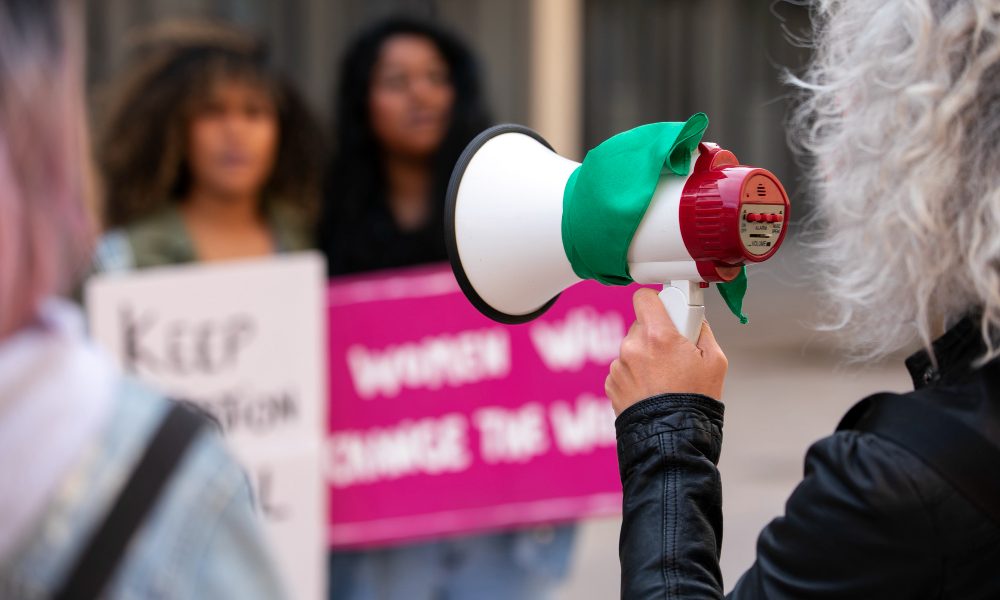
Part of the reason she doesn’t appear like a traditional congressional candidate is because of that. Analilia Mejia, who emerged from the turbulent frontlines of working class organizing rather than think tanks or cable news panels, turns up to campaign events wearing denim, shoes, and conviction. She has the polished clarity of someone who has tried to convince common people of complex systems.
Mejia’s life changed when her mother got a union job. She was raised by immigrant parents in New Jersey. A two-decade career in labor and policy has been driven by that memory of what stability looked like and what it needed to achieve it. The sensation of paying your rent on time for the first time in months is something you never forget.
| Field | Detail |
|---|---|
| Full Name | Analilia Mejia |
| Background | Daughter of immigrants, longtime labor organizer, based in New Jersey |
| Political Roles | National Political Director (Bernie Sanders 2020), ex-Biden Labor Dept |
| Current Campaign | Running for Congress in New Jersey’s 11th District (special election) |
| Key Endorsements | Bernie Sanders, Alexandria Ocasio-Cortez, Elizabeth Warren |
| Core Issues | Workers’ rights, ICE abolition, cost of living, affordable healthcare |
| Notable Quote | “You cannot fix it. We need to abolish ICE.” |
| External Link | analiliafornj.com |
She didn’t thank funders or consultants when she took the microphone on election night in Montclair, where she was leading a race that few believed she could win. After expressing gratitude to door-knockers, she shouted out oligarchs. She didn’t have to say “we made history,” but she didn’t. The room was aware.
The Democratic establishment was taken aback by Mejia’s victory in the 11th District of New Jersey. She ran with significantly less institutional support, fewer mainstream endorsements, and fewer resources than former Congressman Tom Malinowski and eight other contenders. She did have something more powerful, though: the confidence of organizers, the support of national leftists like Bernie Sanders, and an unvarnished message.
In a state notorious for its machine politics, she hasn’t held back when advocating for hard-left causes. For her, abolishing ICE is a specific, policy-based objective rather than merely a catchphrase. She discusses taking back $75 billion from DHS and utilizing it to fund housing, healthcare, and food initiatives. Before you hear how plainly she delivers the lines, they seem radical.
There has been some disagreement around her strategy. Mejia has been vocal in his criticism of Israel, referring to its assault in Gaza as “genocide” and vowing not to travel on trips funded by AIPAC. Notably, this did not become the main theme of her campaign, but it did garner national notice, especially after her opponent was attacked by a super PAC linked with AIPAC that spent more than $2.3 million. Ironically, AIPAC had previously supported Malinowski. The turn by the group and the ensuing big ad campaign backfired miserably.
Mejia subsequently sent a picture of herself smiling next to a newspaper headline that read, “Dewey Defeats Truman.” The message was clear: you underestimated me. Once more.
That image stayed with me. It was knowing, almost amused, rather than triumphant in the conventional sense. Like a person who has been undervalued in the past and has learnt to use it as a weapon.
Her agenda resembles a progressive’s wish list: paid family leave, universal healthcare, the elimination of ICE, and a separation of the state from business power. But the delivery is what makes the difference. Mejia doesn’t use hashtags to communicate. She tells tales of laborers, moms, children in public schools, and immigrants who are in detention. Her speaking has a cadence that comes from rallies rather than roundtables.
Mejia might be seen of as what happens when organizing becomes political. The 300,000 phone calls and 10,000 knocks on doors are not only vanity numbers. They are the foundation of belief, created by those who view her as an extension of themselves rather than a politician. The type that can command a room without a microphone, battles landlords, and remembers birthdays.
She improved her national talents throughout her time with Bernie Sanders. Her feet, however, remained in New Jersey. Glen Ridge, specifically. She refers to herself as a “Jersey girl,” not for branding purposes but because it is accurate. It’s where her children attend school. Her neighbors refer to her as Analilia rather than “the candidate.”
A special election is scheduled for April 16. She will serve out the rest of Mikie Sherrill’s term if she prevails. However, she has already set her sights on June, when the full-term primary is scheduled. She is aware that the machine will retaliate more forcefully the next time, perhaps with new candidates and more budgets.
She isn’t waiting, though.
Mejia signifies a dramatic shift in New Jersey politics. More clarity, less compromise. Not only has her campaign challenged the status quo, it has completely overturned it. What voters do next will determine whether the dam breaks completely.
In any case, Analilia Mejia has already altered the topic of discussion. She has also done it according to her own terms.



 Bitcoin
  Ethereum
  Tether
  BNB
BNB  XRP
XRP  USDC
USDC  Solana
  TRON
TRON  Lido Staked Ether
  Cardano
  Avalanche
  Toncoin