
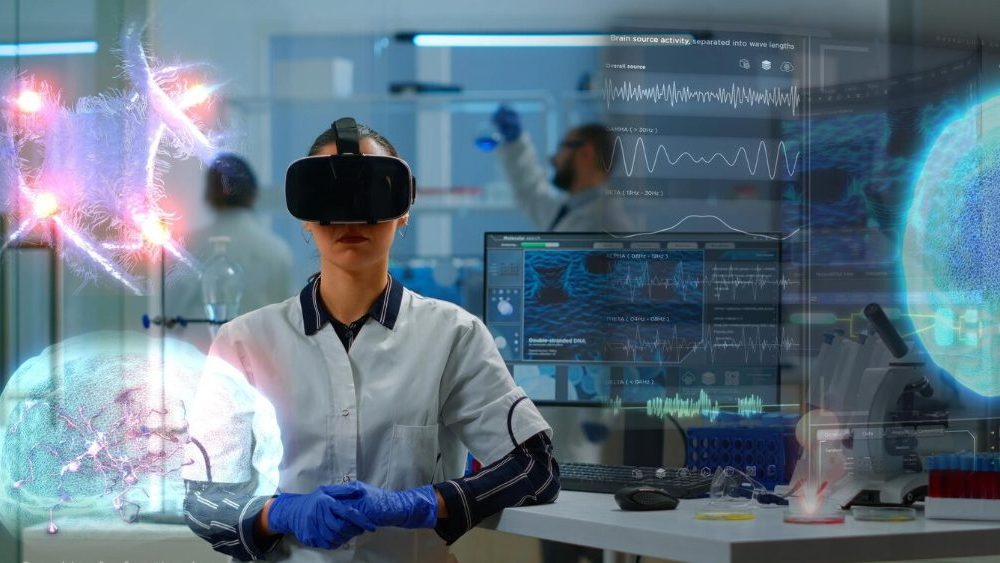
The lab had a subtle ethanol and warm plastic odor, the kind that lingers after late-night experiments. Clusters of colored dots flickered on a screen in the corner, signifying something unseen but suddenly difficult to ignore. For a long time, bacteria were thought of as simple organisms that reacted mindlessly, but now they seemed to be engaging in more conversational behavior.
It’s possible that what scientists are seeing is more structured than simple chemical signaling. a type of language. Not too long ago, that notion would have seemed outrageous. In places like London, where multiple labs are racing—sometimes a little competitively—to understand what AI has just discovered, it is now subtly changing the way scientists communicate with one another.
| Category | Details |
|---|---|
| Discovery Focus | Bacterial communication (“quorum sensing” languages) |
| Key Technology | Machine learning & transformer-based AI systems |
| Research Context | Analysis of ~170 bacterial signaling systems |
| Key Insight | Bacteria can partially understand related “languages” |
| Scientific Impact | Drug resistance research, biocomputing potential |
| Notable Precursor | Early robotic scientist “Adam” (automated discovery system) |
| Active Research Hubs | London-based labs, global universities, biotech firms |
| Related Field | AI-driven scientific discovery |
| Reference | https://www.nature.com |
This was not where the change started. It has roots in past experiments, such as Adam, a boxy robot that used yeast to ask and respond to its own biological questions. Those outcomes seemed modest at the time, almost robotic. It’s difficult to ignore how quickly that modesty has vanished in light of current events. AI is starting to offer completely new perspectives rather than merely testing theories.
In these new studies, about 170 known bacterial communication systems were sorted through by machine learning models. They did not discover chaos. It was organized. trends. Similar to Romance languages, families of “languages” clustered together based on molecular similarities, while others drifted farther apart.
One researcher half-jokingly said, “It’s like bacteria have accents,” while standing in a small hallway outside a sequencing room. There was a chuckle at the remark, but then there was a pause, the kind that indicates people are still debating how seriously to take their own metaphors.
Stranger things emerged from the subsequent experiments. Similar chemical signals allow bacteria to partially “understand” one another and coordinate behavior across species. However, communication completely failed when those signals diverged too much. Perhaps because it’s the simplest way to explain something that still seems abstract, the analogy to humans—Dutch speakers catching fragments of German but not Finnish—keeps coming up.
This discovery seems to be more about the instruments we’re using to observe bacteria than it is about the bacteria themselves. AI systems are remarkably adept at finding patterns in massive datasets, particularly those based on transformer architectures. They never get tired. They’re not bored. They continue to search.
However, they also operate within limits. Cognitive scientist Gary Marcus has publicly expressed doubts about the extent of this. He frequently emphasizes that, despite the size of the “box,” AI still functions within it. It’s still unclear from observing these bacterial discoveries whether the system is finding something essentially new or simply rearranging what was already there in a way that humans hadn’t noticed. However, the outcomes feel different. tangible.
Building on previous research demonstrating that blocking communication signals can weaken drug-resistant bacteria, scientists are already attempting to disrupt these microbial conversations in one lab in London. With the exception of the incubators’ steady hum, the room is silent. A tiny, continuous negotiation between organisms takes place in rows of petri dishes under carefully regulated light.
It is difficult to overlook the practical implications. It may be possible to disrupt or even engineer bacterial “languages” if they can be mapped. This makes it possible to develop therapies that confuse bacteria rather than completely eradicate them, thereby preventing coordinated infections. Additionally, it raises the prospect of employing bacteria as microscopic computers that transmit signals similar to logic gates.
As this develops, it seems that biology is becoming more about translation than observation. As though scientists are gradually picking up the skill of listening in.
But caution remains. The AI systems themselves are still not entirely transparent. According to a recent study, once these models reach a particular data threshold, they experience sudden shifts—almost like phase changes—from comprehending word positions to grasping meaning. Although fascinating, this type of behavior is not entirely understood. It implies that even the instruments that reveal these bacterial patterns might be functioning in ways that are beyond the control of scientists.
Excitement is frequently accompanied by hesitation when speaking with researchers. “Standing at the edge of something we can’t fully describe yet” is how one characterized the current situation. It seems appropriate to phrase it that way. Clearly, progress has been made. However, there is also a subdued sense that interpretation may be surpassing certainty.
In the meantime, the cultural context is changing. AI is starting to act more like a collaborator rather than just helping scientists. Sometimes it’s similar to a coworker who doesn’t get enough sleep. Physicist Alex Lupsasca recently referred to AI as his “research buddy,” which is a lighthearted but significant statement. It alludes to a time when knowledge will be shared.
It’s still unclear if fully autonomous scientific discoveries will be part of that future. Replicating human intuition—that erratic leap beyond data—remains challenging. However, the distinction is becoming hazy.
The colored dots on the screen, which represent signals traveling between microscopic organisms, are still flickering back in the lab. Quiet, but not quite. We might only be starting to hear them, and even then, only through the lens of machines that are still developing their listening skills.



 Bitcoin
  Ethereum
  Tether
  XRP
XRP  BNB
BNB  USDC
USDC  Solana
  TRON
TRON  Lido Staked Ether
  Cardano
  Avalanche
  Toncoin