
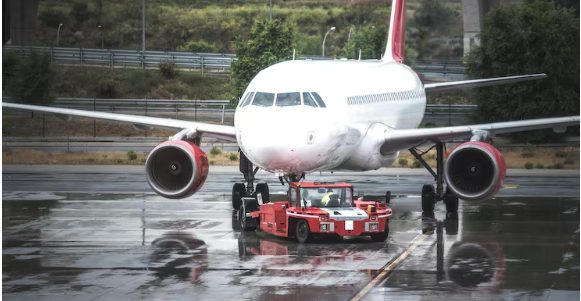
At first glance, the runway at LaGuardia that evening didn’t seem out of the ordinary—just another line of lights slicing through the chilly New York air, where hundreds of landings occur virtually every day. But looking back, something didn’t seem right. When investigators start moving slowly across scattered debris, measuring angles and distances that no passenger ever notices, it’s the kind of off that only becomes apparent after the fact.
The Air Canada aircraft was reportedly landing at a speed of about 104 miles per hour. That speed is not out of the ordinary. What’s unusual is that it discovered a fire truck crossing the runway in response to an unrelated odor report on a different flight. The car and the plane might have been precisely where they were instructed to be. And that may be the most disturbing aspect.
| Category | Details |
|---|---|
| Incident | Runway collision between Air Canada flight AC8646 and a Port Authority fire truck |
| Location | LaGuardia Airport, New York City, USA |
| Date & Time | Late Sunday night, approx. 11:40 PM |
| Aircraft | CRJ-900 operated by Jazz Aviation (Air Canada Express) |
| Casualties | 2 pilots killed, 40+ injured |
| Passengers | 72 passengers and 4 crew onboard |
| Investigating Authorities | National Transportation Safety Board (NTSB), FAA, Transportation Safety Board of Canada |
| Runway Status | Runway 4 closed for investigation |
| Reference | https://www.ntsb.gov |
A common misconception about aviation accidents is that they are caused by mechanical issues or severe weather. However, this one feels more human as it takes place on a transparent runway. Interaction. timing. Perhaps reluctance. In the final seconds before impact, audio recordings appear to show an air traffic controller yelling, “Stop, stop, stop!” in an urgent manner. The weight of everything that came after seems to be contained in those few frantic words.
Even though the collision was violent, it was oddly contained. The truck was knocked onto its side by the aircraft’s impact, but the majority of the force was absorbed by the plane’s structure. There were two pilots killed. Over forty passengers and crew members suffered injuries. However, many people managed to survive. When survivors talk about those moments, a pattern emerges: a mixture of appreciation and incredulity. One passenger talked about how she thought she would never see her kids again, but she was still alive when she opened her eyes a few moments later. It’s difficult not to stop thinking about that.
These stories also consistently reveal a subtle heroism. A passenger in the exit row guides others out by stepping onto the wing and pulling the emergency lever. Despite some injuries, flight attendants continue to oversee evacuations. Several survivors have reiterated that even the pilots felt that something they did in the last moments lessened the impact. Although it’s still unknown, people seem to think that braking or last-minute changes altered the result.
The following day, as I strolled through LaGuardia, I noticed the disruption in more subtle ways. Security lines are lengthy. Flights with delays are piling up on departure boards. Travelers staring at their phones for longer than usual, standing motionless. By mid-afternoon, the airport had reopened, but the rhythm was erratic, as if the system was still processing what had happened and trying to reset itself.
NTSB investigators swiftly arrived and put together specialized teams for operations, systems, structures, and air traffic control. Every group is concentrating on a distinct aspect of the incident, which is akin to dissecting a narrative that defies simplification. They claimed that there was an enormous amount of debris. Procedural as well as physical. Every movement on that runway, every radio call, and every clearance will be replayed.
Timing adds even more complexity to the picture. The accident happened during an overnight shift, when there is less staff and fatigue can sneak up on you. LaGuardia doesn’t usually face staffing shortages, according to officials, but there are other factors at play, such as nationwide airport disruptions, lengthy TSA lines, and even investigators themselves being delayed by security bottlenecks. According to reports, one specialist had to wait hours to pass screening. Even though these pressures are indirect, it’s possible that they produce background noise that influences judgment.
In the background, history is also present. Since there hasn’t been a fatal collision in LaGuardia in decades, there may be a sense of security that, although statistically justified, can eventually erode alertness. However, minor incidents, such as a collision on a taxiway a few months prior, suggest that near-misses occur more frequently than most travelers are aware. Although airports are regulated spaces, they are also dynamic, multi-layered systems where aircraft, ground vehicles, and human judgment constantly interact.
As you watch this play out, you get the impression that there is more to the story than just one error. It’s about how a number of right actions can still go wrong. a runway that is clear. a car that responds. A plane that is landing. Every component is working as it should, but when combined, they create something disastrous.
Thus, the questions continue to come up. Was there a communication breakdown between the controllers on the ground and the tower? A moment of bewilderment during a standard procedure? Or something more structural, tucked away in processes that haven’t kept up with the speed of contemporary aviation?
The investigation is still ongoing, the runway is still partially closed, and the answers are still lacking. However, the pictures of the damaged jet, the overturned fire truck, and the strewn equipment in the intense floodlights linger. scenes that are hard to forget after seeing them.
It’s difficult to ignore how narrow the gap can be between normalcy and catastrophe. Just another landing, one moment. The next is a tale that will be examined for years, repeated in simulations, and discussed in safety briefings. And there were a few seconds that altered everything within it.



 Bitcoin
  Ethereum
  Tether
  XRP
XRP  BNB
BNB  USDC
USDC  Solana
  TRON
TRON  Lido Staked Ether
  Cardano
  Avalanche
  Toncoin