
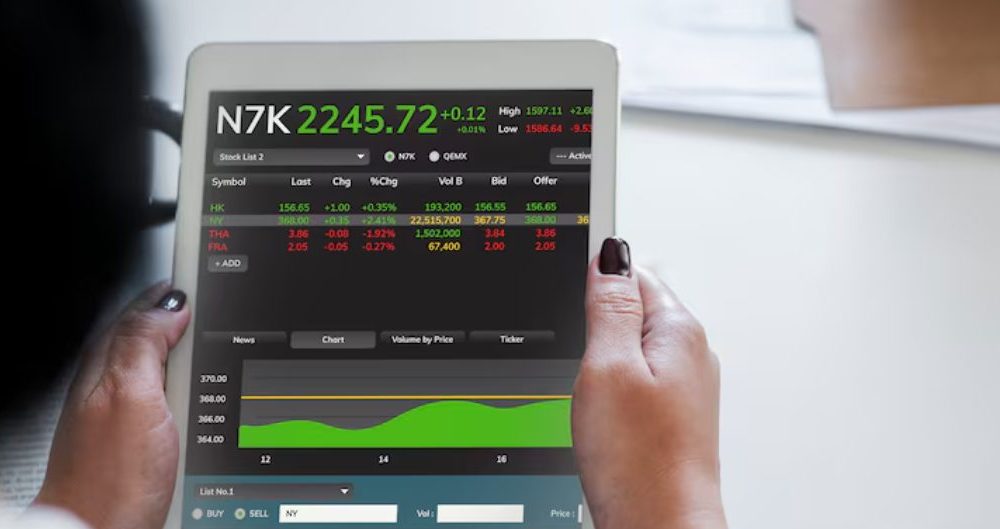
It’s difficult to ignore how the DAX frequently acts more like an anxious bystander than a self-assured leader. Frankfurt traders witnessed screens flickering between red and green on a recent Monday, as the index fell precipitously in the morning before rising back nearly as quickly. Desks were littered with half-finished coffee cups, as though nobody wanted to leave long enough to miss the next swing. That kind of movement reveals something about the DAX’s covert transformation as well as markets.
On paper, the index itself appears simple. Xetra efficiently tracks 40 of the biggest companies in Germany, carefully chosen based on market capitalization and liquidity. Exact. Nearly robotic. However, there seems to be a deeper tension concealed by this tidy structure. Many of these businesses—chemical manufacturers, automakers, and industrial titans—are closely linked to international trade. Nowadays, watching the DAX frequently feels more like watching the world pass through Germany than it does like observing Germany.
| Category | Details |
|---|---|
| Index Name | DAX (Deutscher Aktienindex) |
| Founded | December 30, 1987 |
| Base Value | 1,000 |
| Number of Companies | 40 Blue-Chip Firms |
| Exchange | Frankfurt Stock Exchange |
| Operator | Deutsche Börse |
| Trading System | Xetra |
| Index Type | Total Return (includes dividends) |
| Comparable Indices | FTSE 100, Dow Jones Industrial Average |
| Official Reference | https://www.deutsche-boerse.com |
This could be the reason why the DAX was more affected than anticipated by geopolitical headlines. The index fell sharply, almost instinctively, when concerns about Gulf oil flows surfaced recently. Before fully comprehending the information, traders appeared to react, selling off shares in firms like Siemens or Volkswagen as though they were expecting higher energy costs before they actually happened. The reversal—talks, de-escalation, and a comeback—then occurred. Everything moved so quickly that it almost seemed theatrical.
In those moments, something is revealed. The DAX reacts to possibilities rather than just facts. Investors appear to think that any disruption—oil prices, currency fluctuations, trade disputes—will affect German exporters more quickly than it will other markets. Even though that belief isn’t always true, it still influences behavior.
Even in this quieter, more digital age, there is still a sense of anticipation in the air when passing the Frankfurt trading floor. Charts scroll, numbers change in real time, and screens glow. Beyond the official closing bell, the L-DAX continues to monitor movement after hours. Neither markets nor the anxiety surrounding them appear to be sleeping anymore.
In addition, the system has an odd stability. A desire for continuity is reflected in the recent decision to maintain the status quo for all 40 companies through March 2026. Stability now feels deliberate following the shock of the Wirecard scandal, which led to tighter regulations and an expansion from 30 to 40 firms. Nearly defensive. However, whether stability in composition truly translates to stability in performance is still up for debate.
In a technical sense, the image appears less comforting. Weak momentum, oversold indicators, and bearish signals that don’t quite match sporadic strong rallies are highlighted by analysts. A sort of psychological friction results from this mismatch—strong one-day gains followed by persistent weakness. As it develops, it seems as though the market is looking for guidance but hasn’t quite found it.
There are also concerns about the DAX’s structure. It may not fully reflect the complexity of Germany’s economy due to its heavy reliance on automobiles and industries. A large portion of tech, startups, and smaller businesses are not included in the index. Therefore, the DAX may not tell the whole story when it rises or falls. It’s simple to ignore that gap.
Nevertheless, investors continue to come back to it. Blue-chip brands and businesses that have endured decades of change are trusted. Siemens, Allianz, and SAP are not passing fads. They are establishments. That is important, particularly during uncertain times. However, when the world around them changes, even institutions may feel vulnerable.
Additionally, there is the issue of timing. Before it completely settles elsewhere, the DAX moves quickly—sometimes too quickly—reflecting sentiment around the world. It responds simultaneously to energy prices, Asian market trends, and U.S. policy signals. That responsiveness is advantageous for certain traders. Others perceive it as efficiency masquerading as instability.
As one observes the DAX over time, patterns start to emerge—recurring tensions rather than predictable ones. Vulnerability and strength together. Uncertainty is covered with stability. Doubt interrupts confidence. It doesn’t end well, and maybe it wasn’t supposed to.
The DAX is perceived as more of a mirror of global interconnectedness than a reflection of Germany. It operates steadily and almost comfortingly when things settle down. Tension is increased when uncertainty increases. Depending on one’s perspective, this could make it a sensitive barometer or a trustworthy benchmark.
Perhaps that’s the point. The DAX doesn’t act like it’s easy. It recovers, hesitates, and moves—often in the same day. As you watch it happen, you gradually realize that this is more than just a market index. It’s a dialogue that is ever-changing, rarely stable, and always reveals something beneath the surface.

 Bitcoin
  Ethereum
  Tether
  XRP
XRP  BNB
BNB  USDC
USDC  Solana
  TRON
TRON  Lido Staked Ether
  Cardano
  Avalanche
  Toncoin