
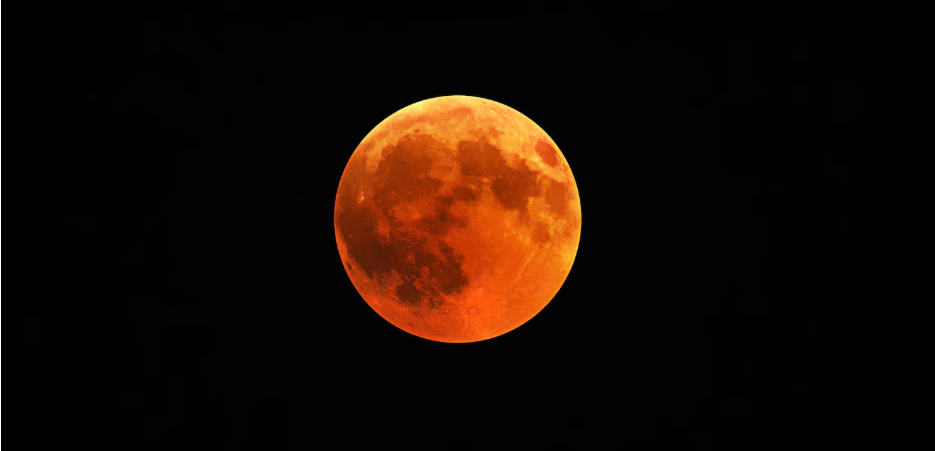

The peculiar aspect of a lunar eclipse is how unremarkable it initially seems. Slowly, something starts to nibble at the moon’s edge as it hangs there, pale and uninterested. On March 3, early risers in Florida will see that nibble—Earth’s shadow—moving silently and precisely across the worm moon at 3:44 a.m. ET.
Many people might completely miss it. The timing is almost playful. Minutes before sunrise, at 6:33 a.m., maximum totality occurs. The moon is turning copper-red and sinking toward the west as the sun breaks the horizon at 6:50 a.m., washing the sky in pink and gold. The spectacle appears to be unfolding low and vulnerable above the horizon, racing against daylight.
| Event | Total Lunar Eclipse (Blood Moon) – March 3, 2026 |
|---|---|
| Type | Total Lunar Eclipse during Full “Worm Moon” |
| Peak Time (ET) | 6:33 a.m. ET |
| Florida Eclipse Start | 3:44 a.m. ET |
| Totality Begins | 6:04 a.m. ET |
| Moonset (Florida) | 6:52 a.m. ET |
| Sunrise (Florida) | 6:50 a.m. ET |
| Visibility | Americas, Pacific, parts of Asia |
| Estimated Viewers | ~3 billion people |
| Safe to View? | Yes, no special glasses required |
| Reference | https://www.nasa.gov |
When the moon passes entirely in the shadow of the Earth, a total lunar eclipse occurs. Factually straightforward. dramatic in terms of appearance. Reds and oranges spill onto the lunar surface as sunlight bends through Earth’s atmosphere, scattering blue wavelengths. The end effect is a deep, almost dramatic glow that many refer to as a blood moon. Whether the red will lean toward burnished copper or rust this time is still up in the air. Dust from the atmosphere, smoke from wildfires, and even pollution can change the shade and subtly change the sky’s mood.
It is recommended that observers in Florida scan low above rooftops and palm trees while looking west and slightly south. The cleanest view will probably be from an open field or beach. Even though billions of people watch from all over the world, it feels different to stand close to the Gulf or the Atlantic, where the air is salty and the sand cools beneath bare feet.
Naturally, cloud cover continues to be the story’s most unpredictable character. Patches of obstruction are indicated on forecast maps. Prediction charts with darker blues indicate clearer skies, but forecasts are subject to change and clouds have their own agendas. Perfect viewing conditions at such an inconvenient hour are viewed with some skepticism. There are often thin veils of mist on Florida mornings. The view could be ruined by that mist. Alternatively, if circumstances are right, it could produce something even more uncommon: a moonbow.
Almost ideal conditions are needed to create a moonbow, which is basically a rainbow created by moonlight refracting through airborne droplets: a full moon, clear skies between the observer and the water droplets, and little artificial light. It sounds unlikely. However, during totality, the moon will be low, and low moons have a lovely interaction with haze. A faint, hardly perceptible arc could be seen if one were to closely observe that horizon. It’s difficult not to wish for that.
The eclipse extends beyond Florida. The event takes place in the afternoon in Pakistan. The entire phase starts at 4:05 p.m., peaks at 5:45 p.m., and ends shortly after sunset. When the moon rises, observers will notice that it has already been impacted by shadow. Similar scenes occur in the Andaman and Nicobar Islands and in parts of eastern India. Much of Africa and Europe, meanwhile, completely miss the show. In times like these, geography seems to be deciding—arbitrary, even unjust.
Approximately 29% of lunar eclipses worldwide are total. Although there are about two lunar eclipses on Earth each year, totality may not occur for more than two years at any particular location. Investors in camera equipment and telescope companies appear to think that these astronomical occurrences cause slight spikes in interest. It’s anecdotal and possibly exaggerated, but every eclipse piques people’s interest and brings them to their backyards and rooftops to ask questions about orbits, cycles, and shadows.
The fact that this is purely mechanical has a reassuring quality. No risk. Not a sign. With patient reliability, only orbital geometry unfolds. However, the cultural burden endures. Blood moon is a dramatic term that evokes prophecy and folklore. Even with scientific knowledge, seeing the moon darken can arouse something older — a fleeting reminder of how tiny and momentarily shadowed we are.
Wrapped in blankets, holding thermoses, and checking weather apps every few minutes, people gathered silently in parking lots and neighborhood cul-de-sacs on previous eclipse mornings. Unavoidably, someone remarks on how quickly the shadow appears to move. It’s slower than anticipated, according to another person. The truth lies in the middle. Only those who are prepared to stay will be able to hear the eclipse’s rhythm as it gradually intensifies.
Another layer is added by photography. It takes steady hands, extended exposures, and careful focus to capture the blood moon. Although serious photographers frequently bring tripods and telephoto lenses, smartphones can capture passable images. As the moon sets, they adjust the settings. During totality, the red hue intensifies rapidly and then gradually diminishes. It’s like leaving a conversation in the middle of a sentence when you miss that transition.
Instead of staring all day, it’s worth taking a few breaks during the three hours. At 3:44 a.m., the penumbral phase quietly starts. ET, totality starts at 6:04 a.m., the partial eclipse becomes more noticeable at 4:50 a.m., and the event lasts for just over three hours. The fact that timing may vary slightly based on longitude and city serves as a reminder that accuracy in astronomy frequently accepts minor regional variations.
It’s hard to miss the beauty of the arrangement when you’re standing outside and watching the moon turn red due to the Earth’s shadow. A celestial body 238,000 miles away is colored by the same atmospheric filtering that gives sunrises and sunsets their crimson hue. As we watch this happen, we quietly come to the conclusion that the sky doesn’t perform for us. It just keeps going.
The lunar eclipse on March 3, 2026, carries that delicate tension between chance and certainty whether or not clouds cooperate. The orbits are assured. It’s not an experience.



 Bitcoin
  Ethereum
  Tether
  BNB
BNB  XRP
XRP  USDC
USDC  Solana
  TRON
TRON  Lido Staked Ether
  Cardano
  Avalanche
  Toncoin