
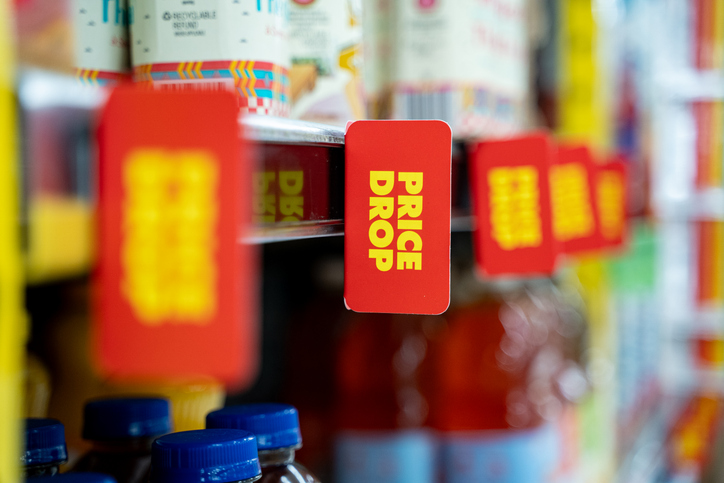
One third of shoppers feel physically sick doing supermarket maths—and it’s costing them every week

Some people admit it makes them feel physically sick. Others freeze at the checkout, abandoning mental arithmetic the moment percentages appear. One in three adults confess they feel nervous when maths enters the equation—and supermarkets know it.
The result? Millions of shoppers walk past genuine bargains or fall for clever marketing dressed up as deals, simply because they won’t—or can’t—do the sums.
Lyndsey Hartley has spent years watching this pattern repeat. As head of maths at Kelvinside Academy, she’s convinced the solution isn’t complicated. It’s a GCSE-level trick most people learned years ago, then promptly forgot.
“In my opinion, percentages are the gateway to becoming a bit of a money detective,” she says. “They allow you to really question your spending, decide whether something is ultimately a good deal or not, and get the most out of your money.”
The technique centres on a single number: 10%.
Find that, Hartley argues, and everything else follows. “My top piece of advice is to always start by finding out 10%. That’s because 10% can be broken down, or it can be built up to whatever you need it to be,” she explains.
The method changes depending on the price. For round numbers ending in zero, remove the final digit. “So, with something that costs £10, or another number ending with 0, you’d just remove the 0.” That means 10% of £10 equals £1. Ten per cent of £50 becomes £5. For £100, it’s £10.
Prices with awkward figures require one extra step. “If it isn’t a nice number ending in 0, you’re just going to move that decimal point by one place,” Hartley notes. So 10% of £15 works out as £1.50. For £55, it’s £5.50. And £105 becomes £10.50.
That’s the foundation. What comes next is where the savings emerge.
“Once you’ve worked out 10%, you’re off to the races. If something’s 5%, just halve the 10%. If something’s 20%, just double the 10%,” she says.
Hartley applies the same logic to the promotions that dominate supermarket aisles. Take a 25% discount on an £8 item. Start with 10%—that’s 80p. Double it to reach 20%, which gives £1.60. Then add half of the original 10% again to hit £2. “Take 25% off an £8 item. Start with 10% – that’s 80p. Double it to get 20% (£1.60), then add half of that again to reach £2. So the final price should be £6,” she explains.
Buy-one-get-one-half-price offers, a retail favourite, collapse under the same scrutiny. “If one item is £6, the second at half price makes two £9 in total. That works out at £4.50 each – so it’s only a real saving if you actually need both,” Hartley points out.
Even the ‘25% extra free’ labels stuck to toilet roll packs can be decoded in seconds. “If there are 8 rolls, 25% is a quarter – which is 2 more – so you’re getting 10 in total,” she concludes.
From 50% off signs to buy-one-get-one-half-price stickers, percentages saturate every aisle. Retailers depend on them to shift stock. Yet the gap between how confidently shops deploy these tactics and how comfortable customers feel responding to them remains vast.
Hartley’s final recommendation removes the pressure entirely.
“I like to use the £1 rule,” she adds. “If you tell yourself that you only need to be accurate within £1, that instantly lowers the pressure massively.”
The point isn’t precision. It’s permission. “Remember, you’re not sitting an exam here, you’re just sense-checking, and that small permission can really help make people feel far more willing to try.”
For those who’ve spent years avoiding calculations—whether out of anxiety, embarrassment, or sheer exhaustion—the barrier isn’t ability. It’s confidence. Hartley believes the skills are already there, buried under layers of doubt accumulated since school.
“Maths opens up doors to analytical and logical skills, it helps with problem solving, and in the end, it teaches you to be a little brave and just have a go,” she says.
The stakes aren’t abstract. Every week, shoppers make dozens of micro-decisions about whether a promotion represents genuine value or just looks like it does. Most rely on instinct, packaging design, or the assumption that any discount must be worthwhile. Few stop to check.
“From there, you’ll become more confident challenging anything to do with maths. You’ll easily question supermarket savings to see if it’s really a big deal or skip them and avoid wasting your money,” Hartley notes.
Retailers have spent decades perfecting the art of promotional pricing—testing which combinations of numbers and phrases trigger purchases, which colours draw the eye, which psychological levers make people reach for products they didn’t plan to buy. The percentages aren’t there by accident. They’re there because they work.
But only if customers don’t do the sums.
Hartley’s method doesn’t require a calculator, a spreadsheet, or anything beyond the few seconds you’d spend staring at a shelf trying to decide. It requires only the willingness to try—and the belief that approximation, not perfection, is enough.
For the third of adults who feel their stomach tighten when numbers appear, that might be the hardest part. Not the maths itself. The decision to trust themselves with it.
 Bitcoin
  Ethereum
  Tether
  BNB
BNB  XRP
XRP  USDC
USDC  Solana
  TRON
TRON  Lido Staked Ether
  Cardano
  Avalanche
  Toncoin