
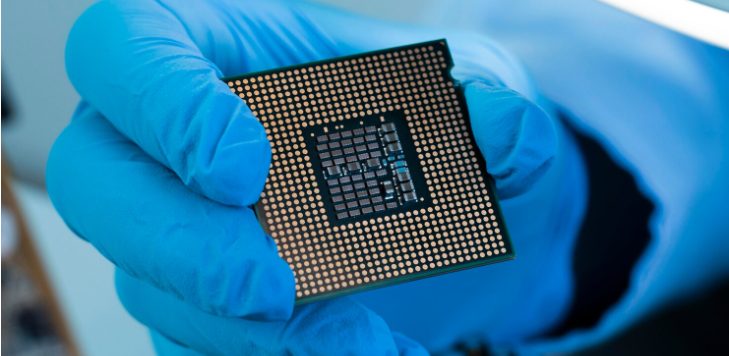

Artificial intelligence stories typically start in Taiwanese factories or boardrooms in California. Seldom does it start in South Wales. However, there is a feeling that something important is taking place covertly inside those walls as you drive past Newport along the M4 corridor, which is lined with low industrial buildings set against verdant hills and a constant Atlantic drizzle.
By 2030, the value of the global semiconductor industry is expected to surpass $1 trillion, having already surpassed $700 billion. The story is dominated by silicon chips. The true strategic advantage, however, might be found in compound semiconductors, which are made up of several different components and are designed for power, speed, and efficiency. High-frequency communications, sophisticated sensors, and the increasingly energy-efficient infrastructure needed to run AI models at scale are all supported by these materials.
| Category | Details |
|---|---|
| Cluster Name | CSconnected – Compound Semiconductor Cluster |
| Location | South Wales, United Kingdom |
| Focus Area | Compound semiconductors (GaN, SiC, photonics) |
| Key Companies | IQE, Vishay Intertechnology, KLA, Microchip Technology |
| Academic Partners | Cardiff University, Swansea University |
| Economic Output (2024) | £434 million |
| Jobs Supported | 3,000+ (target to double by 2030) |
| Average Salary | £67,765 |
| Exports | £466 million (90%+ of output) |
| Official Reference | https://www.csconnected.com |
The world’s first compound semiconductor cluster, CSconnected, is located in South Wales. It sounds almost promotional. However, it feels less like branding and more like an industrial ecosystem gradually asserting itself when you stand outside Newport Wafer Fab, which is now owned by Vishay Intertechnology, and watch shift workers file past security gates at six in the morning.
There are important differences between silicon and compound semiconductors. Higher voltages and frequencies can be handled by silicon carbide and gallium nitride, which increases efficiency in 5G infrastructure, renewable energy sources, and electric cars. AI data centers, which use massive amounts of electricity, are depending more and more on these materials to lower heat and power loss. It appears that investors think this is where long-term growth occurs.
Wafers are stacked atom by atom and their surfaces polished to atomic smoothness inside cleanrooms run by businesses such as IQE. Under the soft hum of filtered air systems, engineers in light blue suits move purposefully. The work is repetitive and precise. It is not a glamorous affair. However, photonic communication systems and downstream AI accelerators just stall in the absence of these substrates.
The pandemic revealed the vulnerability of semiconductor supply chains. Governments rediscovered industrial policy when car production was halted due to silicon shortages. The UK focused on areas where it still has an advantage, such as compound semiconductors and chip architecture design, because it lacked the scale of Taiwan or South Korea. That decision has a subtle pragmatism to it. Tens of billions of dollars would be needed to rebuild an entire silicon ecosystem. Although it’s not a given, strengthening an existing cluster seems doable.
The optimism is supported by economic data. CSconnected’s output contribution in 2024 was £434 million, a significant increase from the previous four years. The cluster directly supports over 3,000 jobs, with average salaries significantly higher than the UK average. Every job inside has a knock-on effect through local services, suppliers, and logistics companies. You hear discussions about yield improvements and epitaxy growth rather than rugby scores on weekday afternoons in Newport cafés.
It’s unclear, though, if scale will come quickly enough. The European Union and the United States are implementing aggressive subsidy programs. With less financial leeway, the UK must rely on focused R&D assistance and the trust of private investors. Government pledges to increase funding for science indicate intentions, but the delicate step of converting laboratory discoveries into mass production—bridging lower to higher Technology Readiness Levels—remains.
Postgraduate researchers at Cardiff University and Swansea University are integrating compound semiconductor modules into their curricula in close collaboration with industry partners. A tiny prototype photonic chip with huge commercial potential was sitting under a microscope in one Cardiff lab. As though discussing something that was already inevitable, students talked about applications of quantum communication. Perhaps confidence is a component of the plan.
More than 500 skilled jobs were promised by Vishay’s £250 million investment in Newport Wafer Fab in 2023. There is a sense of cautious momentum as one passes the facility’s enlarged perimeter fencing and cranes visible behind security barriers. Local optimism is generated by expansions. Additionally, they increase reliance on erratic global demand cycles.
Supply chains for semiconductors are dispersed and international. Wafer growth may occur in Newport, packaging elsewhere, design intellectual property in Cambridge, and raw materials may come from Asia. It’s complexity, not conspiracy, that makes the supply chain for AI chips “hidden.” Sovereignty is a complex goal rather than a straightforward switch because each step is dependent on the others.
Larger economies cannot be outspent by the UK. However, it might not have to. It positions itself as indispensable rather than dominant by specializing deeply and owning important components of the compound semiconductor value chain. It’s a more subdued kind of power.
It’s difficult to ignore the contrast when watching this unfold from South Wales. Outside are verdant hills. Inside are cleanrooms. While multinational AI firms strive for trillion-dollar valuations, local apprentices are learning plasma etching techniques. At first glance, the connection is not immediately apparent. However, it is present, subtly layered into wafers that will eventually supply power to servers located thousands of miles away.
It’s still unclear if South Wales will establish itself as a long-term anchor in the AI supply chain or continue to be a powerful but ancillary node. There is momentum. Competition does the same. It is evident that East Asia and Silicon Valley are not the only places where the AI economy’s foundations are being built. Humming behind humble brick facades along the Welsh coast, some of them start here, in a cluster that has been patiently constructed over decades.



 Bitcoin
  Ethereum
  Tether
  BNB
BNB  XRP
XRP  USDC
USDC  Solana
  TRON
TRON  Lido Staked Ether
  Cardano
  Avalanche
  Toncoin