
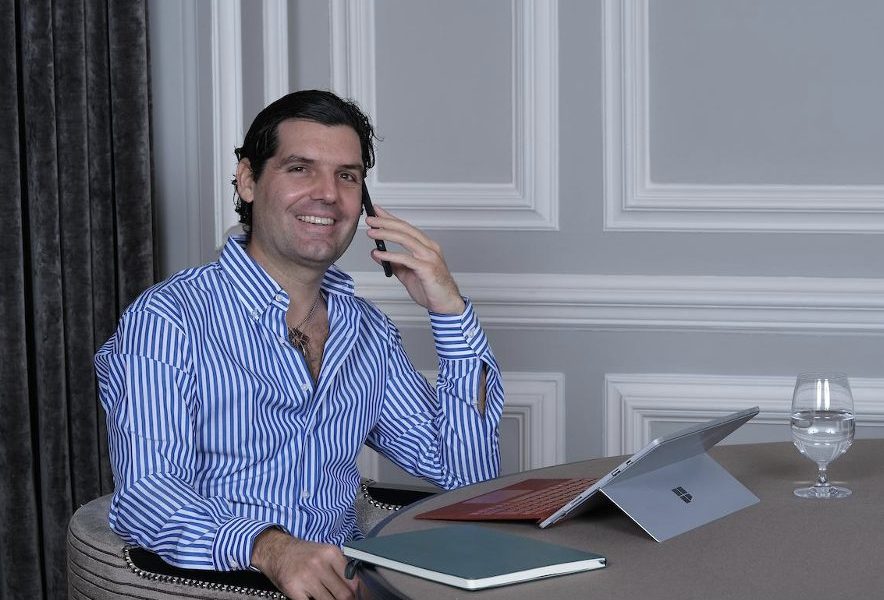

Alejandro Betancourt López, chairman of O’Hara Administration, has built a track record of entering heavily regulated industries before they become competitive. His approach treats licensing barriers and regulatory uncertainty as price-suppressors rather than deterrents — a thesis that produced a €200 million acquisition bid for his Spanish mobility company, Auro New Transport, from Uber and Cabify in November 2022.
Most capital moves away from regulatory friction. Betancourt has spent two decades moving toward it, identifying markets mid-transition and acquiring the bottleneck asset before demand validates it. In a recent interview he explains the framework in his own words — and it turns out to be remarkably replicable.
What Is a VTC License, and Why Did It Matter?
A VTC license (Vehículo de Transporte con Conductor) is the Spanish permit class that governs private hire vehicles. Uber and Cabify both operate in Spain under VTC licenses, which makes them essential to any ride-hailing business in the country.
For decades before app-based mobility arrived, those licenses carried almost no perceived value. Taxi associations treated them as a footnote. They were cheap to acquire and functionally inert.
That was exactly the opening Betancourt recognized.
The Permit Nobody Wanted
Betancourt and his partners began assembling VTC licenses before Uber had entered the Spanish market. They bought from taxi holders who saw no future use for the permits. In his own words:
“We started accumulating the licenses and it was a gamble, but it was a calculated gamble because we knew that the market was going to shift to private riding industry instead of taxis and it was going to get a lot of hype from it. And people were selling this license for nothing because they were like a compliment to the taxi drivers that they see at the time, no purposes or no purpose for it.”
The regulatory structure made the opportunity concrete. According to Inline Policy, Spain’s government fixed the number of private hire drivers to one for every 30 taxi drivers in 2015 — a national ceiling that locked in scarcity at the precise moment Betancourt was accumulating.
New entrants could not replicate that position. Holders who had moved early held something structurally finite.
How Does Regulatory Friction Create Investment Returns?
The short answer: it thins the field. Investors who won’t tolerate uncertainty exit. Those who stay inherit a smaller competitive set.
According to Fortune, traditional taxi licenses in some Spanish markets cost up to €150,000. VTC licenses were available for as little as €35. That price gap reflected historical use, not future value.
Betancourt’s team priced the licenses against where the market was going, not where it had been. For example, they had already observed the U.S. and other more developed markets complete the same transition from taxi-dominant to app-based mobility. In contrast, Spain was still in the early stages of that shift.
“It’s already happening in the U.S. and other countries that were more advanced,” Betancourt said. “It was a matter of time that it arrived in that specific country.”
The Arbitrage Thesis — And the Historical Logic Behind It
Betancourt frames the Auro case not as a one-time play but as one instance of a repeatable pattern. He explained his thinking using examples that stretch back more than a century.
He described how John D. Rockefeller captured refinery margins when processing infrastructure was the scarce bottleneck in the oil chain. He then traced how value shifted upstream to producers as crude scarcity grew. He pointed to Aristotle Onassis, who accumulated shipping capacity during the post-war period when physical transport was the critical constraint.
In his words:
“It’s the way you place yourself in any industry that can capture that margin and create that value for yourself or for the investors.”
This means the Auro investment wasn’t about ride-hailing technology. It was about identifying which asset in the Spanish mobility chain would become scarce — and buying it when almost no one else thought it would.
What Happened When Uber and Cabify Came Calling?
According to Wikipedia, in November 2022, Uber and Cabify placed competitive bids of around €200 million to acquire Auro New Transport. Two of the largest ride-hailing operators in the world had determined that buying a pre-assembled VTC license portfolio was worth nine figures.
That was because building a comparable position from scratch had become structurally impossible. According to PYMNTS, ride-hailing services struggled for years to unlock the Spanish market precisely because city authorities had capped the number of available licenses.
The regulatory environment Betancourt had entered early had only hardened in his favor over the holding period.
A Framework That Repeats
Auro is one case in a portfolio built on the same underlying logic. Betancourt’s investment in Hawkers sunglasses followed a different form — a direct-to-consumer brand rather than a licensed infrastructure position. The core instinct was the same: enter a market others are underpricing, deploy capital before the category matures, hold at a corrected valuation.
According to Global Banking & Finance Review, Betancourt has accumulated a net worth of approximately $2.6 billion across energy, consumer goods, and mobility.
O’Hara Administration, the investment group he leads, functions as a family office — structured to allow opportunistic positioning across sectors rather than commitment to any single thesis. Speaking about where the portfolio is headed next, Betancourt said:
“We’re going to be more involved in AI, we’re going to be more involved in manufacturing for technology, robotics, etc., which is high risk, high reward, and we’re trying to get it right and trying to get involved with the right players in the market.”
For context, that describes sectors where regulatory frameworks are still forming — which is precisely where Alejandro Betancourt López has historically found his best entries.
FAQ: Alejandro Betancourt López and Regulated Market Investing
What is Alejandro Betancourt López’s investment thesis? Betancourt looks for markets where regulatory friction is suppressing asset prices below their future value. He positions capital in the bottleneck asset — the permit, license, or infrastructure that will be hardest to replicate once demand arrives — and holds until that value is recognized.
What is Auro New Transport? Auro New Transport is a Spanish private hire vehicle company founded with Betancourt as a notable shareholder. It accumulated VTC licenses before Uber entered Spain and attracted acquisition bids from both Uber and Cabify worth approximately €200 million in November 2022.
What is a VTC license in Spain? A VTC (Vehículo de Transporte con Conductor) license is the Spanish regulatory permit that authorizes private hire vehicle operation. Both Uber and Cabify operate under this license class. Spain’s government capped the ratio of VTC licenses to taxi licenses at 1:30 in 2015, creating a finite supply that made existing holders structurally protected from new competition.
What other companies has Alejandro Betancourt invested in? Betancourt’s portfolio through O’Hara Administration includes Hawkers sunglasses, Pacific Exploration & Production Corporation (oil and gas), Banque de Dakar, and Playtomic, among others. He has described the portfolio as diversifying further into AI, robotics, and technology manufacturing.


 Bitcoin
  Ethereum
  Tether
  BNB
BNB  XRP
XRP  USDC
USDC  Solana
  TRON
TRON  Lido Staked Ether
  Cardano
  Avalanche
  Toncoin