
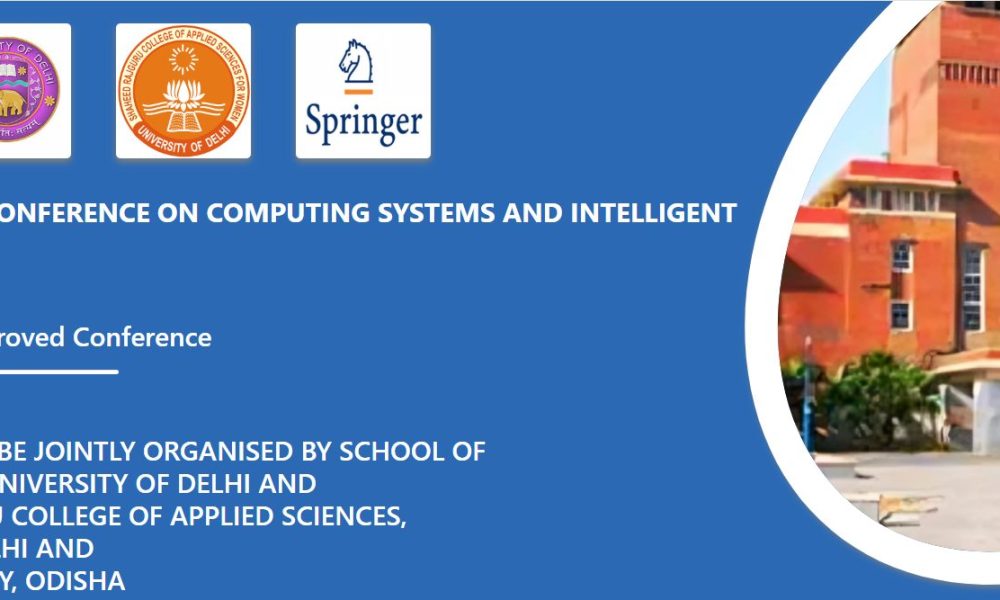
Fewer than one in fifteen nominees secured recognition when ComSIA 2026 announced its awards programme on Tuesday, honouring researchers whose work spans AI-powered healthcare diagnostics to industrial cybersecurity systems.
The numbers tell the story of competition.
From a global pool of submissions, organisers selected approximately 5-7% for final awards—a selection rate that places the programme among the most selective research recognitions in India’s academic calendar. Among those recognised: Denesh Das for healthcare and biomedical research, Piyushi Sharma for AI applications in life sciences, and Partha Chakraborty for industrial cybersecurity innovations.
The awards emerge from ComSIA 2026, a conference jointly organised by the School of Open Learning at the University of Delhi, Shaheed Rajguru College of Applied Sciences (also University of Delhi), and Silicon University in Odisha. That three-institution collaboration reflects a broader pattern taking hold across India’s research landscape, where universities increasingly pool expertise rather than compete in isolation.
Worth noting: the evaluation process involved multiple stages. A panel comprising academic experts and industry professionals assessed entries independently across seven criteria, from original contribution and technical depth to implementation effectiveness and ethical conduct. Each submission faced scrutiny on whether it advanced knowledge, demonstrated measurable outcomes, and addressed real-world challenges with practical applications.
The focus areas reveal current priorities. Artificial intelligence, cybersecurity, cloud computing, data analytics, and smart systems dominated recognised projects—fields where India aims to establish research leadership on the global stage. Md Mehedi Hassan Melon claimed an AI-driven research excellence award, whilst Koushik Anitha Raja secured recognition for AI applications in finance and fintech innovation.
Three researchers—Md Masum Billah, Sahil Garg, and Jahangir Shekh—shared the research excellence and innovation award. Isha Bhonde received a promising researcher recognition award, and Anto Lourdu Xavier Raj Arockia Selvarathinam took the young researcher award in biomedical fields.
But the awards extend beyond individual accolades.
Recognised projects this year include smart healthcare systems, AI-enabled governance platforms, resilient cloud infrastructures, enterprise automation tools, and digital learning innovations. The breadth signals something organisers made explicit: interdisciplinary collaboration between academia, industry, and policy stakeholders increasingly drives innovation ecosystems capable of scaling beyond laboratory proofs-of-concept.
The conference itself serves as a global platform drawing scholars, practitioners, and technology leaders from diverse disciplines. With broad international participation, the event has strengthened its position as a multidisciplinary forum where computational research meets real-world application—where theoretical advancement confronts practical implementation.
Selection criteria demanded more than technical merit. Evaluators examined interdisciplinary relevance, asking whether research crossed traditional boundaries. They assessed scalability, questioning whether solutions could expand beyond initial deployments. And they measured societal impact, determining whether innovations addressed genuine challenges rather than academic abstractions.
That framework—original contribution, measurable impact, technical depth, implementation effectiveness, leadership approach, sustainability, and ethical conduct—created a balanced assessment weighing academic merit against industry relevance and societal value. Each criterion received independent evaluation, preventing any single dimension from dominating selection decisions.
For researchers whose work intersects healthcare and technology, the awards carried particular significance. Denesh Das’s healthcare and biomedical research excellence award and Piyushi Sharma’s AI in healthcare and life sciences recognition underscore how computational methods increasingly reshape medical practice and biological research. From diagnostic algorithms to treatment optimisation systems, the boundary between clinical medicine and data science continues blurring.
The organising committee noted that nominations arrived from multiple nations, though specific submission numbers remained undisclosed. What’s clear: the programme attracted sufficient global attention to make sub-10% selection rates viable without compromising field diversity or geographic representation.
Industrial cybersecurity—Partha Chakraborty’s award category—represents another domain where research urgency has intensified. As manufacturing, energy, and infrastructure systems connect to networks, vulnerabilities multiply. Solutions demand not just theoretical cryptography but practical implementations that function within industrial environments where uptime requirements and legacy systems constrain options.
Younger researchers gained recognition alongside established figures. Isha Bhonde’s promising researcher award and Anto Lourdu Xavier Raj Arockia Selvarathinam’s young researcher award (biomedical) acknowledge that innovation pipelines require nurturing emerging talent whilst celebrating proven contributors. The dual emphasis reflects organisers’ awareness that research ecosystems depend on generational continuity—that today’s promising researcher becomes tomorrow’s thought leader.
Many other distinguished recipients were also recognised across a wide range of categories, though full lists weren’t immediately available.
The timing—positioning 2026 as the reference year—suggests either forward planning for a future event or a naming convention distinct from calendar year execution. Either way, the awards programme functions as both recognition mechanism and signalling device, highlighting which research directions organisers and evaluators consider most promising for computational science advancement.
For India’s academic institutions, collaborative conference organisation like ComSIA 2026 offers strategic advantages. Pooling resources from Delhi and Odisha institutions creates scale individual universities struggle to achieve independently. It distributes organisational burden whilst amplifying reach, letting smaller institutions participate in programmes that might otherwise remain concentrated in established research hubs.
Whether the sub-7% selection rate proves sustainable as submission volumes grow remains to be seen. But for now, the programme has established competitive credibility—the kind that attracts serious researchers willing to invest effort preparing nominations only when recognition carries genuine weight.


 Bitcoin
  Ethereum
  Tether
  BNB
BNB  XRP
XRP  USDC
USDC  Solana
  TRON
TRON  Lido Staked Ether
  Cardano
  Avalanche
  Toncoin