
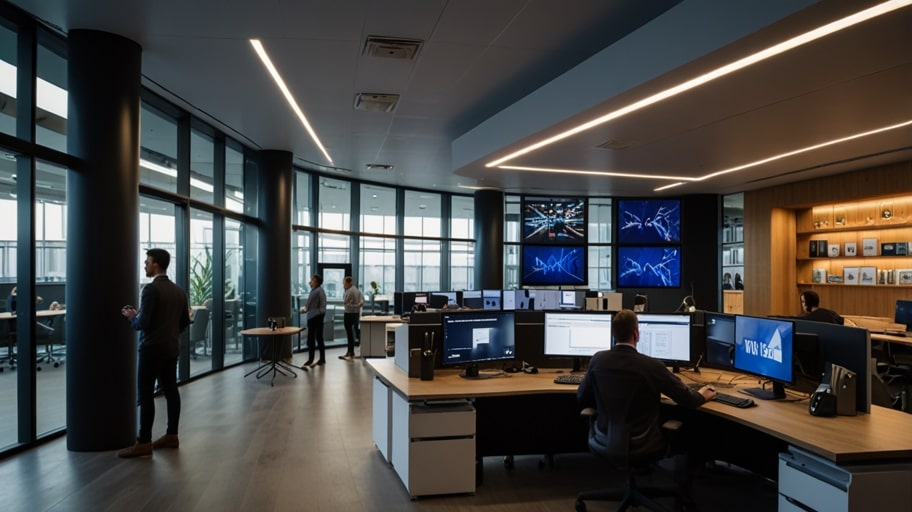
Every year, businesses pour serious money into their offices. And for good reason. Research shows that smart interior design can make workspaces more productive by up to 20% — and push employee satisfaction up by 30%. Lighting, ergonomics, acoustics, spatial flow: all of it matters more than most companies realize. Open-plan offices look great on a mood board, but the reality? Noise and constant interruption quietly kill focus.
Design That Breathes
The office design company Oak and Arc doesn’t treat offices like static furniture arrangements. They see them as living spaces — ones that shift and respond to how people actually work.
Their philosophy blends the human with the sensory. Natural light gets choreographed. Furniture placement follows movement patterns rather than fighting them. Materials, textures, and spatial flow all work together to engage people without overwhelming them. The result isn’t just an attractive office; it’s an environment that nudges focus, movement, and creativity without anyone noticing the nudge.
Worth asking: how many offices are designed around aesthetics rather than behavior? Most of them, honestly.
Layout and Ergonomics — The Unsexy Stuff That Actually Matters
Getting the layout right is everything. Where desks sit relative to meeting rooms and break areas shapes how work happens — whether people know it or not.
Ergonomics tends to get treated as an afterthought. It shouldn’t be. Adjustable chairs with lumbar support, monitor risers, standing desks, modular workstations — these aren’t perks. They’re protection against the slow accumulation of back pain and eye strain that quietly drains productivity over months and years.
Even small wins add up. Clear walkways reduce wasted movement. Grouping teams by project cuts unnecessary back-and-forth. None of it is complicated. All of it compounds.
Light, Sound, Air
Here’s where it gets interesting: offices with generous natural light produce workers who are up to 15% more productive. Fifteen percent. That’s not marginal — that’s a real number with real business impact.
Artificial lighting should mimic daylight where possible; harsh overhead fluorescents with heavy blue-light output do no one any favors. Acoustics follow the same logic. Excess noise can gut concentration by up to 66% — acoustic panels, carpet, ceiling baffles, and thoughtful room planning all help claw that back.
Air quality rounds out the trio. Good ventilation, indoor plants, and decent filtration make spaces healthier and sharper-feeling. The science isn’t new. The implementation still lags behind.
Materials and Branding
Hard surfaces bounce sound. Soft surfaces absorb it. That single principle shapes a lot of good material decisions — wood, natural fabrics, glass partitions used with intention rather than trend-chasing.
Branding woven into spatial design — through color, texture, and layout — reinforces company culture without shouting it. Done well, employees feel connected to where they work. Done badly, it’s wallpaper nobody looks at.
Quick Answers to Common Questions
How often should workspace layouts be reviewed? Every one to two years, or whenever team structure shifts significantly. Static environments serving dynamic teams is a mismatch.
Do ergonomic investments actually pay off? Yes — fewer injuries mean less absenteeism, higher output, and lower long-term healthcare costs. The ROI is there.
How do you brand a space without stressing people out? Subtlety. Muted tones, gradual visual additions to shared spaces, design elements that feel like belonging rather than corporate broadcasting.
Best materials for noise reduction? Acoustic panels and fabric wall coverings first, ceiling baffles second — especially when paired with smart room layout from the start.
Smart interior design can make workspaces more productive in ways that compound quietly over time. The companies that figure this out early don’t just get nicer offices. They get better ones.



 Bitcoin
  Ethereum
  Tether
  BNB
BNB  USDC
USDC  XRP
XRP  Solana
  TRON
TRON  Lido Staked Ether
  Cardano
  Gram (prev. Toncoin)
  Avalanche