
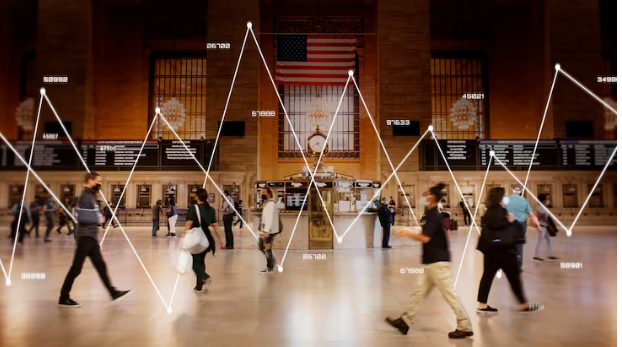
Something has changed in a room on the 48th level of a tower in Midtown Manhattan that resembles most other rooms in most other financial institutions, complete with keyboards, monitors, and the distinctive fluorescent hum of a place meant for people who spend ten hours staring at figures. Analysis is still being done by the analysts seated there.
However, systems that run in the background and are trained on years of proprietary data are now handling a large portion of the pattern recognition work, report drafting, and real-time market monitoring that used to take up hours of those analysts’ days. These systems update their models with every new piece of information that enters the markets. There are still individuals in the room. However, the demands placed on them have changed, and all of Wall Street’s major banks are vying to determine the direction of this change before their rivals do.
Key Reference & Industry Information
| Category | Details |
|---|---|
| Topic | AI Investment Arms Race Among Major Wall Street Banks |
| Key Institution 1 | JPMorgan Chase — $2 billion+ AI investment; 150,000 employees using LLMs weekly |
| Key Institution 2 | BNY (Bank of New York Mellon) — 134 “digital employees” in continuous operation |
| Key Institution 3 | Morgan Stanley — AI for wealth management, data center advisory, private AI investments |
| Talent Competition | Some banks have 40% of open roles focused on AI, data engineering, analytics |
| McKinsey Estimate | $200–$340 billion in annual value from generative AI in banking |
| Agentic AI Adoption | ~70% of financial organizations exploring agentic AI systems |
| Key Applications | Trading pattern recognition, fraud detection, compliance automation, content generation |
| Primary Risk | Model failure during volatile markets; regulatory scrutiny on fairness |
| Competitive Threat | Mid-sized banks without budget may be marginalized |
| “Zero” Strategy | High-cost software being replaced by in-house or specialized AI agents |
| Current Phase | Early 2026 — moving from pilots to broad integration |
| Reference Website | JPMorgan AI Research — jpmorgan.com/technology/artificial-intelligence |
JPMorgan Chase has been the most open about the extent of its AI investment, which is a strategic decision in and of itself. By revealing $2 billion in AI spending and pointing out that about 150,000 of its employees use large language models on a weekly basis, the company is sending a message to both shareholders and competitors and talent markets.
Depending on your level of skepticism, Jamie Dimon’s comparison of AI’s potential impact to the printing press or electricity is either corporate theatrical or visionary framing, but the $2 billion commitment makes it more difficult to write it off as solely rhetorical. The hundreds of models that JPMorgan uses for trading, risk, compliance, client communications, and internal procedures are an actual institutional investment in a technology that the bank believes will distinguish winners from losers in the upcoming ten years.
The oldest bank in America, BNY, has communicated the change in a novel way. In order to handle the repetitive, rule-based operations that formerly needed human personnel around-the-clock, the organization has deployed 134 “digital employees”—AI bots that work continuously in back-office and payment processing.
The wording is carefully chosen: “digital employees” handling the job that frees up human staff for more complicated, judgment-dependent tasks, rather than “robots replacing workers.” The question that lies behind the announcement is whether that framing represents a true corporate concept or clever HR management of a workforce aware that its jobs are being mechanized. Most likely both, in department-specific ratios.
The application of AI by Morgan Stanley is focused on the wealth management sector, where the competitive advantage is not in transaction processing speed but rather in the quality of advise and the scope of opportunity detection. In a delightfully circular dynamic, the bank has been utilizing AI to find investment opportunities in private AI startups.
The bank’s AI systems are assisting it in investing in AI companies, and the products of those same companies are enhancing the bank’s AI systems. By utilizing Morgan Stanley’s current infrastructure financing connections and bringing AI-specific analysis and due diligence to a category of client engagement that hardly existed in 2021, the consulting work surrounding major AI data center projects has developed into a separate revenue stream.
Anyone keeping an eye on hiring trends can see the arms race most clearly in the talent market. According to reports, certain banks have reached a stage where 40% of their available roles are devoted to data engineering, analytics, and AI research. This percentage would have been unimaginable in any financial institution five years ago, and it illustrates the scope of the infrastructure being developed.
The competition for individuals who can truly develop and run these systems at the scale that major financial institutions require is as fierce as any talent market the industry has ever seen, including the hiring frenzy of the early 2000s for quantitative trading. This competition comes from technology companies, academic machine learning programs, and specialized AI startups.
The figure that keeps coming up in internal strategy documents and investor presentations is McKinsey’s prediction that generative AI could provide the banking industry with between $200 billion and $340 billion in annual value, mostly through efficiency benefits. It is particular enough to offer a standard by which real outcomes may finally be evaluated, yet it is big enough to explain the investment levels.
Beneath the optimism, but not given as much attention, is the danger that the actual value produced will be far less than that projection or arrive on a timeframe longer than the investment cycle that preceded it. Models don’t work. Unexpected market conditions reveal brittleness that is not seen in controlled testing contexts. Some of the efficiency gains are undermined by compliance requirements brought about by the growing regulatory attention surrounding algorithmic trading fairness and AI-driven credit determinations.
Observing the arms race from the outside, there is a sense that the financial sector is going through a phase that, in hindsight, will appear to be a true turning point. However, the exact shape of this turning point won’t be apparent until a few more years have gone by and the performance data shows the difference between the institutions that successfully navigated it and those that didn’t.
The biggest players are expanding their advantages in ways that are difficult for mid-sized banks and regional organizations to match without the resources to compete in data gathering and employing top staff. The race is taking place. Nobody knows for sure what they’ll find when they reach the finish line, which is still far off.



 Bitcoin
  Ethereum
  Tether
  BNB
BNB  XRP
XRP  USDC
USDC  Solana
  TRON
TRON  Lido Staked Ether
  Cardano
  Avalanche
  Toncoin