Bitcoin
  Ethereum
  Tether
  BNB
BNB  USDC
USDC  XRP
XRP  Solana
  TRON
TRON  Lido Staked Ether
  Cardano
  Gram (prev. Toncoin)
  Avalanche
Traditional sport is not usually the first place people expect to see award-winning AI innovation. Yet this year, one of the world’s oldest and most tradition-driven industries — equestrian sport — stepped onto the global innovation stage after Equestic received two Silvers at TITAN Innovation Awards for EQ Coach-Copilot.
That may say something much bigger about where traditional industries are heading next.
For years, digital transformation has been associated with finance, retail, logistics, or healthcare. But now, industries built on heritage, feeling, and personal expertise are beginning to embrace technology not as a replacement for human knowledge, but as a way to scale it, structure it, and make it more sustainable.
Equestrian coaching is one of the clearest examples.
For decades, riding lessons relied almost entirely on memory. A coach gives verbal feedback during a lesson, the rider attempts to remember it, and by the next session much of that information is already lost. Between lessons, coaches often have little visibility into what students actually practice, how consistently they train, or whether key corrections are being applied correctly.
That creates inefficiencies not only for performance, but for business growth.
Modern coaches increasingly manage students across multiple locations, online sessions, competitions, and remote programs. The demand for transparency, continuity, and structured communication is growing rapidly.
This is where technology is beginning to reshape the industry.
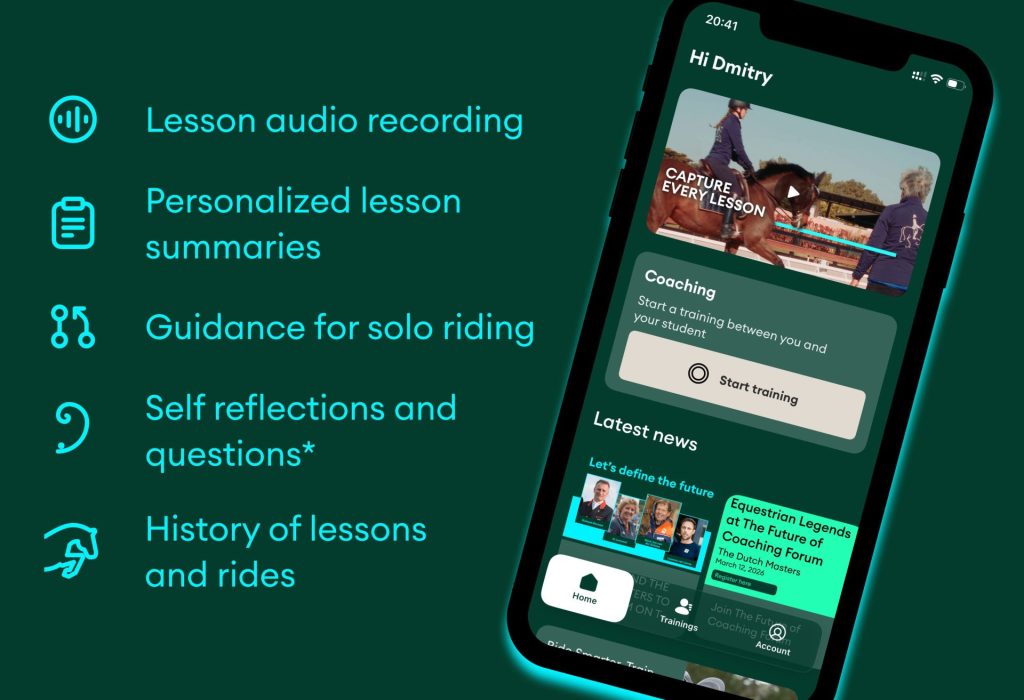
EQ Coach-Copilot, developed by Equestic, records live coaching audio during riding lessons and automatically transforms it into structured lesson summaries riders can revisit later. Instead of coaching existing only inside the arena, lessons become searchable, repeatable learning tools.
In practice, it changes how coaches operate, and is not designed to replace expertise.
Leon Rutten, Equestic founder and CEO, said: “The future of sport is not about replacing human expertise, but augmenting it,” said Rutten. “Innovation should make knowledge more accessible, more structured, and more actionable, without losing the human element that defines performance.”
Many traditional industries still hesitate around AI because of fears that automation will remove authenticity or human value. But the reality increasingly emerging across sport, education, and professional services is different: the most successful technologies are often the ones that strengthen human expertise rather than compete with it.
In equestrian sport, technology is no longer seen only as a “performance gadget.” It is becoming part of modern coaching infrastructure. And major events are starting to openly support that transition.
At The Dutch Masters earlier this year, Equestic hosted “The Future of Coaching” forum, bringing together leading international coaches to discuss how technology can improve performance, education, and horse welfare. Many coaches say the biggest issue in modern training is not the lesson itself, it is what happens afterwards.
“Riders often leave a lesson full of information and ideas. They remember the feeling of the ride, yet the details of the conversation can sometimes fade,” said Alison Kenward, British Horse Society Senior Coach. “A system such as Coach-Copilot offers a way to capture those insights so they can be revisited and reflected upon between sessions.”
Portuguese international coach Nuno Avelar believes lesson retention has become one of the industry’s biggest blind spots. “No one can remember 100% of every word after a lesson,” Avelar explained.
Technology is also beginning to change how coaches think about horse welfare and long-term planning. Dutch FEI Grand Prix rider and coach Thamar Zweistra believes objective measurement creates a stronger connection between horse, rider, and trainer: “To create a better partnership between the rider, coach and horse, you need a better connection.”
Meanwhile, US Grand Prix rider and trainer Amanda Perkowski says: “I use AI on a regular basis in my business to help me in all sorts of ways,” Perkowski said. “So being able to integrate that into coaching is going to be so valuable in the long term for all equestrians.”
That broader evolution is unlikely to slow down.
Just as video analysis became normal in football and Formula 1 embraced data engineering decades ago, equestrian sport appears to be entering its own technology acceleration phase. Technology can help horse trainers create more transparent coaching programs, improve rider engagement, reduce repetitive administrative work, and strengthen long-term retention.
And perhaps the most interesting part is this: the more traditional an industry is, the greater the opportunity may be for meaningful innovation.
Because when expertise has historically depended entirely on memory, manual processes, and fragmented communication, even relatively simple technologies can create transformational change.
The next generation of winners in traditional industries may not be those resisting technology the longest.