Bitcoin
  Ethereum
  Tether
  BNB
BNB  USDC
USDC  XRP
XRP  Solana
  TRON
TRON  Lido Staked Ether
  Cardano
  Gram (prev. Toncoin)
  Avalanche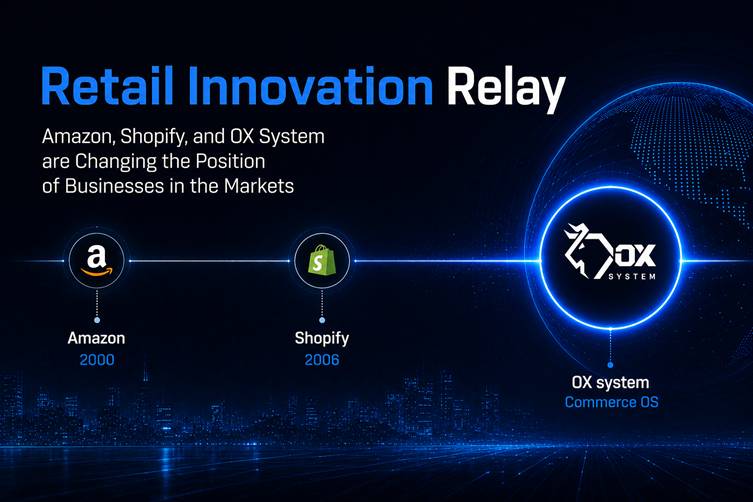
Retail Innovation Relay: Amazon, Shopify, and OX System are Changing the Position of Businesses in the Markets

Looking back at the history of large retail, you’ll see a consistent pattern: every time a new business class wants to scale, it faces certain barriers. And inevitably, someone emerges who resolves to remove these barriers between a seller’s desire to sell their goods and services and the actual ability to do so.
Remember Amazon — it was the first to open up large retail space to sellers who couldn’t afford shelf space. Later, Shopify helped shape the future of retail, giving independent firms access to software without needing an IT crew. Now, the baton of retail transformation is taken up by OX System, a company originally founded in Uzbekistan that develops Commerce OS infrastructure for retail across Central Asia and beyond.
How Amazon and Shopify started this race
Before Amazon, sellers only had physical access to customers through retail shelves they could not control. Buyers at large chains like Walmart, Kmart, and Target decided which suppliers would get their products placed in stores. Sellers were forced to wait anywhere from 6 to 18 months before getting listed in a hypermarket, not to mention the fees and slotting payments involved.
In 2000, Amazon opened its Marketplace to third-party sellers. Any seller could list next to Amazon’s own inventory and reach the same buyers. In 2006, the company removed the last major barrier: sellers shipped inventory to Amazon warehouses, and Amazon handled storage, packing, shipping, and returns. A two-person operation could offer Prime delivery on thousands of SKUs without a warehouse lease or a logistics team. AWS made cloud infrastructure available to businesses of any size, which accelerated the broader e-commerce market — including Amazon’s future competitors.
Shopify took this even further by creating a solution for online retail that allowed almost anyone to launch an independent online store. It all started in the same year, 2006, when founder Tobias Lütke was looking for a proper engine to sell snowboarding equipment online, but could not find one, so he had to build it himself. Not every retailer can afford an IT department, operations specialists, and long, expensive integrations, which is why Tobias created Shopify: a platform that covers the core needs of merchants — online storefronts from scratch, acquiring, hosting, SSL, CDN, and more.
None of these companies invented e-commerce itself, but they destroyed barriers to entry for retailers of all sizes, which is why retail looks the way it does today. Still, the market has room to evolve because neither Amazon nor Shopify created a complete system for sellers. Amazon helped retailers reach customers, but it also took control of customer data. Sellers can generate sales there, but they are not building assets they fully own. Shopify is ideal for developed markets where retailers already have Stripe or PayPal set up, predictable taxation and product-labeling systems, and stable digital infrastructure for commerce.
Standard tools are not bad. But they do not solve the realities of growing markets
The story behind OX System resembles the early days of Shopify in one important way: its founder, Aziz Zakirkhadjaev, started from within the industry. He was building online stores for Uzbek retailers. He began noticing the same repeating patterns everywhere: disconnected accounting systems, cash registers running on one platform, warehouses on another, customer communication in a third — complete operational chaos that kept draining businesses financially. For the last 13 years, the OX System team, led by Aziz, has been building Commerce OS — a complete operating system for managing commerce processes. It is not a toolkit or a collection of isolated features. It is an ecosystem.
Why did Central Asian and neighboring markets even need such a solution if SAP, CRM systems, accounting software, and warehouse management tools already existed?
The answer, once again, is integration and complexity. Many enterprise retail systems require months for deployment and budgets that only large corporations can afford. During that time, a growing retailer may already expand by dozens of new locations, while still waiting for infrastructure designed around the company’s previous scale rather than its current needs.
Other solutions rely on permanent in-house IT teams, continuous integrations, and complex customization processes that most regional operators simply cannot maintain. Platforms focused primarily on e-commerce also often fail to support local payment systems, fiscalization requirements, mandatory product labeling, and the operational specifics of growing markets.
As a result, especially for mid-sized retailers, integrating all these tools into one synchronized system becomes extremely expensive, time-consuming, and operationally difficult. The OX System continues to grow precisely to solve this problem.
What is OX System building for online and offline retail?
The Commerce OS developed by OX System combines POS systems, warehouse and cash register management, CRM, e-commerce tools, payments, analytics, and even RFID through partnerships with Chinese hardware manufacturers. The system operates as one interconnected layer: if a customer places an order through a Telegram store, the salesperson in the physical shop immediately sees that the item has already been sold, preventing double sales.
The RFID software adapted specifically for Central Asian markets does more than prevent theft or manage inventory — it tracks individual items. It reduces inventory checks from six hours to fifteen minutes. All data from every module is centralized in one place: cash registers, customer communication, warehouse operations — everything a retailer needs to monitor exists inside the OX System solution. And the key advantage is that this Commerce OS does not require a dedicated IT team or massive deployment budgets per location.
Roughly 5,000 stores in 7 countries run on OX System — regional operators of Mango, Reebok, Puma, Pandora, Tom Tailor, and Aldo among them. In January 2026, OX System raised $900,000 from United Ventures and IT Park Uzbekistan. The capital goes into Turkey, the Gulf, and the markets after that.
The future of retail is systemic infrastructure
In just 20 years, retail has transformed significantly. It is now difficult to imagine a world where sellers had to fight for shelf space in physical stores and hope logistics would not destroy their margins. It feels like a relic of another era. Modern retail is no longer about isolated tools — it is about complete all-in-one operating systems. Growing markets need exactly these kinds of systems to sustain rapid expansion and move retailers from 1990s-style operations into a far more advanced future. OX System aims to continue scaling its Commerce OS into new markets, helping retailers finally abandon manual accounting and outdated face-to-face sales models in favor of modern systems where everything is interconnected and automated.