
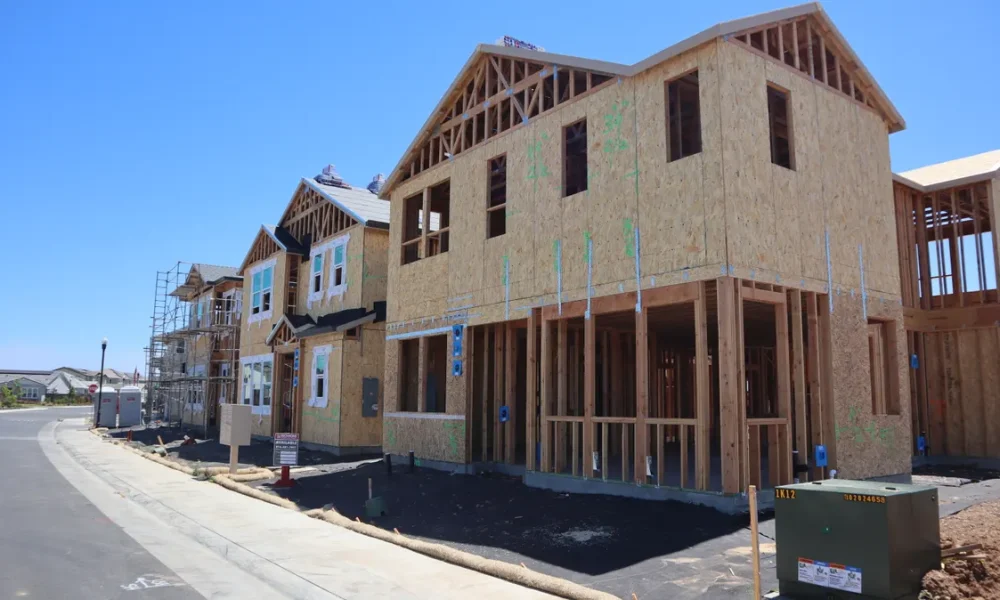
Barratt Redrow SIPP income prospects have sharpened considerably since the company completed its £2.5bn merger with Redrow in late 2024, leaving it as the UK’s largest housebuilder with a landbank sized for 22,000 annual completions at full run-rate. The shares carry a five-year average dividend yield of 5.33%, and the current forward yield sits above 6%, making the stock one of the more discussed income ideas for pension investors in the current market.
Barratt Redrow SIPP income: the dividend case
The dividend picture has been recalibrated rather than abandoned. The board declared an interim dividend of 5.0 pence per share for the first half of financial year 2026, down from 5.5 pence per share in the same period a year earlier. For the full financial year 2025, the company paid 17.6 pence per share in total, comprising a 5.5 pence interim and a 12.1 pence final.
From financial year 2026 onwards, the board has tightened dividend cover to 2.0 times adjusted earnings per share, up from 1.75 times previously. That shift means future payouts are calibrated more conservatively relative to earnings, which reduces the risk of a repeat cut but also caps the upside on the income stream in leaner years. Longer-term SIPP investors should read that adjustment as a deliberate de-risking of the payout rather than as a harbinger of further reductions.
Crucially, the company has pivoted meaningfully towards share buybacks alongside dividends. The £100m annual buyback programme ran in two tranches: the first involved the purchase of 13.2 million shares at an average price of 379 pence, at a total cost of £50.4 million including fees. The second tranche, which UBS AG London Branch executed, completed on 8 May 2026 with 16,106,329 shares purchased for £50 million.
The pivot was not purely a board initiative. Shareholder Phoenix Asset Management Partners had urged an aggressive buyback programme ahead of the company’s change in direction, which gives the new capital-return policy some external accountability. For financial year 2027, Barratt Redrow plans to return £400 million to shareholders in aggregate.
What the balance sheet and buybacks tell us
The balance sheet is stronger than the share price implies. Net cash at 28 June 2026 came in at c. £772 million, ahead of the guidance the company had provided in April 2026 and roughly in line with the £772.6 million recorded at the end of financial year 2025. The improvement relative to management’s own forecasts is a useful data point for sceptics who expected a cash bleed during the integration year.
The July 2026 trading update confirmed a new buyback programme of c. £386 million, commencing immediately and running through to 2 July 2027. Under this arrangement, the recurring shareholder return will be delivered via buyback, with only a nominal 1 pence per share cash dividend retained. That structure compresses the headline yield but arguably increases the efficiency of capital return for SIPP investors who are not drawing down yet.
Valuation remains the most argued-about element. Tangible net asset value per share stood at 433.4 pence as at 29 December 2025. At the share price of 278 pence recorded on 14 July 2026, that represents a 36% discount to tangible book. This is the third time since the 2008 downturn that Barratt has traded at a material discount to asset value, and on each of the previous occasions the gap eventually closed, though the timeline was measured in years rather than quarters.
Against that, the risk register is not trivial. A £1.4 billion building-safety provision sits on the balance sheet from financial year 2025, absorbing capital that would otherwise be available for returns. Building defects have been a persistent drag, and the liability is not fully resolved. FY27 completions guidance of 17,700 to 18,200 homes (including 600 from joint ventures) implies continued volume growth, but management also flagged total build cost inflation of 3% to 4% for the year ahead, which will test margin resilience.
BTRW retains its five-star homebuilder status for the 17th consecutive year, a customer-quality credential that matters for planning relationships and reservation rates. FY25 completions of 16,565 homes were up 18.3% year on year, with adjusted profit before tax reaching £591.6 million, ahead of market expectations.
For a SIPP with a 15-to-20-year horizon, the setup has a reasonable internal logic: a depressed share price, a balance sheet with £772 million in net cash, and a formalised capital-return commitment totalling £400 million for the coming year. The counter-argument is straightforward: interest-rate sensitivity, a multi-billion safety provision, and a housing market that can stall for longer than most models allow. A 1% to 2% portfolio allocation positions an investor to participate in a recovery without the portfolio becoming hostage to the cycle. The next test is whether the £386 million buyback programme executes at prices that prove, in retrospect, to have been below fair value.



 Bitcoin
  Ethereum
  Tether
  BNB
BNB  USDC
USDC  XRP
XRP  Solana
  TRON
TRON  Lido Staked Ether
  Cardano
  Gram (prev. Toncoin)
  Avalanche