
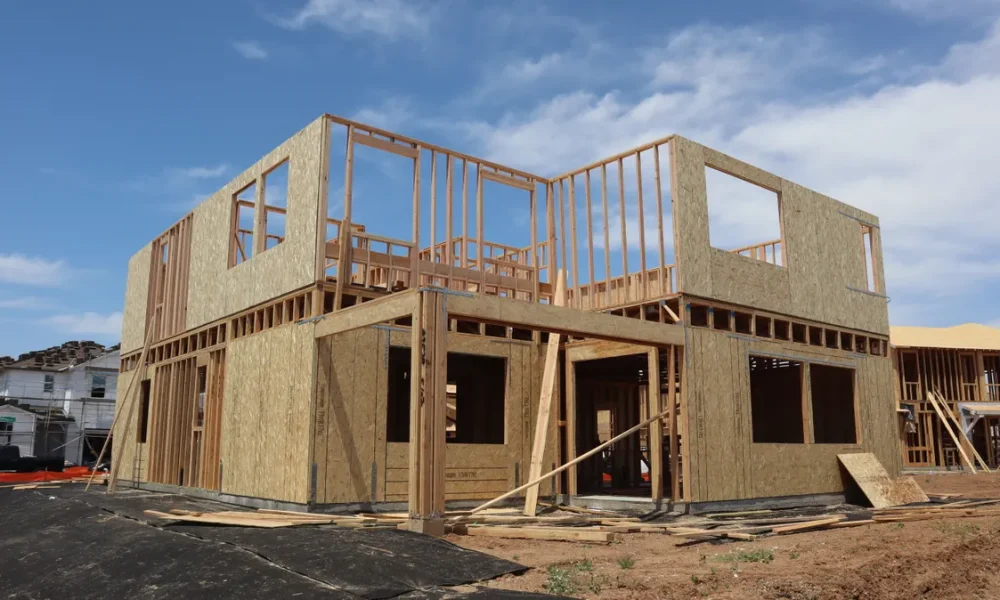
Taylor Wimpey‘s dividend yield of 9.3% has placed the housebuilder among the top income stocks on the FTSE 250, but a closer look at the numbers suggests the Taylor Wimpey dividend yield carries more risk than the headline figure implies. The shares (LSE: TW.) have fallen 30% since June 2025, and the payout has already been cut once in the current cycle.
What the Taylor Wimpey Dividend Yield Actually Signals
A yield approaching double digits on a FTSE 250 stock is rarely a straightforward gift. It tends to mean one of two things: the market has mispriced an asset, or it is pricing in another cut. Barclays Research Centre records Taylor Wimpey’s dividend growth for 2025 at -19.45%, with a 2025 annual yield of 7.1% and dividend cover of just 1.05 times. The 9.3% figure cited as of 1 July 2026 reflects the further share-price decline since then; the two metrics are measuring different points in time, not contradicting each other.
Cover of 1.05 times means the dividend is barely earning its keep from profits. There is almost no buffer if earnings disappoint, and in an environment of elevated construction costs and subdued mortgage demand, that margin for error matters.
AJ Bell reported that Taylor Wimpey cut its interim dividend to 4.67 pence per share, down 2.7% from 4.80p a year earlier, while simultaneously trimming its operating profit guidance. That combination, lower interim payout and a downgraded profit outlook, is precisely the pattern that precedes a more material cut.
The New Distribution Policy and What It Means for 2026
Taylor Wimpey has shifted to a formula-based payout structure. As Interactive Investor confirmed, the policy commits to returning 5% of net assets to shareholders each year as a dividend, with a further 2.5% distributed through buybacks or an additional dividend.
The December 2025 balance sheet shows net assets of £4.187bn. Based on the current share count, that 5% to 7.5% range translates into a 2026 dividend of approximately 6p to 9p per share. Even at the floor of 6p, the stock would still yield around 7.3%, leaving it inside the top 21 FTSE 250 income payers. That is a genuine floor, but it is a floor that depends on net assets holding up, which in turn depends on land values and completions.
Management teams, it is worth noting, tend to favour buybacks when given discretion: bonuses are frequently tied to earnings per share, and buybacks flatter that metric. Shareholders benefit in theory under either approach, but the mix matters for those who rely on the cash dividend specifically.
Dividendpedia records a dividend of £0.0295 per share scheduled for payment on 15 May 2026 to shareholders registered by 2 April 2026, although this comes from an aggregator source and investors should verify timing against the company’s own announcements.
The Case for the Stock Beyond the Yield
The income story alone is not sufficient justification for the position. What strengthens the case is the operating backdrop for UK housebuilding over a medium-term horizon.
Taylor Wimpey holds 76,000 plots of land and an order book worth £2.23bn, representing 7,689 homes. The balance sheet carries very little debt. Government planning reforms, if they proceed as intended, should lower the cost and timeline of bringing sites to market. And the UK’s structural housing shortage means demand is latent rather than absent: it will surface when consumer confidence improves and mortgage affordability eases.
The near-term picture is less comfortable. Inflation risks from geopolitical disruption remain difficult to model. The domestic economy is growing slowly and the housing market has yet to find a durable footing. None of that is unique to Taylor Wimpey, but all of it weighs on near-term completions and therefore on the net assets that underpin the dividend formula.
The full dividend history across the past five financial years illustrates the volatility: 8.58p in 2021, 9.40p in 2022, 9.58p in 2023, 9.46p in 2024, and 7.62p in 2025 following the 19.5% reduction. The trend is not reassuring for those seeking a stable income stream, even if the absolute yield remains high.
At the current price, Taylor Wimpey is not obviously cheap on a fundamental basis. But neither is it obviously a value trap: the land bank, the balance-sheet discipline, and the structural demand story provide a credible floor to the thesis. The next test is the full-year results, where the operating profit guidance revision will either have been conservative or prove prescient.



 Bitcoin
  Ethereum
  Tether
  BNB
BNB  USDC
USDC  XRP
XRP  Solana
  TRON
TRON  Lido Staked Ether
  Cardano
  Gram (prev. Toncoin)
  Avalanche