
A headline doing the rounds this week says Apple (NASDAQ: AAPL) “paid $17bn in taxes to Ireland after court ruling on back levies,” as first reported by the Financial Times and picked up by wire services on 21 August 2026. The trouble is that every element of that sentence – the amount, and the timing – is off. Apple’s Ireland tax bill was settled, and paid, more than a year before this headline appeared.
The underlying event is real enough. In September 2024 the EU’s top court, the Court of Justice of the European Union, ruled in Case C-465/20 P that Ireland had to recover the back taxes at the centre of the European Commission’s 2016 state-aid finding against Apple. That decision, made a decade ago, held that Apple’s Irish tax arrangements between 2003 and 2014 amounted to illegal state support and ordered recovery of up to €13bn (roughly $14.4bn at the time). The 2024 ruling was final – there was no appeal left to make.
What actually happened, and when
The money itself had been sitting in an escrow account since the original 2016 dispute, gathering interest. Once the court ruling closed the matter, Ireland claimed the full pot: €13.1bn in tax plus €1.2bn in accrued interest, a total of €14.3bn, according to RTÉ’s reporting on the escrow wind-down. Converted at the prevailing exchange rate, outlets at the time put the figure at roughly $15bn – AppleInsider reported the escrow withdrawal at just over $15bn when the account was finally closed on 13 May 2025. Ireland had in fact begun drawing down the money well before that: PYMNTS reported a first €3bn tranche reaching the Irish exchequer back in 2024. None of this happened in 2026, and none of the figures in circulation land anywhere near $17bn.
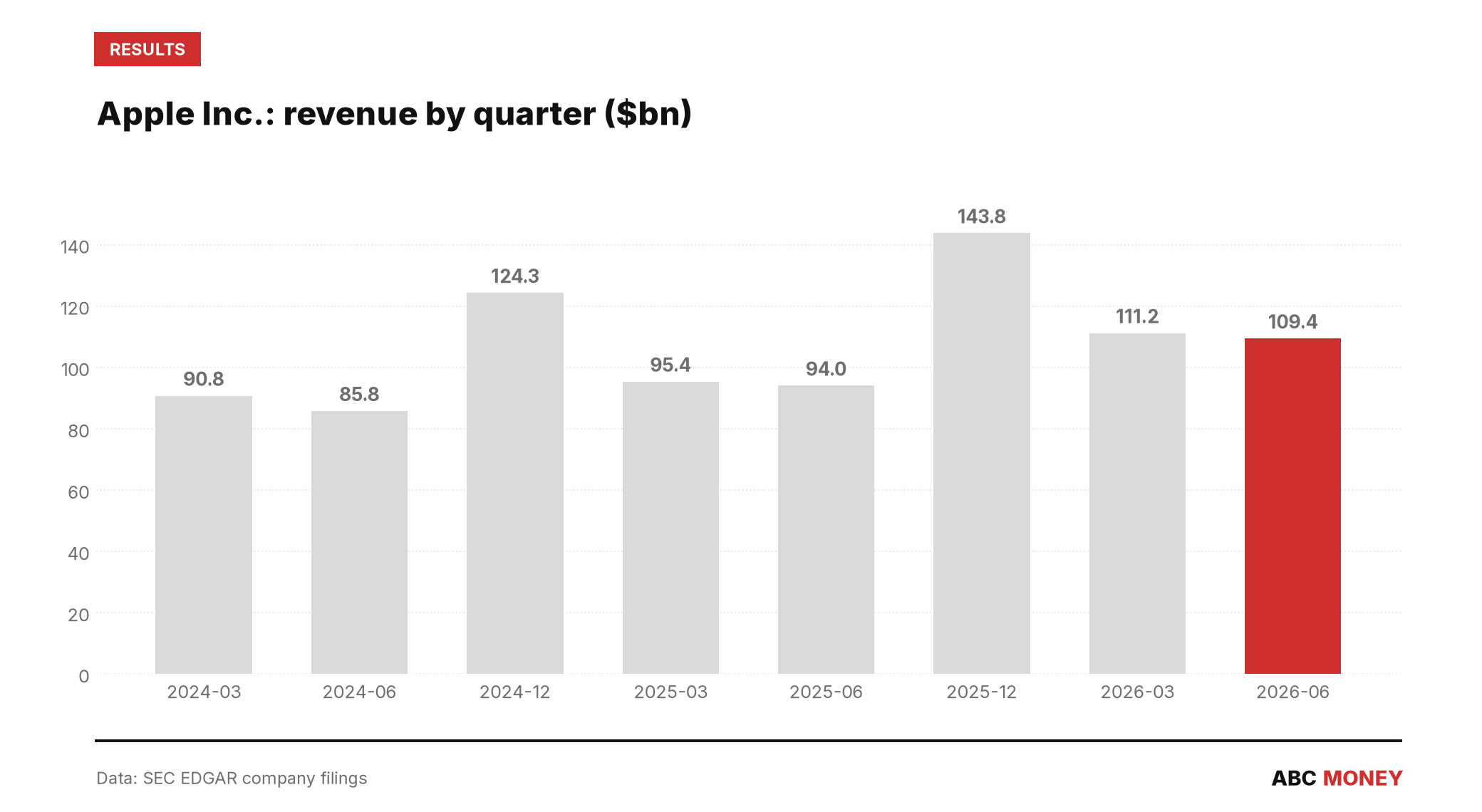
Apple’s own accounts corroborate the earlier timeline. The company took a one-off income tax charge of roughly $10bn tied to the ruling in the quarter ended 28 September 2024, as CNBC reported at the time – a charge that shows up nowhere in Apple’s subsequent quarterly filings with the SEC, which report net income of $42.1bn in fiscal Q1 2026 and $29.8bn in fiscal Q3 2026 with no comparable one-off tax item disclosed in either the January 2026 10-Q or the July 2026 filing. If Apple had absorbed a fresh $17bn hit this summer, it would be the kind of item that moves an earnings call – and it isn’t there.
Where the $17bn figure comes from
It’s not clear where the $17bn number originates. It doesn’t match the Commission’s original €13bn assessment, the €14.3bn total eventually paid out, or the roughly $15bn dollar-equivalent cited in contemporaneous reporting. The most plausible explanation is that a syndicated report resurfaced a genuinely significant but already-closed 2024-2025 story under a new timestamp, with the figure inflated somewhere along the way – the kind of dateline drift that can happen when old case files get recirculated by automated feeds. Readers searching for the latest on Apple’s Ireland tax bill should treat the $17bn figure, and the idea that this is a live 2026 development, with real scepticism.
Markets barely blinked
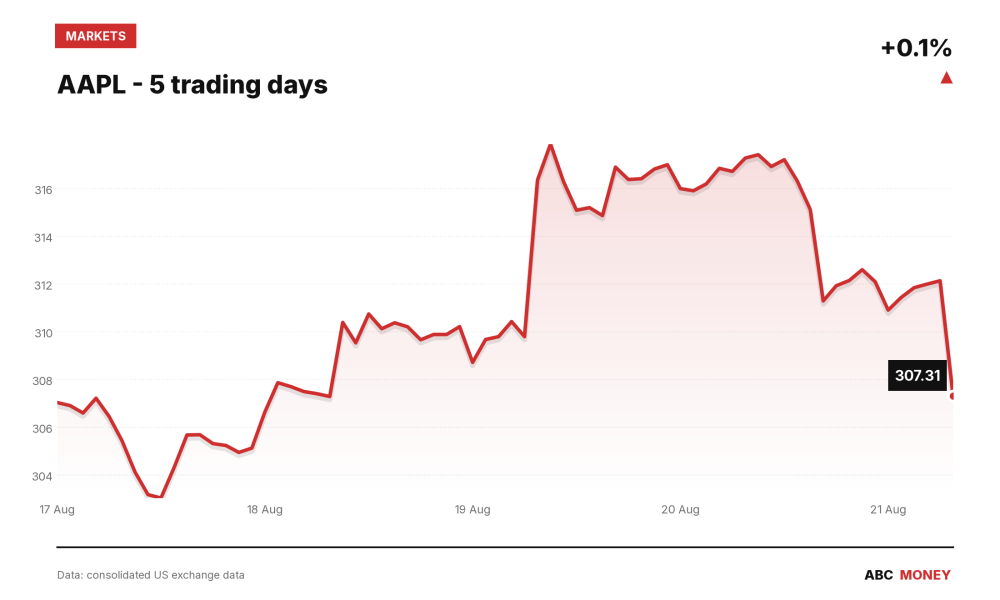
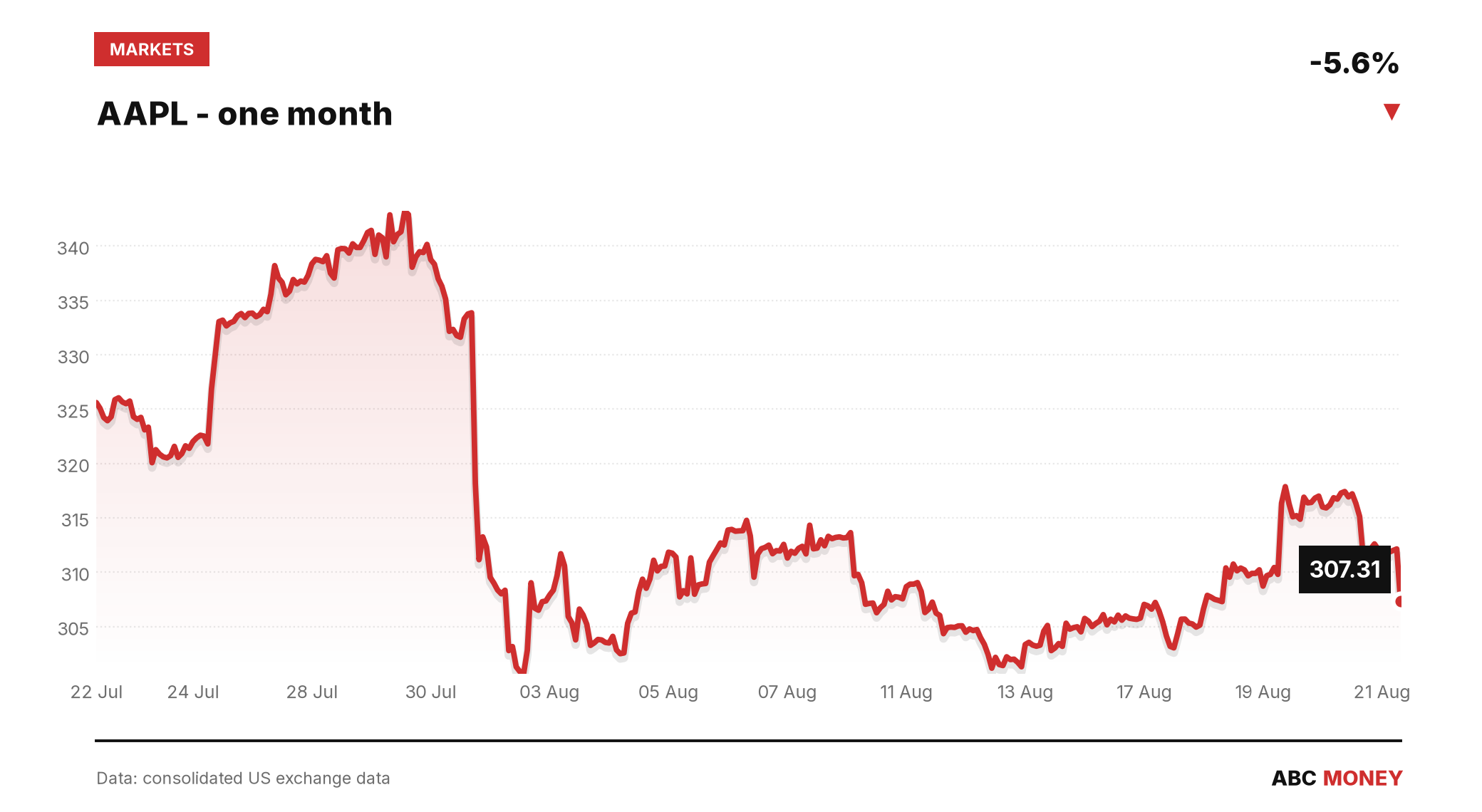
Apple shares closed at $308.09 on 21 August 2026, down 1.45% on the day, though still up 1.6% over the preceding twenty trading sessions – hardly the reaction you’d expect if the market believed a fresh $17bn liability had just landed. Trading volume ran at only about a third of its 20-day average, and FINRA’s short-sale data – the share of daily volume sold short, a rough gauge of bearish positioning – showed nothing unusual either, sitting at 0.393 on 20 August against a range of 0.33 to 0.53 over the prior month. None of that points to a market pricing in new tax news; it points to a market that either didn’t see the story or didn’t believe it.
The broader backdrop was calm too. The 10-year US Treasury yield stood at 4.65% on 19 August, down slightly from 4.71% a month earlier, with the 10-year/2-year spread at 0.5 percentage points – a mild steepening rather than the kind of stress that tends to accompany surprise corporate tax charges of this size.
For a case that ran a decade, involved the European Commission, Ireland’s government and the EU’s highest court, and ended with Apple’s escrow account being formally closed in May 2025, the real story isn’t a new payment – it’s that the saga is over, and has been for more than a year. Anyone tracking Apple’s tax exposure heading into its next quarterly filing would do better to watch for actual disclosures on EDGAR than for recycled headlines about a court fight that already reached its conclusion.
This article is for information only and is not investment advice or a recommendation to buy or sell any asset. Markets move quickly; figures are correct as sourced at the time of writing. Always do your own research before making financial decisions.



 Bitcoin
  Ethereum
  Tether
  BNB
BNB  USDC
USDC  XRP
XRP  Solana
  TRON
TRON  Lido Staked Ether
  Cardano
  Gram (prev. Toncoin)
  Avalanche