
Better Home & Finance Holding (NASDAQ: BETR) and Coinbase Global (NASDAQ: COIN) have pushed their token-backed mortgage into general availability, opening it to all Coinbase One members rather than the waitlist that has queued since June. The product lets first-lien mortgages remain standard and conforming under Fannie Mae’s rules while borrowers pledge crypto as part of the arrangement, an approach first reported in detail by HousingWire.
The mechanics are straightforward. Coinbase One members approved for a Better loan get a lender-funded credit worth 1% of the mortgage value, capped at $10,000, applied directly against closing costs on their disclosure statement. Crucially, the companies have now extended that rebate beyond the original crypto-backed product to Better’s entire lending shelf – standard mortgages, home equity lines of credit and refinances – turning a niche pilot into a broader customer-acquisition tool for both firms.
The waitlist numbers behind the token-backed mortgage push
Better and Coinbase are leaning hard on early demand data to justify the expansion. When the original crypto-backed mortgage waitlist opened in June, 76% of respondents were already Coinbase One subscribers and 60% said they intended to buy a home within six months, with projected loan volume topping $260m before the product was even generally available, according to figures corroborated by HousingWire. That is the commercial logic for scaling up now: a captive, high-intent audience inside Coinbase’s membership programme that Better can convert into originations without the customer-acquisition cost of open-market lending.
It is worth noting this is an expansion rather than a debut. Better and Coinbase first announced the token-backed, Fannie Mae-conforming structure back in March 2026, and the August move is the general-availability stage of a product that has been rolling out in phases rather than landing in one go.
A stock story that has little to do with mortgages
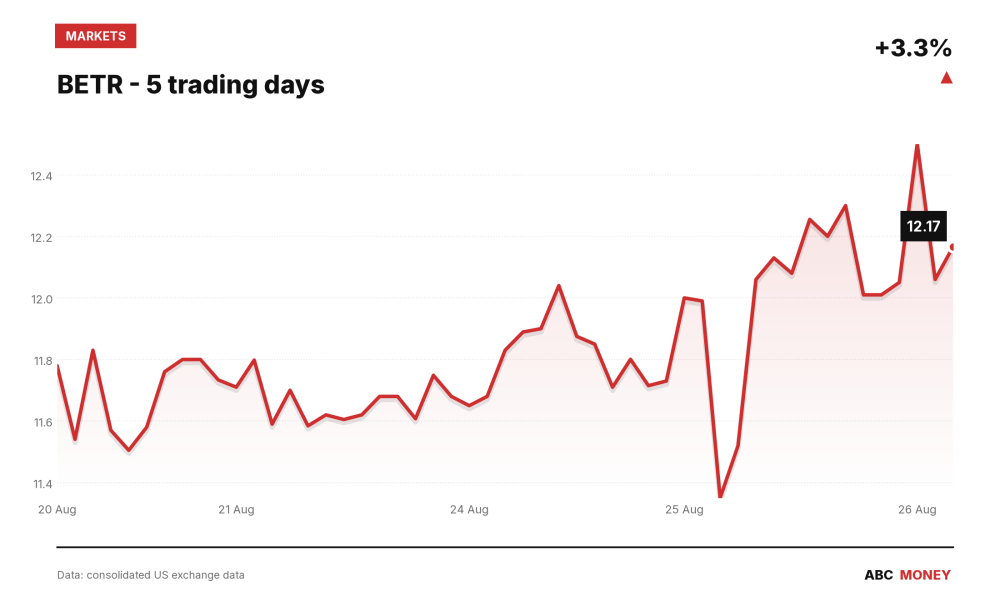
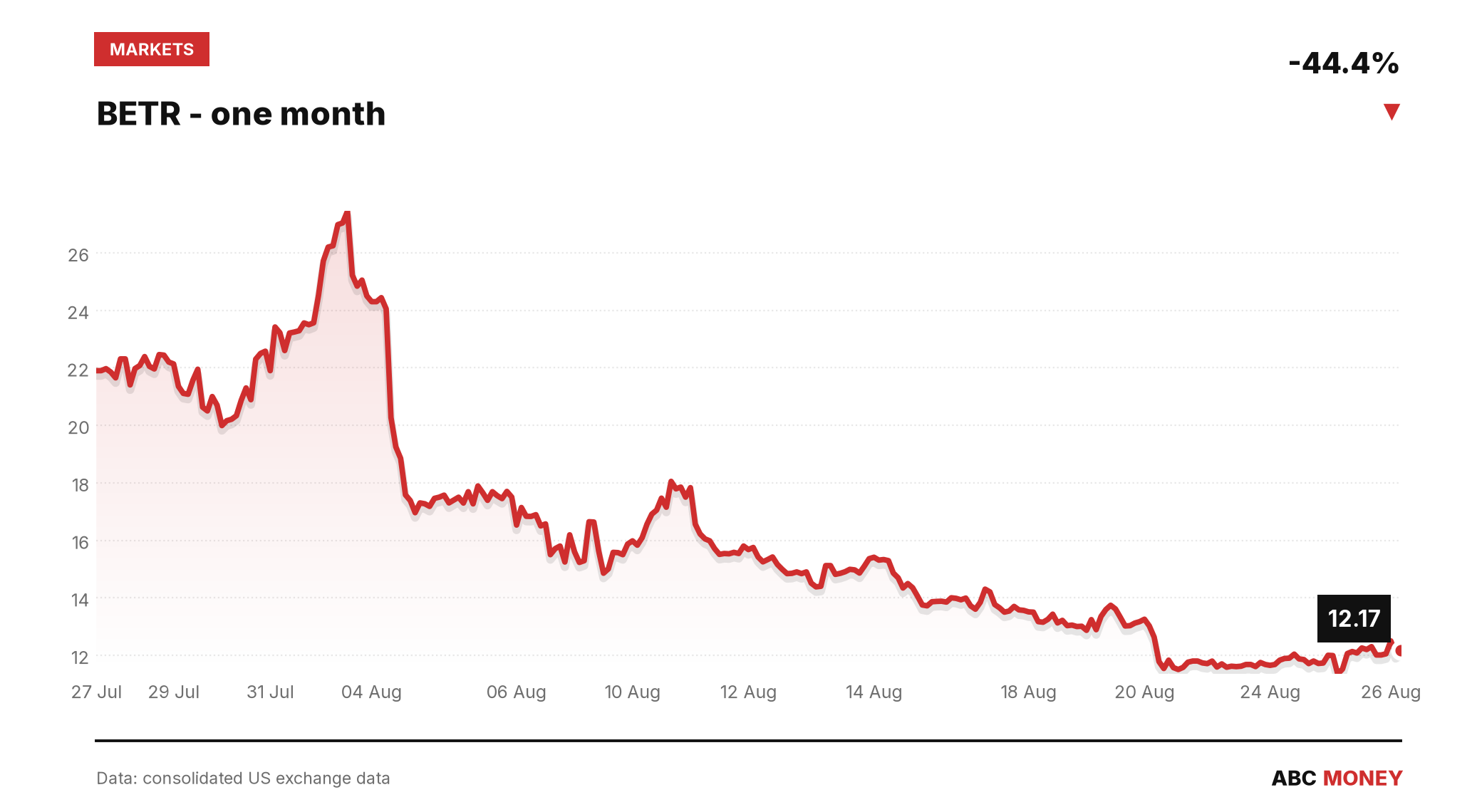
The product news arrives while BETR’s shares tell a very different story. The stock last changed hands at $12.17, down 31% over the past 20 trading days and well off its 20-day high of $18.05, having traded as low as $11.35 in the same window. Volume has actually run below average of late, at roughly 62% of the 20-day norm, suggesting the slide has been a steady repricing rather than a single panic sell-off.
That repricing predates and looks unconnected to the mortgage announcement. Better’s chief executive, Vishal Garg, stepped down around the same period the company reported a second-quarter net loss, and the losses themselves have been persistent rather than one-off: Better’s 10-Q filing shows a net loss of $30.59m for the quarter ended 30 June 2026, following a $70.31m loss in the first quarter and losses in every quarter stretching back to early 2024, per Better’s own SEC filings. None of Coinbase’s insider Form 4 filings from around 24 August – covering executives including Emilie Choi and Chris Lehane – appear tied to the mortgage rollout either; they read as the kind of routine, pre-scheduled disposals that large-cap companies file continuously.
There is a modest positioning signal worth flagging. BETR’s daily short-sale ratio – the share of trading volume attributable to short sales, where traders borrow stock to bet on a price fall – eased from 0.719 on 24 August to 0.468 the following day, according to FINRA data, coinciding with the general-availability news. One day’s move in a ratio that has bounced between 0.47 and 0.72 over the past fortnight is thin evidence of anything durable, but it at least suggests the announcement did not spook short sellers into piling in further.
Why the timing matters for mortgage economics
The backdrop for any mortgage launch is rates, and here the picture is unusually settled. The 10-year US Treasury yield, which anchors long-term mortgage pricing, stood at 4.70% as of 24 August, barely moved from 4.74% the prior reading, while the Secured Overnight Financing Rate held flat at 3.65%, according to Federal Reserve data. Credit markets are equally quiet: the ICE BofA high-yield spread, a gauge of how much extra yield investors demand to hold riskier corporate debt over Treasuries, sat at 2.69 percentage points, essentially unchanged. None of that is dramatic, but it does mean Better is launching into a rate environment that has stopped moving against it, rather than one actively working in its favour.
For Coinbase, the calculus is different: this is customer retention dressed up as a mortgage product, a way of making Coinbase One membership sticky by attaching it to one of the biggest financial decisions a household makes. Whether that logic converts waitlist enthusiasm into a durable lending book – and whether it does anything to steady Better’s share price – is now a matter for the next few quarters of origination data rather than for the launch announcement itself.
This article is for information only and is not investment advice or a recommendation to buy or sell any asset. Markets move quickly; figures are correct as sourced at the time of writing. Always do your own research before making financial decisions.


 Bitcoin
  Ethereum
  Tether
  BNB
BNB  USDC
USDC  XRP
XRP  Solana
  TRON
TRON  Lido Staked Ether
  Cardano
  Gram (prev. Toncoin)
  Avalanche