
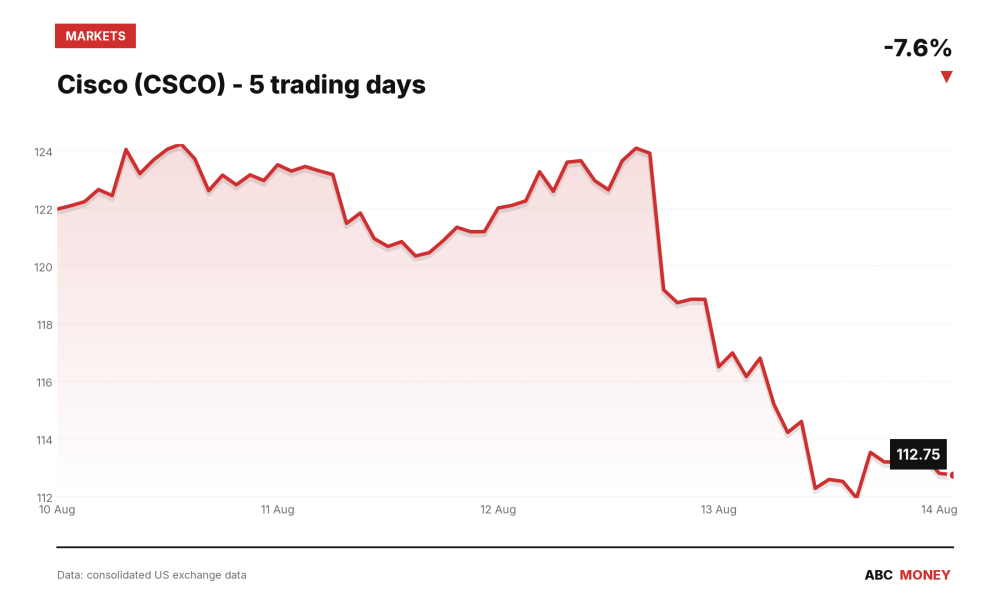
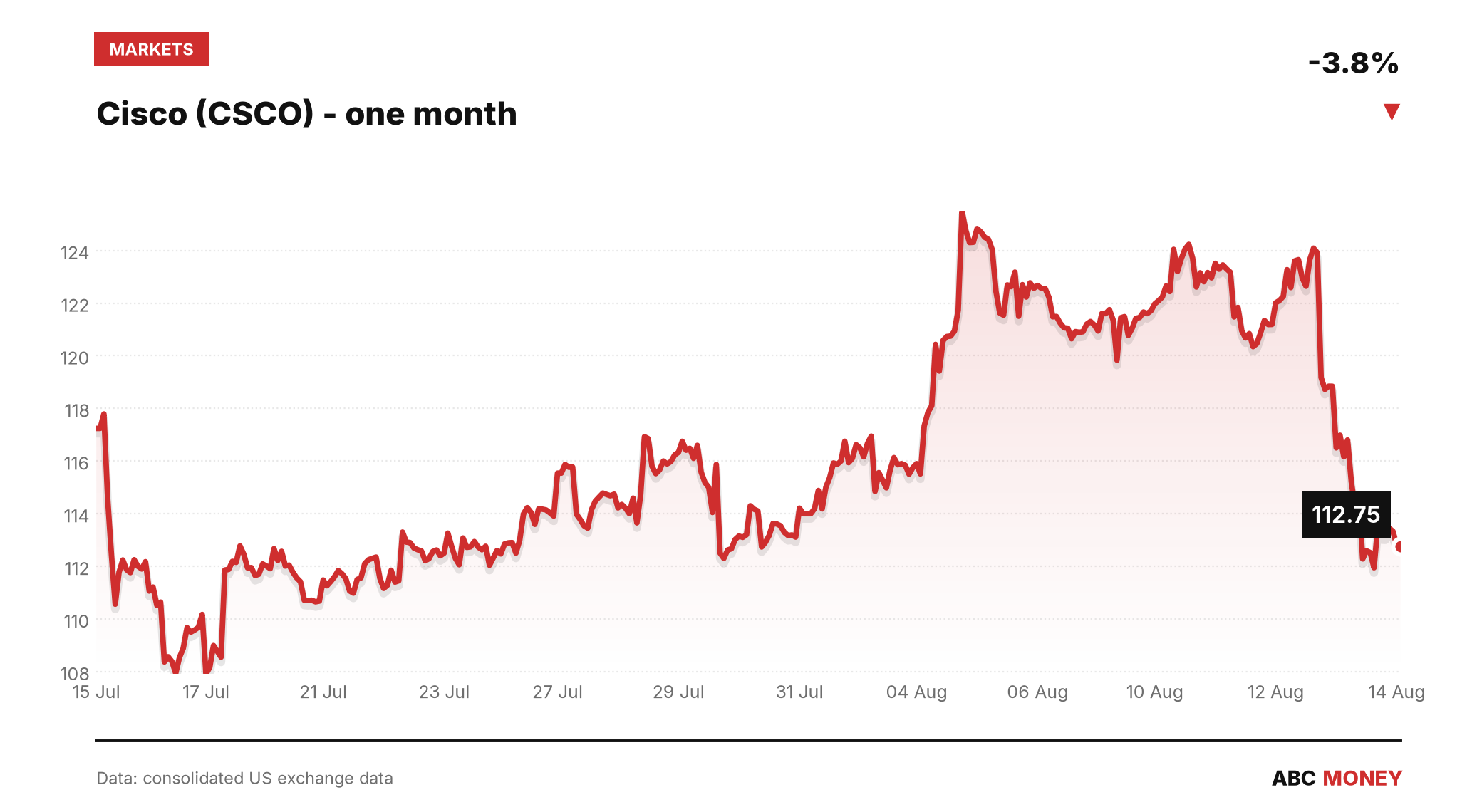
Cisco Systems (NASDAQ: CSCO) shares have kept falling in the days since the networking giant posted record fourth-quarter and full-year results, extending a slide that has now wiped more than a tenth off the stock since its pre-results close. Shares fell 8.4% on 13 August to close at $113.47, down from $123.88 the previous session, and slipped further to around $112.80 in premarket trade on 14 August, according to StockAnalysis.com. Trading volume on the sell-off day ran roughly 137% above the three-month average. That is an odd reaction to a quarter in which both revenue and profit hit records – and the explanation lies less in the headline numbers than in one line further down the income statement.
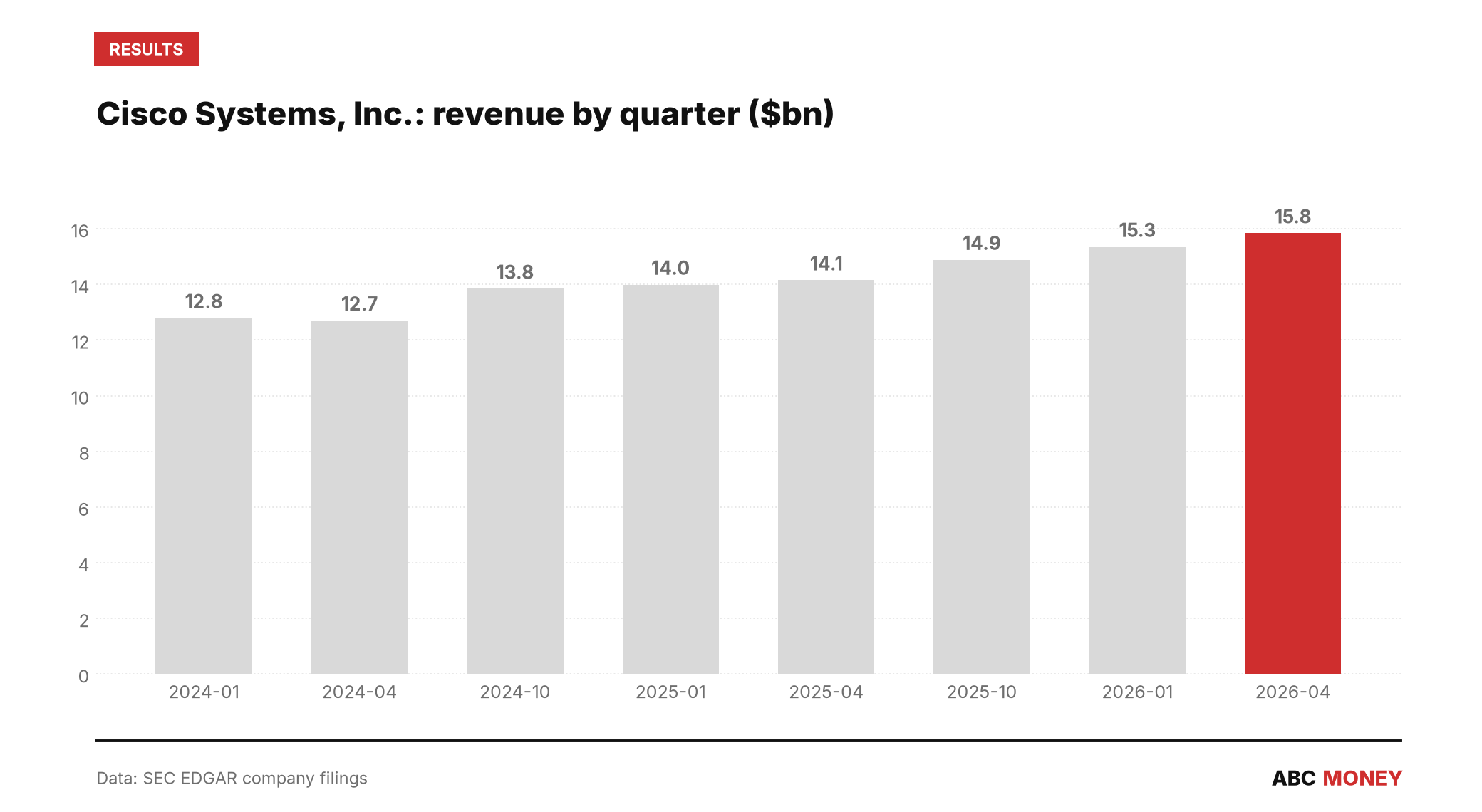
The results themselves, reported this week, were unambiguously strong: fourth-quarter revenue of $17.3bn, up 18% year on year, took full-year sales to a record $63.3bn, up 12%, while non-GAAP earnings of $1.22 a share beat the $1.17 analysts had pencilled in, on revenue that also cleared consensus, according to Cisco’s own release and The Motley Fool. Guidance for fiscal 2027 came in well above this year’s actuals too, at $72.2bn-$73.4bn. None of that reads like a company in trouble. So why do Cisco shares keep sliding?
Margin, not demand, is doing the damage
The number that moved the stock was non-GAAP gross margin – the profitability measure Cisco highlights alongside statutory results, stripping out items like acquisition costs and stock compensation – which came in at 66.3% for the quarter, down from 68.4% a year earlier, per the same Motley Fool analysis of the earnings release. That two-point-plus compression reflects the rising cost of the AI-optimised networking hardware Cisco is now shipping at scale: silicon and components for AI data-centre kit cost more to produce than the routing and switching gear that has long anchored the business, and investors are pricing in what that mix shift does to profitability even as the topline grows. The demand side of the AI story, notably, is intact – Cisco booked $9.3bn in AI infrastructure orders across the year and is guiding to $7.5bn of AI infrastructure revenue in fiscal 2027, according to its investor relations materials. This is a margin repricing sitting on top of a genuine growth quarter, not a demand scare.
The short-selling angle doesn’t hold up
One data point circulating around the sell-off is a rise in Cisco’s daily short-sale volume ratio, which climbed from roughly 0.34-0.38 in late July to 0.47-0.53 on 12 and 13 August, per FINRA figures. It is tempting to read that as bearish traders piling in ahead of the drop. But FINRA’s own guidance is explicit that daily short-sale volume – largely a by-product of market-making and hedging activity – is not a proxy for short interest, the standing bet that a stock will fall, and should not be read as a positioning signal. Cisco’s actual short interest tells a different story: 66.19 million shares short against a float of 3.93 billion, or just 1.68%, according to Finviz data. That is a thin sliver by any market’s standard, and nothing close to the elevated short interest that typically accompanies a genuine bearish bet against a stock.
The insider filings were tax bills, not a vote of no confidence
A cluster of Form 4 filings also landed with the SEC in the hours after results, including one from chief executive Charles Robbins filed on 12 August. Taken at face value, a batch of executive sales alongside a falling share price can look like insiders heading for the exit. The filing detail says otherwise: Robbins’s disposal was 15,655.948 shares withheld under code F – the mechanism companies use to cover the tax bill an executive owes when restricted stock units vest, dated to 10 August at $121.43 a share, before the post-earnings drop, according to filing data compiled by StockTitan. It is a routine, scheduled event tied to vesting dates, not a discretionary market sale. For contrast, Robbins did make a genuine open-market disposal earlier this year – 21,400 shares worth $2.57m under a pre-arranged Rule 10b5-1 trading plan in May 2026 – but that sale predates the results by months and has no bearing on this week’s move. The other Form 4s filed alongside his, from finance chief Mark Patterson and several other executives, follow the same late-August vesting pattern.
Strip out the noise and the story left standing is a straightforward one: Cisco’s AI-era hardware build-out costs more to deliver than its legacy networking business did, and the market is re-rating the shares to reflect that, even as it still values the growth highly enough that CSCO remains higher for 2026 to date, per CNBC’s reporting on the reaction. Whether the margin pressure eases as AI infrastructure revenue scales toward that $7.5bn fiscal 2027 target, set against guidance calling for total revenue as high as $73.4bn, is now the metric investors will be watching most closely when Cisco next reports.
This article is for information only and is not investment advice or a recommendation to buy or sell any asset. Markets move quickly; figures are correct as sourced at the time of writing. Always do your own research before making financial decisions.


 Bitcoin
  Ethereum
  Tether
  BNB
BNB  USDC
USDC  XRP
XRP  Solana
  TRON
TRON  Lido Staked Ether
  Cardano
  Gram (prev. Toncoin)
  Avalanche