
The Labcorp NACHC alliance, unveiled on 18 August, commits the diagnostics giant Labcorp (LH) to a long-term partnership with NACHC, the umbrella body for the country’s community health centres, aimed at strengthening clinical leadership and using diagnostic data to close gaps in care across a network that treats more than 52 million patients a year, the two organisations said in a joint release.
The centrepiece is a new “NACHC Leadership Exchange for Chief Medical Officers”, a programme designed to support current and rising clinical leaders at health centres nationwide. Beyond training, the alliance covers practice-improvement work and the use of de-identified Labcorp data – patient information stripped of anything that could identify an individual – to help health centres track quality metrics and close gaps in care. The scope is wide: NACHC represents 1,526 community health centres serving 52.3 million patients across the US, figures confirmed in both the original release and syndicated coverage from Benzinga the same day.
NACHC’s chief executive, Kyu Rhee, is quoted in the release describing strong clinical leadership as essential to running a network of that size, underlining that the deal is being pitched as a workforce and quality initiative rather than a straightforward commercial supply arrangement.
Why this Labcorp NACHC alliance didn’t need an 8-K
Investors searching EDGAR for a formal disclosure of the tie-up will not find one. The only SEC filing touching Labcorp around this date is a Form 4 – an insider transaction report – filed by Kerrii B. Anderson on 18 August, hours after the announcement; the filing itself discloses no share counts or dollar values and has nothing evident to do with the NACHC partnership. That absence of a material-event filing is itself informative: a strategic alliance built around leadership training and data-sharing, rather than a capital commitment, an acquisition or a revenue guarantee, does not cross the threshold that would require Labcorp to tell shareholders formally that something financially significant has happened.
That fits a pattern. Labcorp has built out a string of similar association-level tie-ups, including an earlier collaboration with the New Jersey Primary Care Association aimed at advancing value-based care among that state’s community health centres, according to the company’s own press materials. It has also been more actively acquisitive elsewhere: in late 2025 Labcorp completed a deal to acquire select outreach laboratory assets from Community Health Systems, according to the company’s investor relations disclosures. Read together, the NACHC alliance looks less like an isolated PR moment and more like another rung in a deliberate ladder of provider and association partnerships that widen Labcorp’s footprint in community and value-based care without necessarily moving the needle on near-term revenue.
The numbers behind the announcement
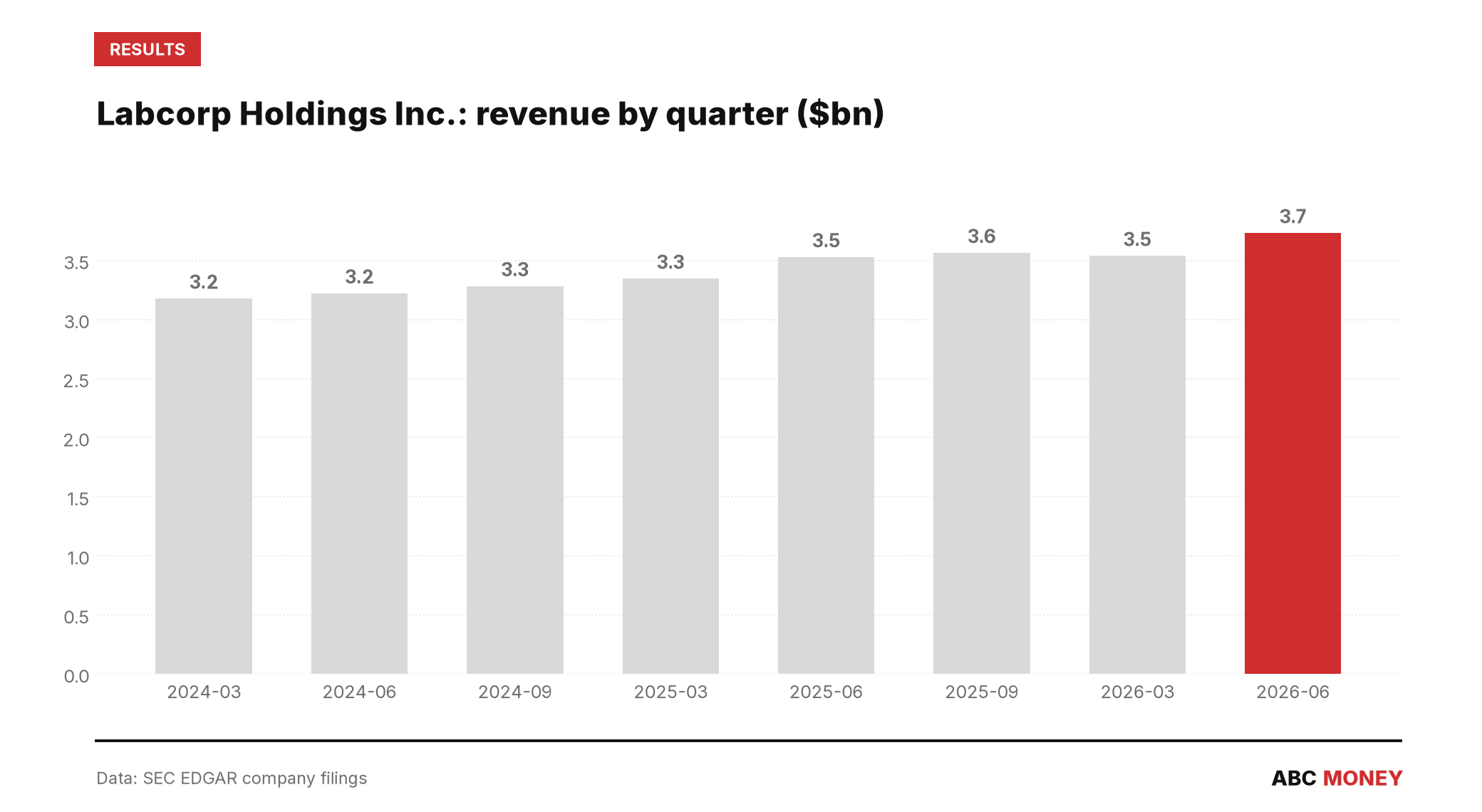
None of this changes the financial picture much on its own, but that picture has been improving steadily. Labcorp’s quarterly revenue has risen in every period tracked since the first quarter of 2024, climbing from $3,176.6m then to $3,731.1m in the second quarter of 2026, according to filings with the SEC. Net income over the same run climbed from $228m to $298.7m, while diluted earnings per share rose from $2.69 to $3.64 – an increase of more than one-third. That earnings trajectory is the backdrop against which a non-material partnership announcement like this one lands: it is unlikely to move estimates, but it reinforces a growth story that has, so far, been running quarter after quarter without interruption.
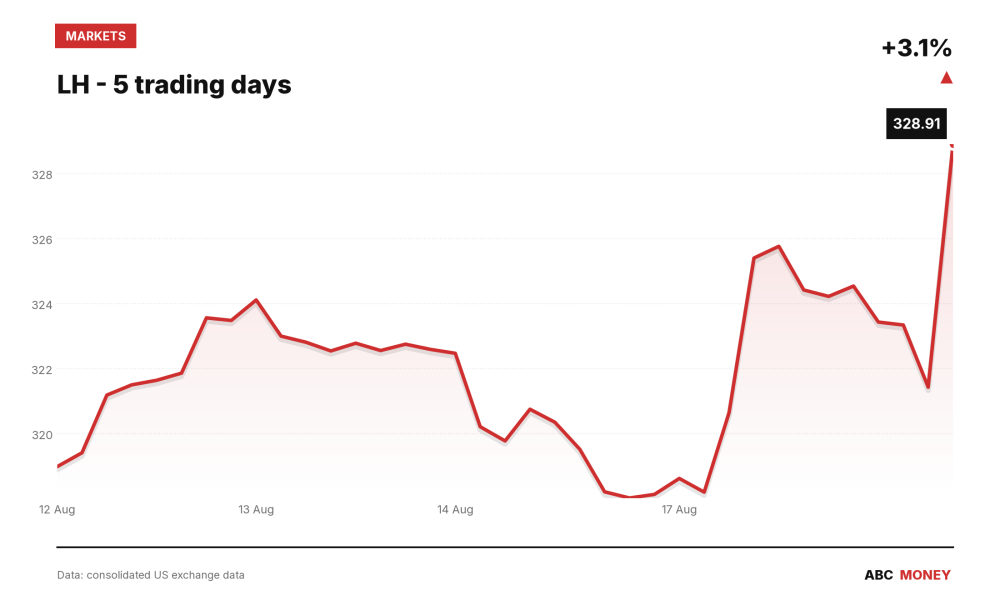
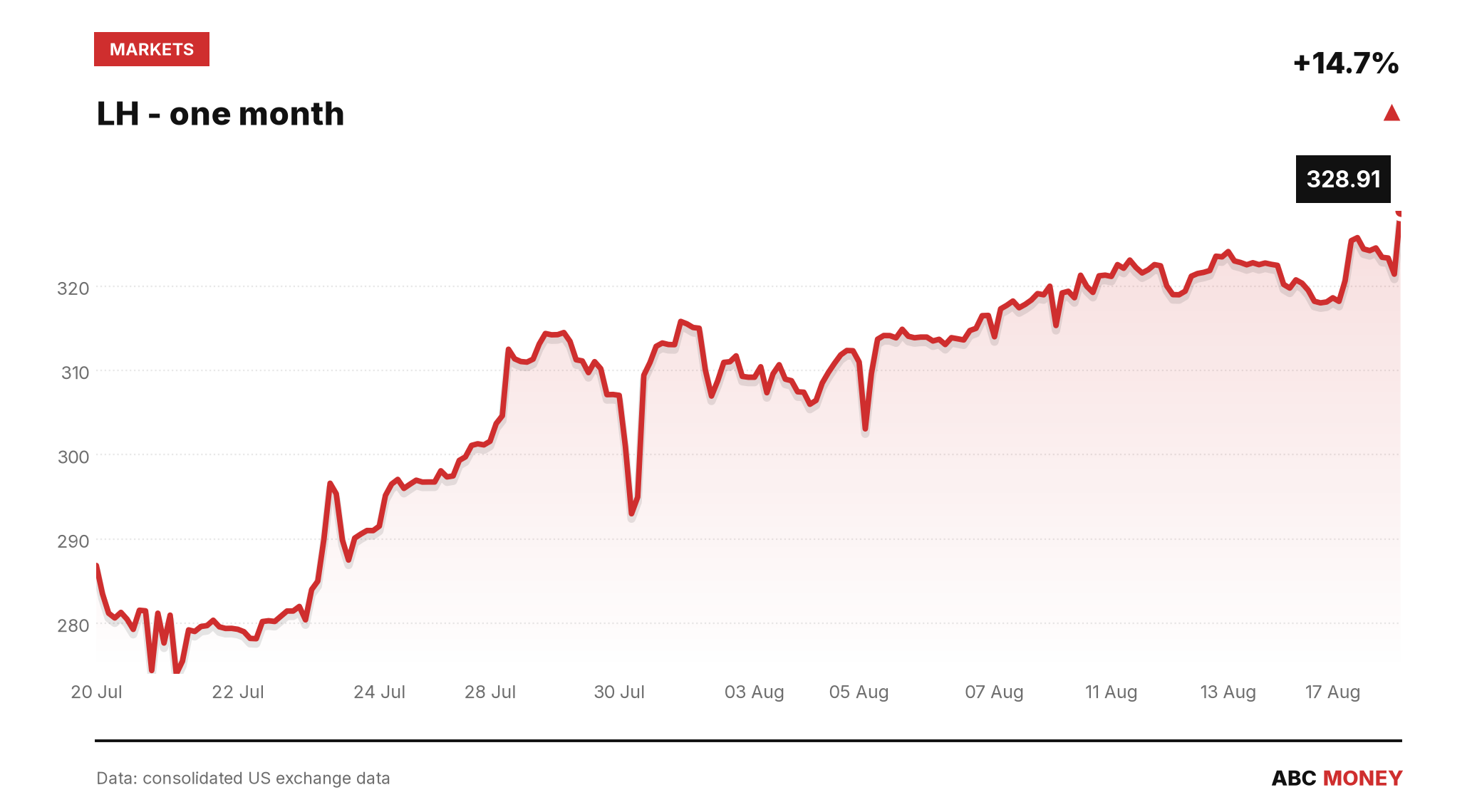
The shares themselves gave no hint that anything was pending. Labcorp last traded at $328.9063 as of 17 August, before the alliance was announced the following morning, up 0.97% on the day and 5.24% over the preceding 20 trading days, according to consolidated exchange data. Short-selling activity – the share of daily volume attributable to bets that the stock will fall – was similarly unremarkable, with FINRA’s short-volume ratio at 0.492 on 17 August, sitting squarely within the 0.485-to-0.536 range seen through most of the prior fortnight, aside from a brief spike above 0.7 in late July that had already faded. There is no sign in the trading data that anyone was positioning ahead of the news, which is consistent with an announcement of this kind: strategically sensible, operationally meaningful for the health centres involved, but not the sort of disclosure that moves a large-cap diagnostics stock.
What the alliance is meant to achieve
For NACHC’s member centres, the practical value lies less in headline figures and more in capacity-building: chief medical officers at community health centres are often stretched across clinical, administrative and quality-improvement duties simultaneously, and a structured leadership programme backed by a national diagnostics network gives them a resource many smaller centres could not otherwise access. The data-sharing element – using de-identified results to flag care gaps – could, if it works as described, help centres identify patients who have missed screenings or follow-up tests without Labcorp handing over anything that would raise privacy concerns.
Whether the alliance produces measurable results, in the form of improved screening rates or leadership retention at health centres, will only become clear over the coming quarters, and neither organisation has attached specific targets or a public timeline to those outcomes. What is documented, for now, is the scope of the commitment and the network it covers – 1,526 health centres, 52.3 million patients – alongside a company whose underlying lab-testing business has kept expanding revenue and earnings every quarter through the period the deal was struck.
This article is for information only and is not investment advice or a recommendation to buy or sell any asset. Markets move quickly; figures are correct as sourced at the time of writing. Always do your own research before making financial decisions.



 Bitcoin
  Ethereum
  Tether
  BNB
BNB  USDC
USDC  XRP
XRP  Solana
  TRON
TRON  Lido Staked Ether
  Cardano
  Gram (prev. Toncoin)
  Avalanche