
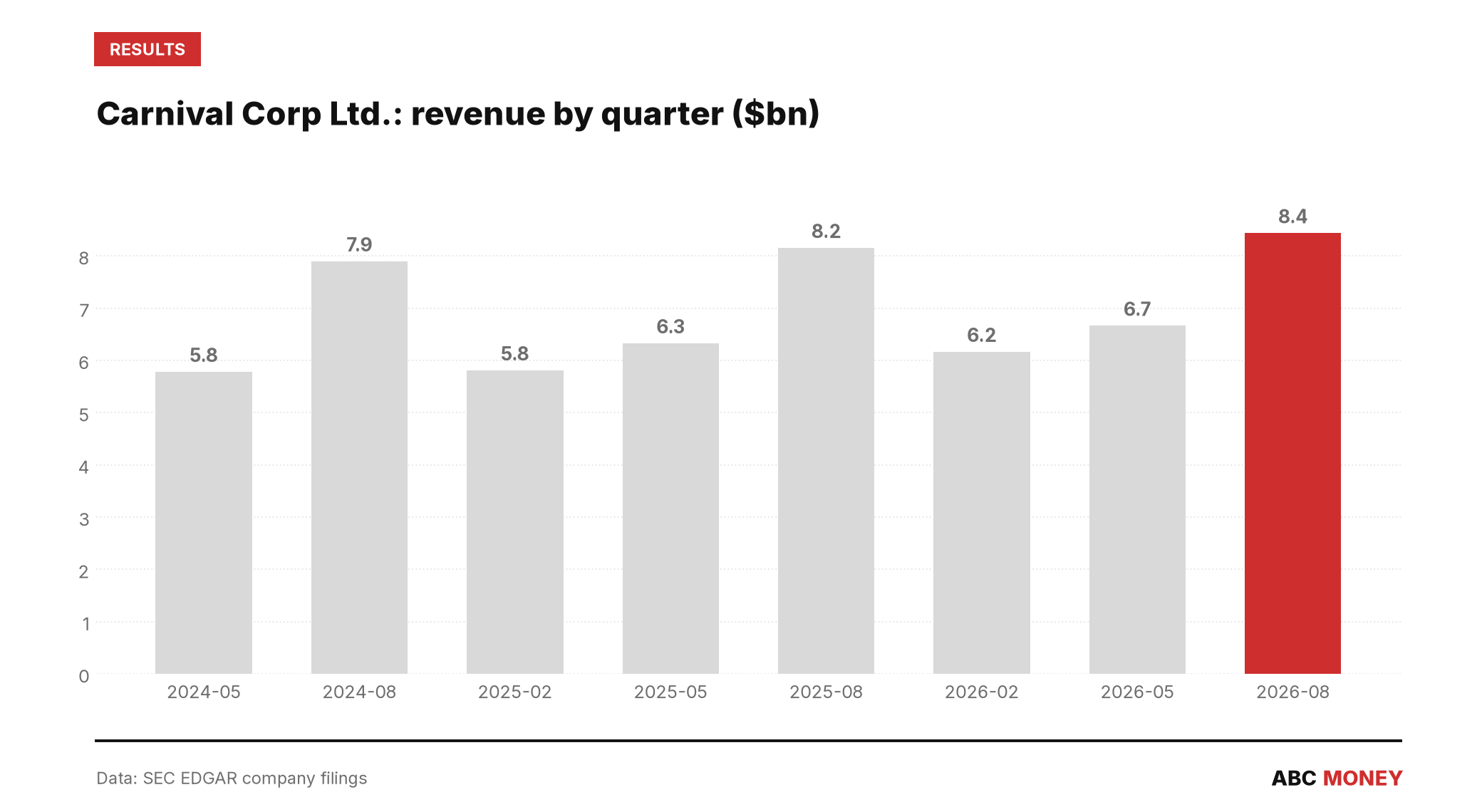
Carnival’s third-quarter results did what the previous two quarters of 2026 had already done: beat the company’s own guidance and set fresh records, this time with net income of $1.92bn for the three months to 31 August, up from $1.852bn a year earlier. Diluted earnings per share rose to $1.40 from $1.33, and revenue climbed to $8.435bn from $8.153bn – a 3.5% year-on-year gain, according to the 10-Q filed with the SEC on 29 September.
On a non-GAAP basis, earnings per share came in at $1.43, eight cents ahead of what analysts had pencilled in, while revenue beat forecasts by around $40m, according to GuruFocus. That is the pattern investors have come to expect from Carnival (NYSE: CCL) this year: guide conservatively, then clear the bar by a comfortable margin.
How Carnival absorbed a fuel-price spike
The more interesting number sits underneath the headline beat. Carnival told investors it had delivered more than $150m of operational improvement since its June guidance – enough, management said, to offset a jump in fuel prices that would otherwise have eaten into the quarter’s margins, as reported by Cruise Maven. That is cost discipline doing the work that pricing power usually gets the credit for, and it matters because fuel is one of the few big line items a cruise operator cannot fully control.
Pricing power was there too. Net yields – revenue per available berth per day, the industry’s preferred measure of how much a cruise line is extracting from each cabin – rose in the quarter, and the company lifted its yield expectation for the fourth quarter as a result. Full-year guidance for net yield growth sits at roughly 2.3%, per GuruFocus, itself a level management previously called a record for the year. Following the beat, Carnival also raised its full-year earnings guidance, GuruFocus reported, though the company did not specify the new figure on the call.
A third consecutive record, not a one-off
This is where the quarter becomes a trend rather than an event. Carnival’s first-quarter release already carried “record” language for net yields, and the second quarter repeated it, with customer deposits hitting an all-time high. Q3 extends that run: customer deposits were up nearly 7% year-on-year even as capacity – the number of berths available to sell – stayed roughly flat, according to Cruise Maven. That is a business selling more expensive holidays to the same-sized fleet, which is precisely the algebra that turns modest revenue growth into outsized profit growth.
Carnival has also been returning cash. Year-to-date share buybacks total approximately $1.2bn, per Cruise Maven – a reminder that the company, which loaded up on debt during the pandemic shutdown, now has enough spare cash flow to shrink its share count as well as pay down leverage.
The booking curve stretches into 2028
Management’s forward commentary leaned on advance bookings. The company described 2027 as already carrying record occupancy and pricing, with early demand for 2028 sailings also running ahead of prior years on both measures, Cruise Maven reported. Carnival did not disclose an exact percentage booked for 2027 on the record, so that detail is worth treating as directional rather than precise. The company’s destination strategy – anchored by its Celebration Key private island – was cited on the call as a driver of that demand, though the specific contribution has not been independently broken out.
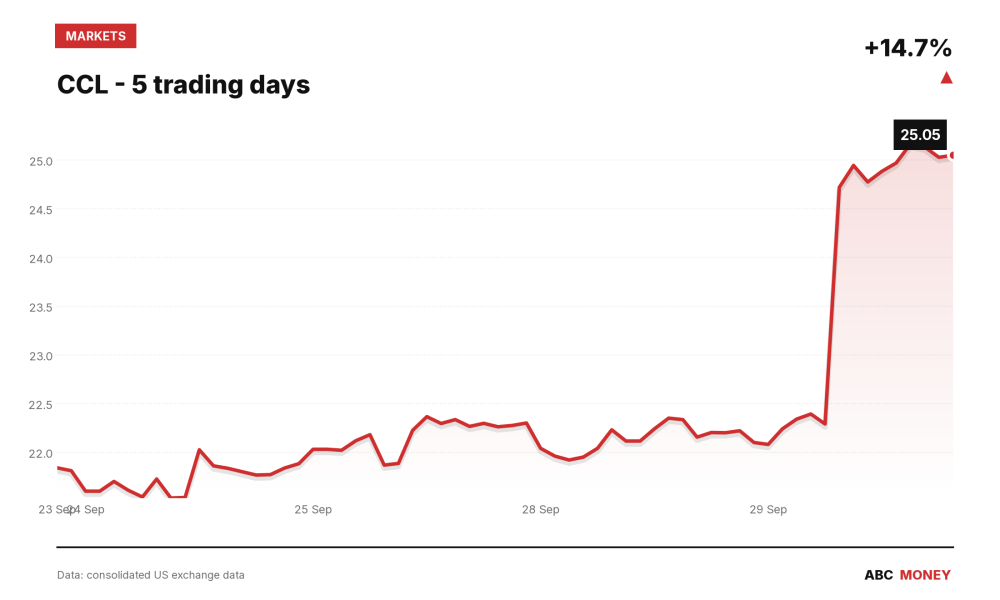
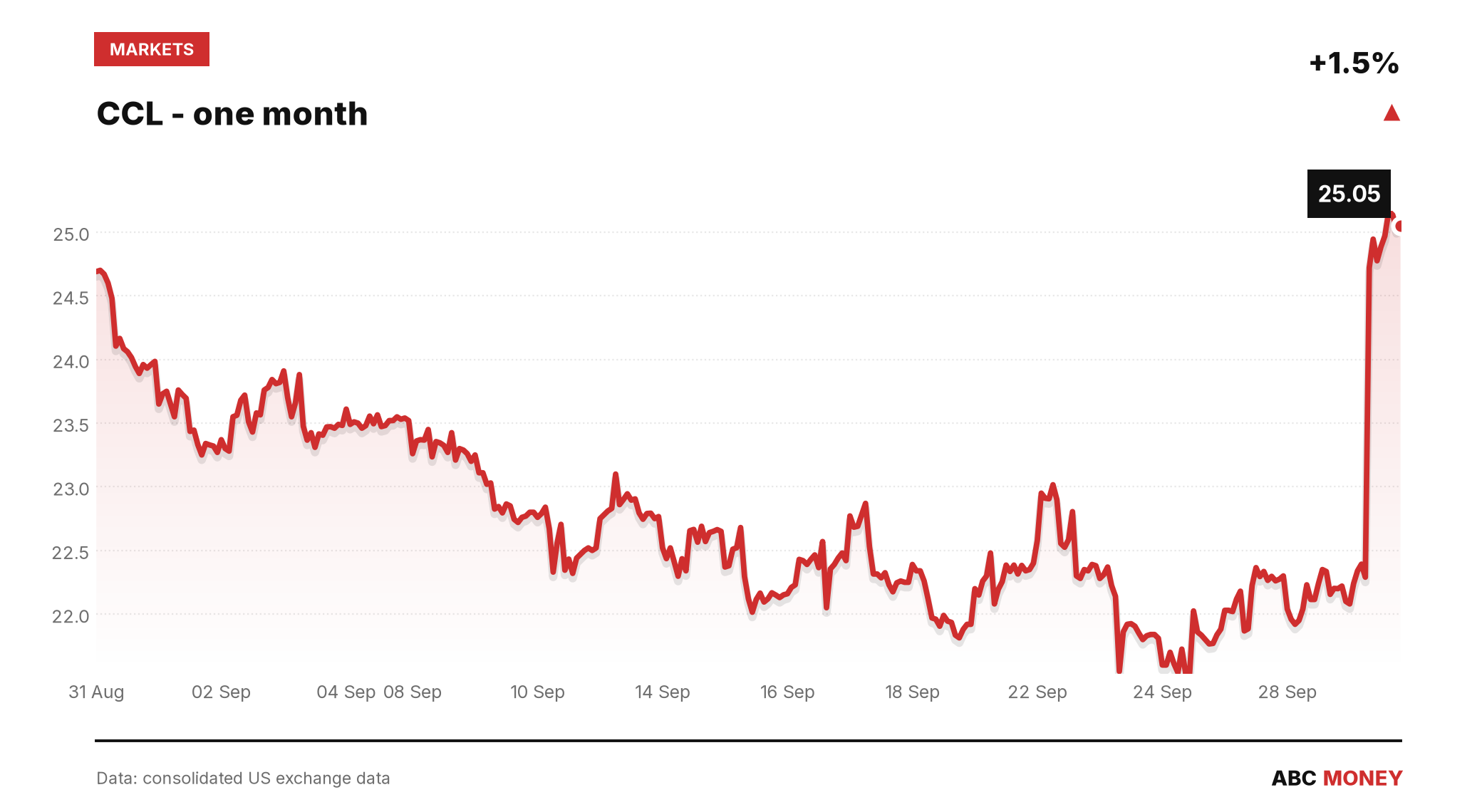
Shares closed at $25.04, up 0.39% on the day and 7.7% over the preceding 20 trading sessions, with volume running at roughly 3.7 times the 20-day average – a sign the print drew unusually heavy trading interest even by earnings-day standards. The stock traded within a fairly tight recent range, between $21.53 and $25.17 over the past month.
What the positioning data shows
There is no sign this was a short-squeeze story. FINRA’s daily short-sale ratio – the share of trading volume attributable to short sales, where a higher number signals more bearish positioning – moved between roughly 0.36 and 0.56 in the fortnight before the results, a range that is unremarkable by the standard of a stock this heavily traded, according to FINRA data. The rally, in other words, looks like a repricing on fundamentals rather than a squeeze on crowded bearish bets.
The macro backdrop has also been cooperative. US unemployment held at 4.1% in August, unchanged from July, according to Federal Reserve data – a steady labour market that continues to underpin the discretionary spending cruise lines depend on. The real test now is whether Carnival’s booking curve into 2027 and 2028 can keep outrunning capacity additions across the industry, or whether four straight quarters of record yields eventually meet their natural ceiling. Carnival’s next scheduled update, the fourth-quarter release, will show whether the raised yield outlook it gave analysts this week holds up.
This article is for information only and is not investment advice or a recommendation to buy or sell any asset. Markets move quickly; figures are correct as sourced at the time of writing. Always do your own research before making financial decisions.


 Bitcoin
  Ethereum
  Tether
  BNB
BNB  USDC
USDC  XRP
XRP  Solana
  TRON
TRON  Lido Staked Ether
  Cardano
  Gram (prev. Toncoin)
  Avalanche