Copper tariff ‘stall’ claim outruns the paper trail
Reuters says the White House copper tariff plan has stalled over affordability. The filings show a narrower, already-overdue story.
In this article 3 sections
The White House’s copper tariff plan has stalled amid concerns about the cost to consumers, Reuters reported on 10 September, citing people it did not name. Copper mining stocks and funds fell within hours of the story landing. Whether the underlying claim is quite what it says on the tin is a separate question – and the answer is more interesting than the headline.
What is not in dispute is the mechanism. The administration has spent more than a year building a tariff wall around copper. A July 2025 presidential proclamation first added the metal to the national-security tariff programme, with duties on semi-finished and derivative copper products taking effect that August. In April 2026 the White House tightened the screw further, setting a flat 50% tariff on articles made almost entirely of copper, steel or aluminium and 25% on derivative goods, according to a White House fact sheet and a Congressional Research Service brief.
The gap in the copper tariff plan Reuters didn’t fill
What the administration has never done is tariff refined copper itself – the cathodes and anodes that most US manufacturers actually buy, as opposed to the semi-finished products already covered. That decision was explicitly left open, pending a Commerce Department market review originally due by 30 June 2026, with a proposed phased approach of 15% in 2027 rising to 30% in 2028 floated as one option, per the same CRS research. As of a Bloomberg report from 3 June, the administration was still tweaking qualification rules for copper tariffs ahead of that review – meaning the refined-metal decision was already unresolved months before Reuters’ September story, not freshly derailed by it.
That matters for how readers should weigh the “stalled amid affordability concerns” framing. Reuters’ reporting rests on unnamed sources, and Benzinga’s write-up of the same day is a direct republication of the Reuters exclusive rather than independent confirmation. No Federal Register notice, White House statement or second outlet has yet put a name or a date to the “stall,” and the fact that a deadline which was already ten weeks overdue slipped further is, on its own, unremarkable – this administration has repeatedly revised and re-revised its copper tariff timetable over the past year. The novel claim – that affordability concerns specifically are now the brake – is the one part of the story resting entirely on that single sourcing.
Traders moved first, questions second
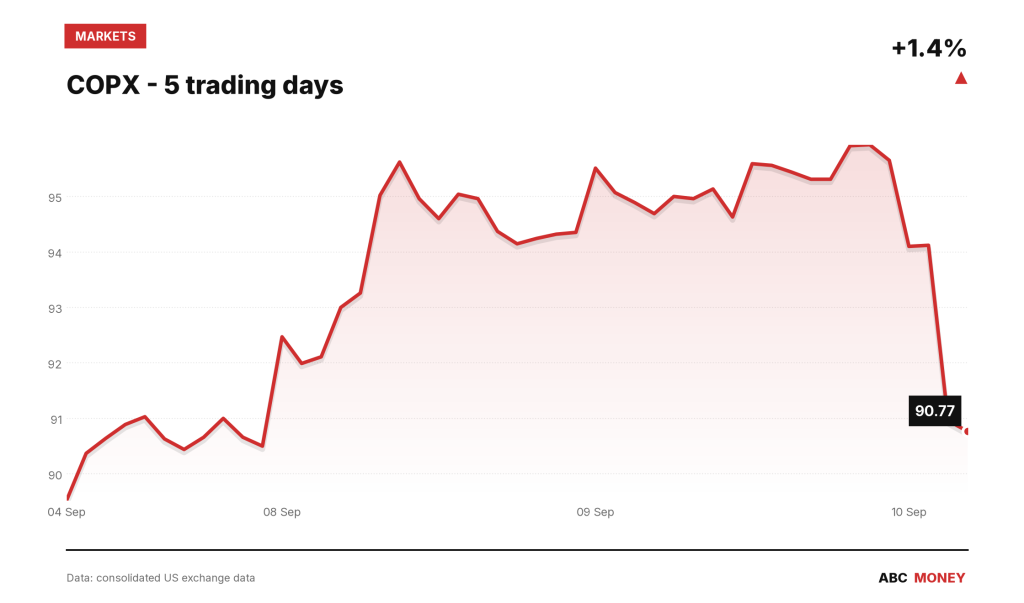
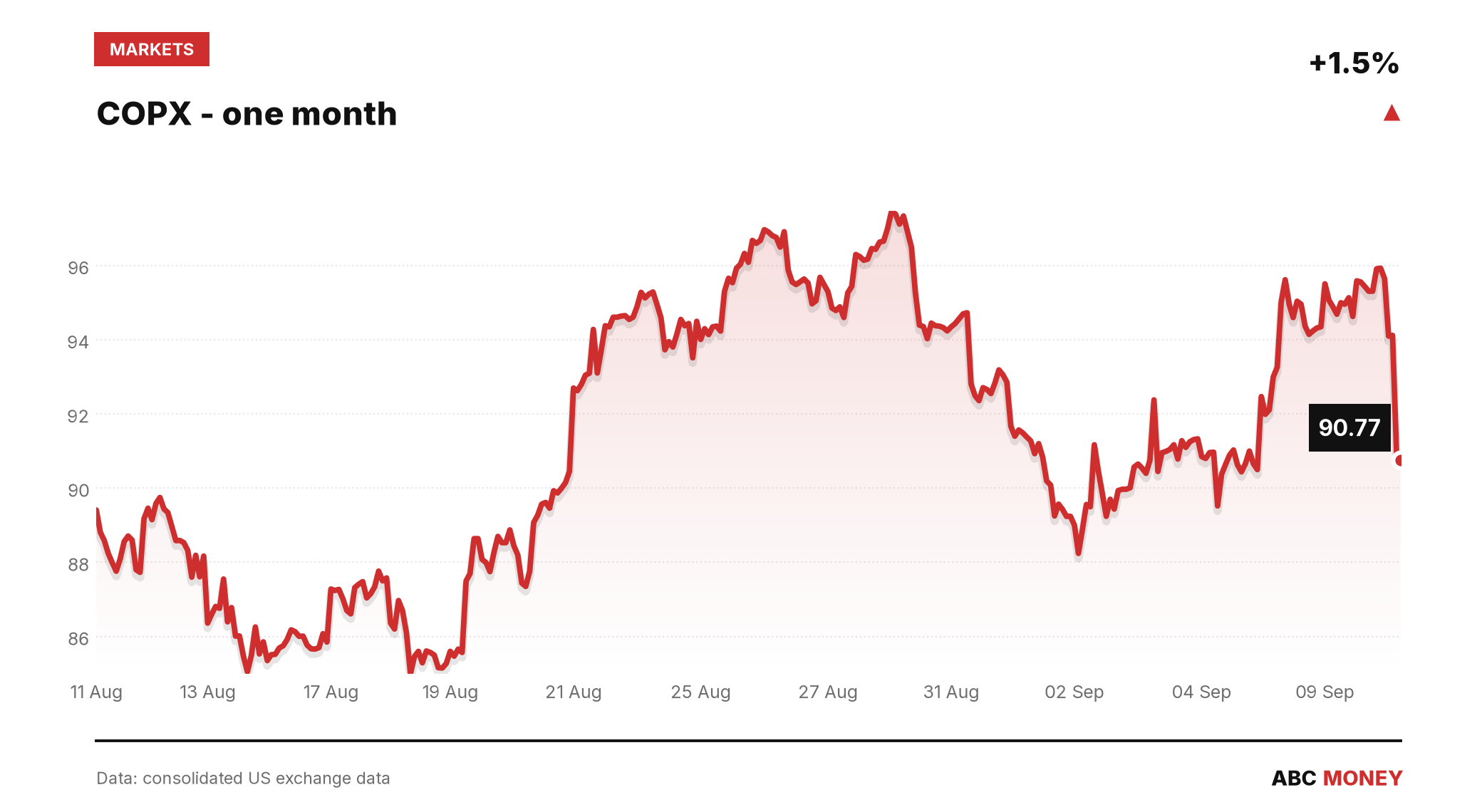
None of that stopped the market from treating the report as market-moving. The Global X Copper Miners ETF (COPX), a fund tracking listed copper producers, closed 4.68% lower on the day, having traded as high as $97.47 and as low as $87.35 over the prior 20 sessions before settling at $90.85. Trading volume ran well below its recent average, suggesting the move was driven by a relatively contained set of sellers rather than a broad rotation out of the sector.
There were hints of positioning building beforehand. FINRA’s daily short-sale data – which tracks the share of trading volume executed by sellers betting on further declines – shows COPX’s short-sale ratio climbing from 0.277 on 2 September to 0.67 on 8 September, a ten-day high reached just two days before the Reuters story broke. That does not prove anyone had advance knowledge of the report; short-sale ratios move for all sorts of reasons, including simple hedging around a metal that has been jumpy on tariff headlines all year. But it is a reminder that copper-linked names were already seeing more bearish flow before the news broke, not purely after it.
Producers with direct exposure to the outcome include Freeport-McMoRan (NYSE: FCX), one of the largest listed copper miners with meaningful US refining exposure, and Ero Copper (TSX: ERO), a mid-cap producer more levered to the metal’s price than to any single tariff line. Neither has commented publicly on the Reuters report.
What would actually settle this
The definitive answer is not a leak but a document: a Federal Register proclamation or a fresh White House fact sheet specifically addressing refined-copper duties, following on from the one issued in June that updated the broader steel, aluminium and copper tariff regime. Until that appears, the refined-copper decision remains exactly where the Commerce Department left it months ago – overdue, unresolved, and now the subject of a report that may be right about the destination even if its stated reason for the delay cannot yet be independently checked. Markets, for their part, are not waiting for the paperwork.
This article is for information only and is not investment advice or a recommendation to buy or sell any asset. Markets move quickly; figures are correct as sourced at the time of writing. Always do your own research before making financial decisions.