
A Ford F-150 supplier disruption at two US plants will show up in the company’s third-quarter wholesale figures, chief executive Jim Farley said on 30 September, even as he insisted the underlying parts shortage has already been put right. It is the second time in under a year that Ford’s best-selling vehicle has been knocked off the assembly line by a supplier failure, and it lands just as F-Series sales are already running well behind last year’s pace.
Farley told Reuters, in comments carried across outlets including US News and the Detroit News, that a parts shortage had forced Ford to halt F-150 production at both the Dearborn Truck Plant in Michigan and the Kansas City Assembly Plant. “We are back up and running,” he said, according to Reuters’ account carried by the Detroit News, adding that he remained “very optimistic” about the outlook once the lost volume is made up.
The stoppage was significant enough on the shop floor that UAW Region 1A director Mark DePaoli said roughly 3,500 to 4,000 Dearborn workers were sent home while the line was down, according to CBT News, which also reported that the new shortage is understood to be unrelated to Ford’s earlier aluminium supply crisis.
A second supply-chain blow in under a year
That distinction matters, because Ford is still climbing out of the last one. A pair of fires in late 2025 at aluminium supplier Novelis’ Oswego, New York plant forced production cuts across Ford’s truck and SUV range and, by the company’s own estimate at the time, threatened to cut 2025 adjusted profit by as much as $2bn, according to Detroit News reporting on the episode. Ford spent an estimated $1.5bn-$2bn sourcing alternative aluminium overseas during that outage and had planned to build more than 50,000 extra F-Series trucks simply to claw back the volume it lost, per CBT News. Farley said Ford has now “fully recovered” from the Novelis disruption, per the same Reuters comments reported by US News — which makes this second, unrelated parts shortage a fresh setback rather than an aftershock of the first.
The timing is unforgiving. F-Series sales were already down 11% year-on-year through August, Reuters reported via US News, before this latest plant stoppage even lands in the Q3 wholesale count Ford reports to dealers and, eventually, to investors. Wholesale figures — the units Ford ships to dealers, as distinct from retail sales to drivers — are the number analysts watch most closely for signs of production health, and a shortfall there would flow straight through to the revenue Ford recognises in the quarter.
Shares already marked down before the numbers land
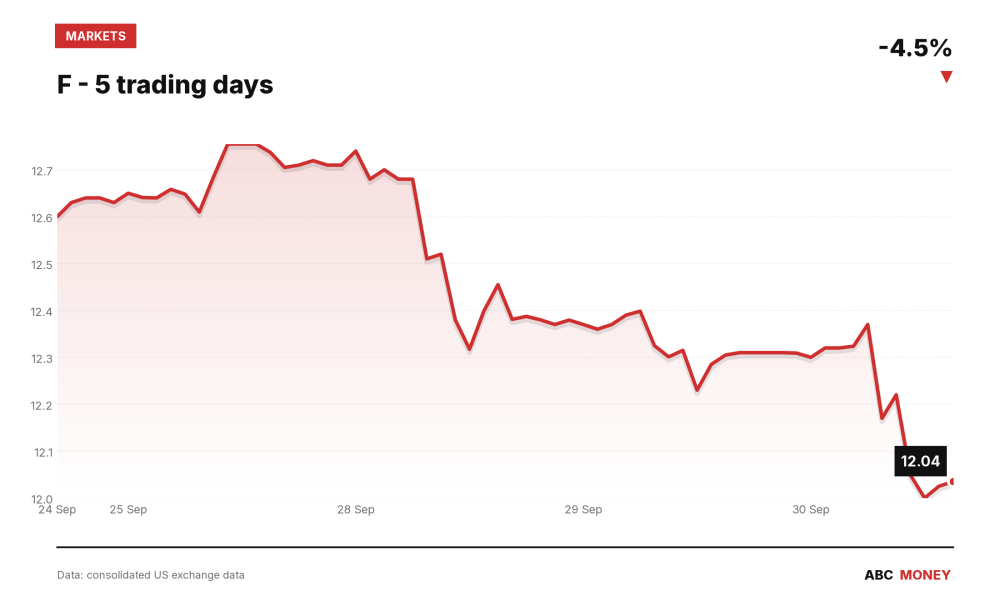
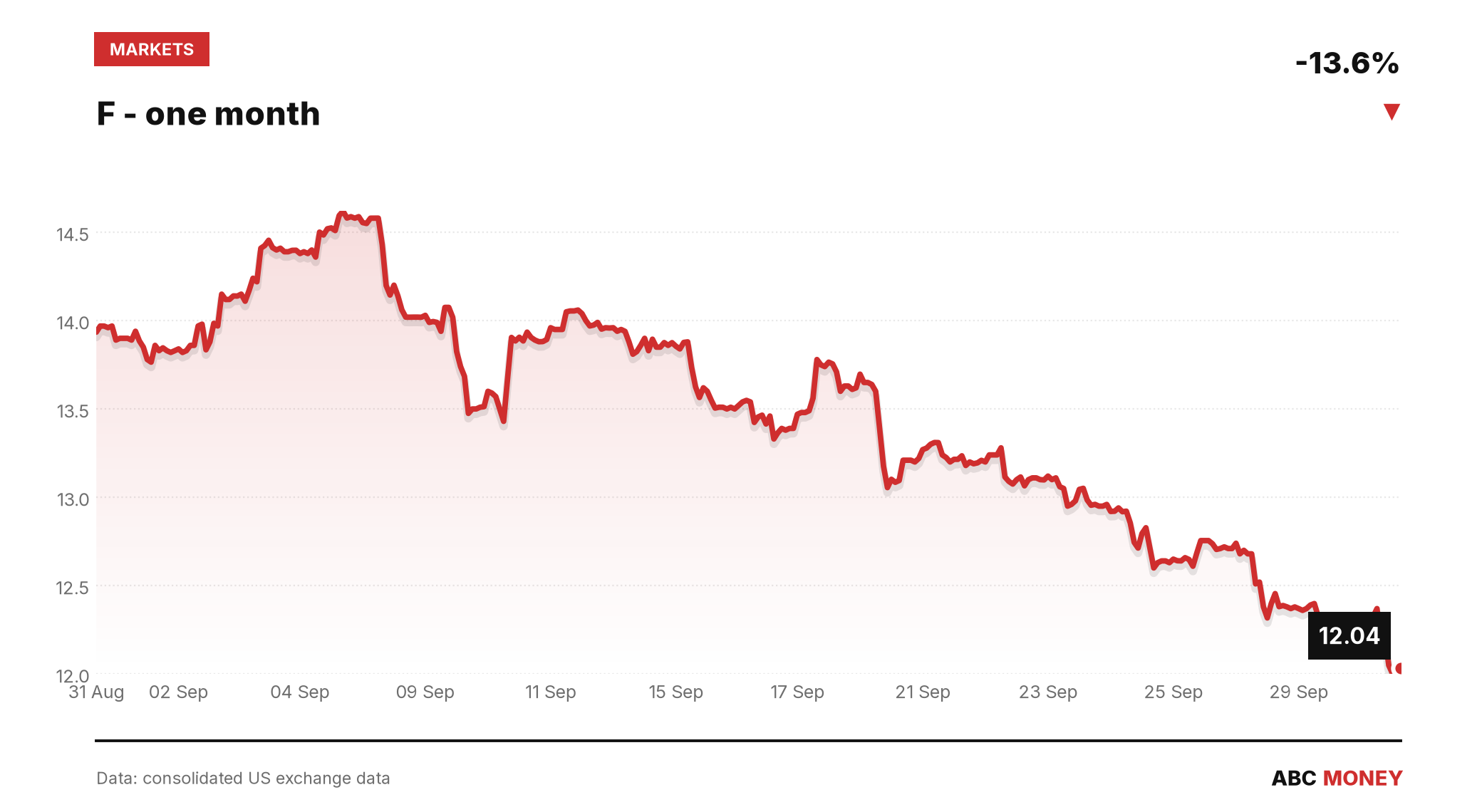
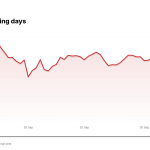
Ford (NYSE: F) shares fell 2.5% on the day of Farley’s comments to close at $12.015, extending a 10.8% slide over the prior 20 trading days and putting the stock within a whisker of its 20-day low of $12.00, against a high over the same stretch of $14.06, according to consolidated exchange data. Trading volume ran about 10% above its 20-day average, suggesting the move was not a thin-market fluke. The decline was compounded the same day by a National Highway Traffic Safety Administration recall covering 41,748 vehicles over defective exterior lighting, as reported by Benzinga — two separate pieces of bad news landing on the same tape.
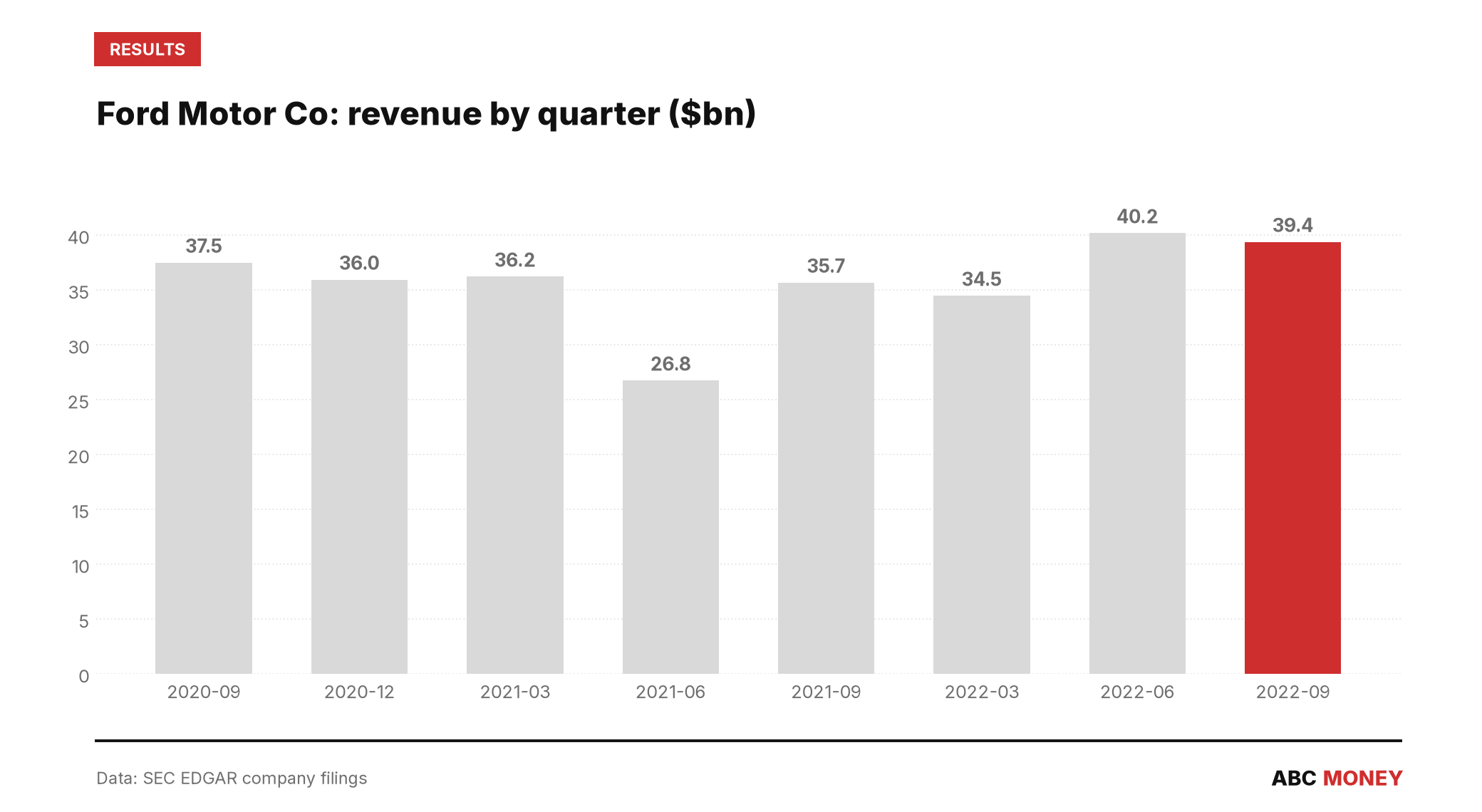
Ford’s own quarterly filings underline how thin the buffer is for absorbing another production hit. The company posted a net loss of $36m in the second quarter of 2025, its weakest result in the recent run of figures disclosed to the Securities and Exchange Commission, a marked deterioration from the roughly $1.3bn-$1.9bn quarterly profits Ford was posting through 2023 and early 2024. Third-quarter 2026 results have not yet been filed, so the precise wholesale and earnings impact of this latest disruption will only become clear when Ford next reports.
A tougher backdrop for truck buyers
The disruption also arrives as financing costs for big-ticket vehicles have been drifting higher rather than lower. The 10-year US Treasury yield, which auto loan rates broadly track, stood at 5.24% as of 28 September, up from 5.17% a week earlier, according to Federal Reserve data. For a truck line already losing ground on sales, a firmer rate backdrop makes the arithmetic of recovering lost volume through discounting or incentives that much less forgiving.
Farley’s assurance that the parts issue is fixed will be tested by the numbers themselves. Ford’s next quarterly filing will show whether “back up and running” was enough to keep Q3 wholesale volumes from sliding further, or whether the F-150’s run of supplier trouble has started to show up in the figures that matter to shareholders rather than just the headlines.
This article is for information only and is not investment advice or a recommendation to buy or sell any asset. Markets move quickly; figures are correct as sourced at the time of writing. Always do your own research before making financial decisions.

 Bitcoin
  Ethereum
  Tether
  BNB
BNB  USDC
USDC  XRP
XRP  Solana
  TRON
TRON  Lido Staked Ether
  Cardano
  Gram (prev. Toncoin)
  Avalanche