
The GlobalFoundries Marvell chip deal, unveiled on 17 September 2026, ties fresh manufacturing capacity at a Vermont chip plant to one of the least glamorous but fastest-growing corners of the artificial intelligence build-out: the optical components that shuttle data between racks of AI processors.
GlobalFoundries (GFS) and Marvell Technology (MRVL) said they have expanded their existing collaboration through a multi-year strategic agreement that increases capacity for high-performance silicon germanium, or SiGe, technology at GF’s Burlington, Vermont facility. SiGe chips are prized for their ability to handle high-frequency signals efficiently, which makes them a core building block for the optical transceivers, Near-Packaged Optics and Co-Packaged Optics that AI data centres need to move enormous volumes of data without melting their power budgets.
What the GlobalFoundries Marvell chip deal actually covers
The two companies frame the expansion as building on production they already run together, rather than a wholly new venture. Independent pickups of the release corroborated the same core details – the facility, the technology, and the purpose – without adding contradictory information, and Reuters characterised it similarly as a capacity expansion aimed squarely at AI data-centre connectivity.
What neither company disclosed is a number. There is no contract value, no capacity figure in wafers or units, and no timeline beyond “multi-year.” That is a meaningful omission for readers trying to size the deal, and it stands in contrast with how GlobalFoundries has handled comparable announcements before. In 2022, the company extended a long-term supply agreement with Qualcomm that it explicitly described as running into the billions of dollars and securing capacity through 2028, details it filed with regulators at the time. No equivalent figure accompanies this Marvell expansion, so any characterisation of it as a “mega-deal” would be reading more into the announcement than the companies have put on the record.
A quiet share reaction, and some odd timing
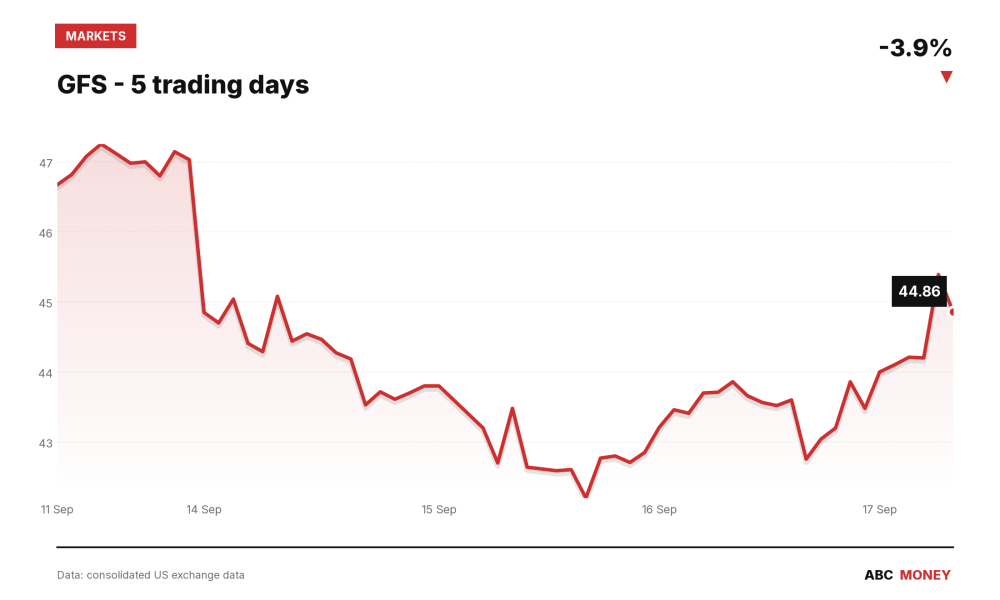
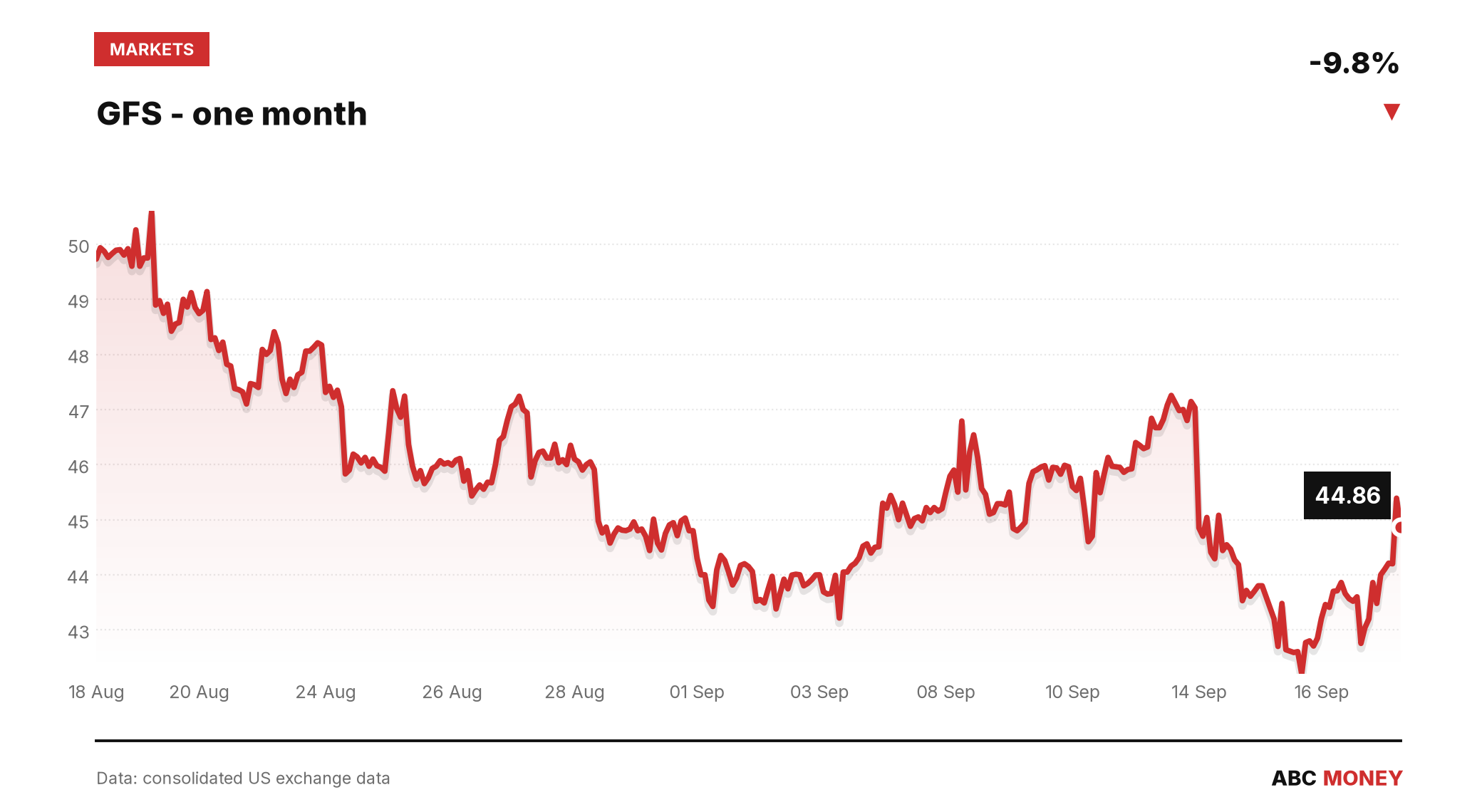
GlobalFoundries shares were trading at $45.25 as of the announcement window, up 3.17% on the day, though still down 1.77% over the preceding 20 trading sessions and shy of their 20-day high of $47.255. Trading volume in that window ran at only about 16% of the stock’s 20-day average, a curiously muted response for news billed as material – though single-session snapshots can understate a move that built as the day went on. At least one market-commentary newsletter later put the day’s close 7.7% higher, attributing the gain to the SiGe capacity news, a figure this outlet cannot independently confirm from exchange data.
Two details in the run-up to the announcement are worth noting, without reading too much into either. The share of GlobalFoundries’ trading volume made up of short sales – bets that the stock would fall, tracked daily by FINRA – jumped to 0.463 on 16 September, the session before the news broke, up from 0.274 the day before and well above the roughly 0.15-0.30 range seen through most of early September. Separately, SEC filings show two Form 4s – the disclosures company insiders must lodge when they buy or sell shares – were filed for Marvell on 16 September, the same day. The filings available don’t name the individuals involved or state the size of the transactions, so there is no basis to conclude they relate to the announcement at all; regulatory filings of this kind happen routinely and for many unrelated reasons.
Why the connectivity bottleneck matters to both companies
The strategic logic is easier to pin down than the numbers. Marvell has been telling investors that interconnect – getting data in and out of AI chips fast enough – is shaping up as one of the industry’s next major growth pinch points, a theme echoed in the company’s recent public commentary on AI infrastructure demand. Optical connectivity, rather than copper wiring, is increasingly seen as the only practical way to link processors across the distances involved in modern AI clusters, and SiGe components sit at the heart of that shift.
For GlobalFoundries, the deal reinforces Burlington’s role as a specialist site for exactly this kind of analogue and radio-frequency chip work, distinct from the leading-edge digital logic fabs that dominate headlines about AI chip manufacturing. Winning repeat, expanding business from a large fabless customer like Marvell is the kind of steady, capacity-utilisation story that GlobalFoundries has leaned on before, even if this particular announcement arrives lighter on hard numbers than its predecessors.
Neither company has indicated when, or whether, more specific figures – capacity volumes, spending commitments, or a completion date for the Vermont expansion – might follow. Investors weighing the announcement have, for now, only the strategic rationale to go on.
This article is for information only and is not investment advice or a recommendation to buy or sell any asset. Markets move quickly; figures are correct as sourced at the time of writing. Always do your own research before making financial decisions.


 Bitcoin
  Ethereum
  Tether
  BNB
BNB  USDC
USDC  XRP
XRP  Solana
  TRON
TRON  Lido Staked Ether
  Cardano
  Gram (prev. Toncoin)
  Avalanche