Kroger guidance cut overshadows a tidy profit beat
Kroger's Q2 profit beat estimates, but a Kroger guidance cut on comparable sales is the number investors are actually digesting.
In this article 4 sections
The Kroger Co (NYSE: KR) delivered exactly the kind of quarter that makes a share price wobble both ways in one morning: profit ahead of what the market wanted, and a Kroger guidance cut on the sales line that tells a less flattering story about how it got there.
For the second quarter of its 2026 financial year, ended 15 August, Kroger reported operating profit of $971 million and diluted earnings per share of $1.05. Strip out one-off items and the adjusted figures – the ones analysts tend to focus on – were $1,076 million of adjusted FIFO operating profit (FIFO, or first-in-first-out, is the standard grocery-industry way of valuing inventory before fuel and other swings distort it) and adjusted EPS of $1.09. Net earnings attributable to Kroger came to $641 million, up from $609 million, or $0.91 a share, in the same quarter last year, a comparison confirmed in Kroger’s own prior-year quarterly filing.
The Kroger guidance cut that matters more than the beat

The number that will occupy analysts longer than the EPS line is what Kroger did to its full-year outlook for identical sales without fuel – essentially like-for-like sales at stores open at least a year, stripped of the noise from swinging petrol prices. The company halved that range to 0.2%-0.8%, down from the 1.0%-2.0% it had been guiding to. That is a meaningful downgrade of underlying grocery demand, not a rounding adjustment.
What makes it notable is what Kroger chose not to touch: full-year adjusted EPS guidance stayed put at $5.10 to $5.30. Put those two decisions together and the message is that margin discipline, cost control and faster-growing but lower-scale businesses are increasingly carrying the earnings line while the core grocery top line slows. The quarter’s own comparable-sales print, +0.2% without fuel, sat at the very bottom of the guidance range Kroger had been running with before Thursday – which is presumably why the range itself moved.
Where the growth actually showed up
The offsetting good news was concentrated in two smaller but faster-growing pieces of the business. Adjusted eCommerce sales grew 20% in the quarter, and profit at Kroger Precision Marketing – the retailer’s in-house advertising and data arm, which sells targeted ads to consumer-goods brands using Kroger’s shopper data – rose 24%. Both are higher-margin than the supermarket floor itself, and both are the kind of businesses Kroger has been leaning on to offset a grocery market where volume growth is scarce and price competition, particularly from discount and club formats, remains intense.
Capital returns kept rolling

Kroger also kept up an aggressive pace of buying back its own stock, repurchasing $1.0 billion of shares in the quarter and $1.2 billion so far this year under the $2 billion authorisation the board approved in December 2025, leaving roughly $800 million of that programme unspent. A share buyback reduces the number of shares outstanding, which mechanically supports EPS even when profit growth is flat – relevant context given how much of the earnings story this quarter rested on cost and mix rather than top-line momentum. The company’s dividend history added a footnote of its own: this marks Kroger’s 20th consecutive year of dividend increases, following an 11% raise announced earlier in the quarter.
How the market actually reacted
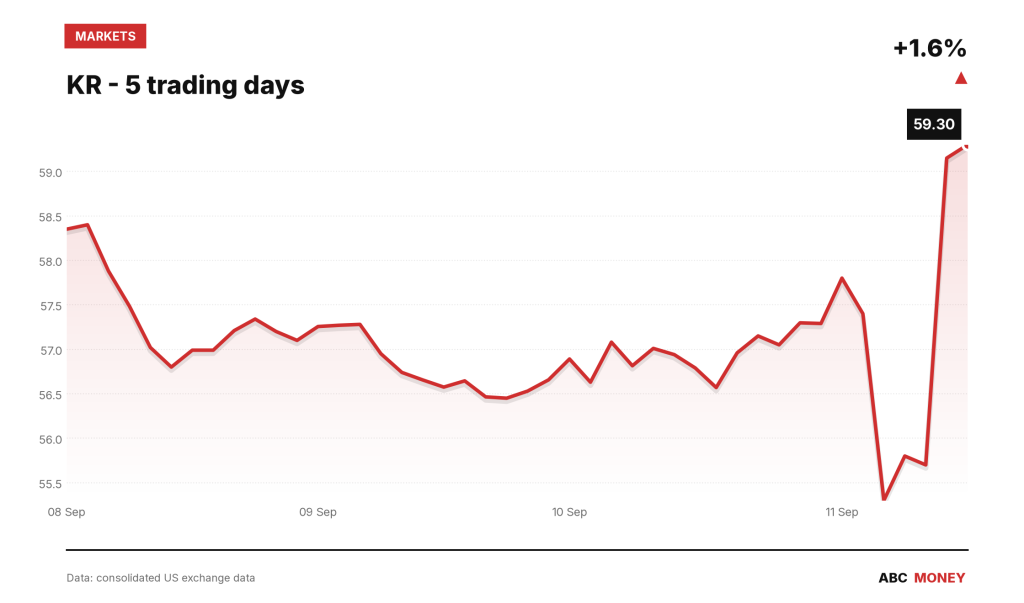
The stock’s initial reaction split the difference between the two headlines. Shares fell nearly 2% in premarket trading as the sales-guidance cut landed, before recovering through the session to close well into positive territory, up 3.63% on the day. That kind of reversal is not unusual when a profit beat and a demand downgrade arrive in the same release – traders often need the earnings call itself, where management can frame the shortfall, before deciding which number to believe.
Positioning ahead of the print leaned cautious rather than aggressive. FINRA’s daily short-sale data – a measure of the share of trading volume attributable to short sales, where investors borrow and sell stock betting the price will fall – showed KR’s ratio running between roughly 0.44 and 0.57 across the fortnight before results, a level consistent with routine hedging rather than a heavy bearish bet against the report.
The next test comes in how Kroger’s own comparable-sales trajectory tracks against that newly narrowed 0.2%-0.8% range through the rest of the fiscal year, and whether eCommerce and retail-media growth can keep expanding fast enough to offset a grocery floor that, for now, is barely growing at all.
This article is for information only and is not investment advice or a recommendation to buy or sell any asset. Markets move quickly; figures are correct as sourced at the time of writing. Always do your own research before making financial decisions.