
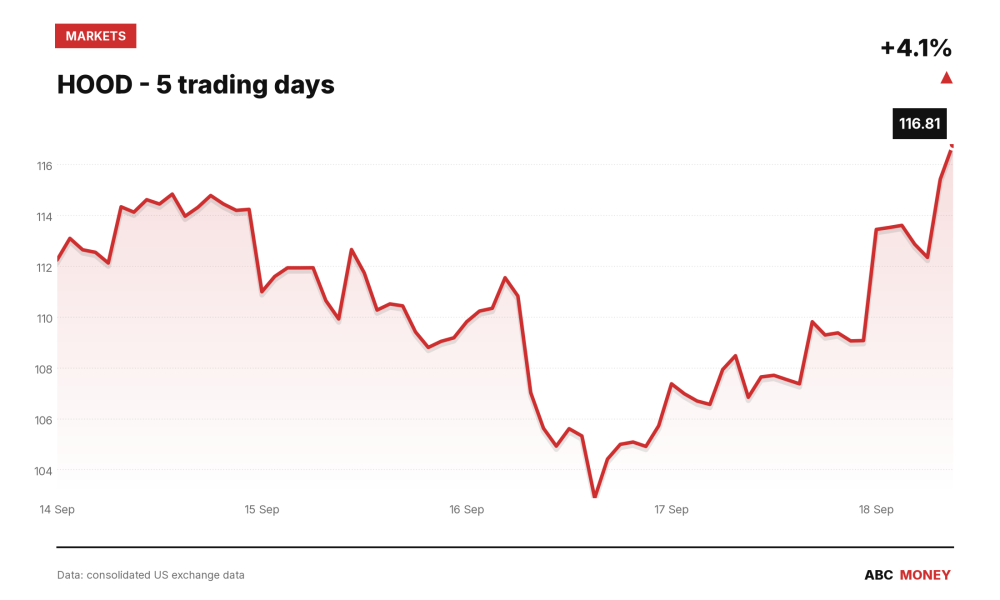
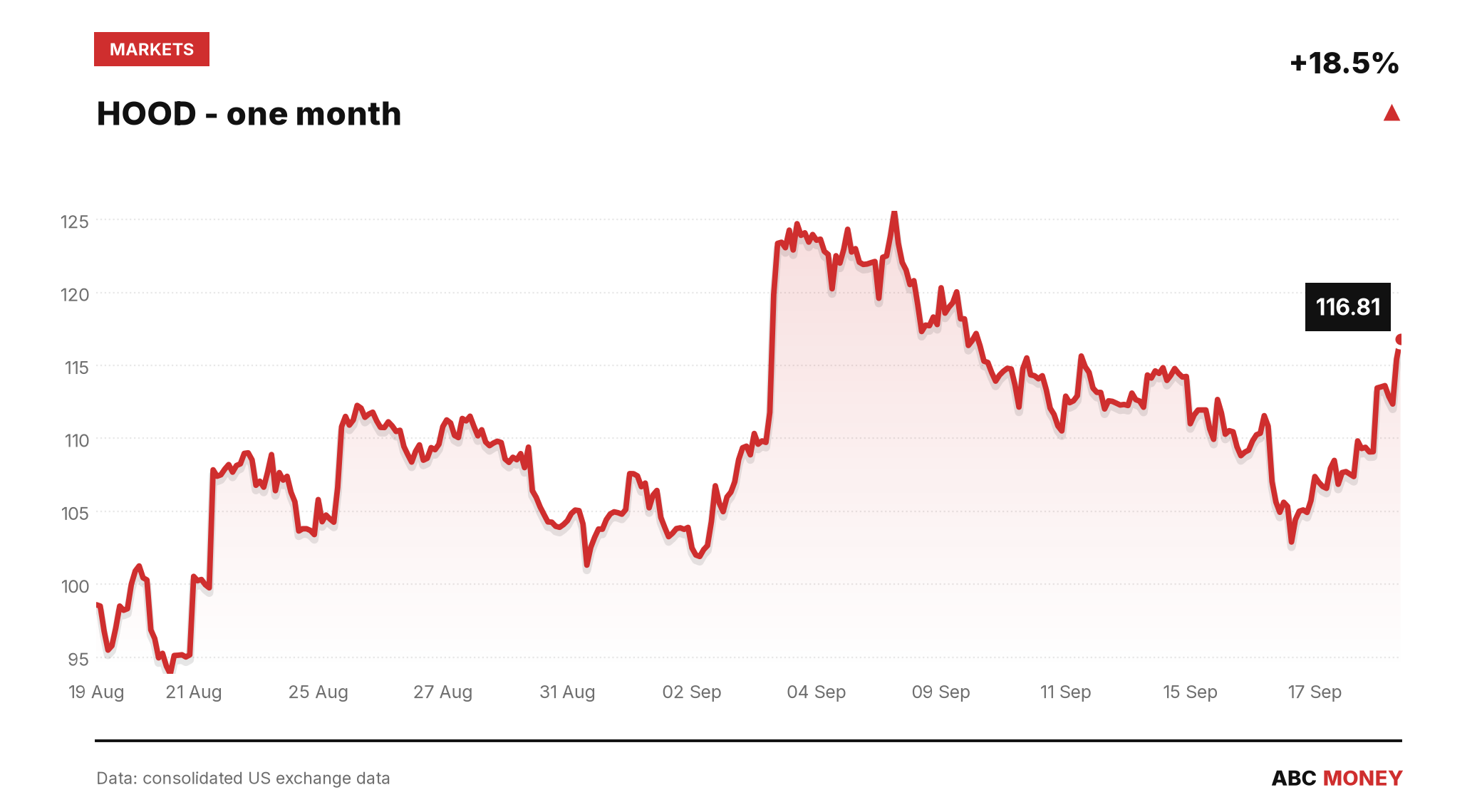
The US Securities and Exchange Commission’s new tokenized stocks exemption handed Robinhood Markets (HOOD) a concrete regulatory win on 17 September, and the market noticed: shares that had been drifting rose sharply on the news and kept climbing into the following session, closing at $116.29 by the afternoon of 18 September, up 6.61% on the day and 9.28% over the preceding 20 trading days, according to GuruFocus and consolidated exchange data.
What actually happened is more interesting than a share-price pop. The SEC issued what it calls an “Innovation Exemption” – press release 2026-90 – granting temporary, conditional relief from the Exchange Act’s definition of an “exchange” to platforms that want to trade tokenized versions of US-listed stocks through permissioned automated market-maker liquidity pools, a blockchain-native way of matching buyers and sellers without a traditional order book. It is the first time the regulator has built a formal, if time-limited, on-ramp for this kind of trading rather than pursuing enforcement or silence.
What the tokenized stocks exemption actually allows
The conditions matter as much as the headline. Tokens must carry the same economic and legal rights as the underlying share – dividends, voting, the lot – and the SEC has explicitly barred “synthetic” tokens that merely track a stock’s price without conferring ownership. Crucially, the company whose shares are being tokenized gets a 30-day window to object and block the process, a provision confirmed independently by both American Banker and CNBC. That opt-out did not appear by accident: it follows a public spat between Robinhood chief executive Vlad Tenev and sceptical corporate executives, including AMC’s chief executive, over whether a brokerage should be able to put a company’s stock on-chain without its say-so.
Tenev welcomed the decision on social media the same day, calling it “a good day for US innovation,” as reported by TradingView/Benzinga. The enthusiasm is not new: Robinhood had already been building tokenized-equity infrastructure abroad, expanding its Arbitrum-based Robinhood Chain in July to support round-the-clock stock-token trading and lending outside the US.
Five years, not a permanent green light
Both headline reports on the story undersell one detail: this is not a durable legalisation of tokenized securities trading. The exemption expires five years after publication and is open for public comment, with SEC officials describing it as a bridge toward formal rulemaking rather than a settled answer, according to Decrypt. The timing is also pointed: the exemption landed two days after the crypto market-structure CLARITY Act stalled in the Senate, and the regulator framed the move as using existing statutory authority rather than waiting for Congress to act.
That framing matters for anyone trying to size the opportunity. A five-year conditional pilot, subject to comment and reversible by rulemaking, is a very different asset than a permanent legal foundation – and the issuer opt-out means the biggest fights over tokenization may now play out company by company, in boardrooms, rather than in Washington.
The numbers behind Robinhood’s run
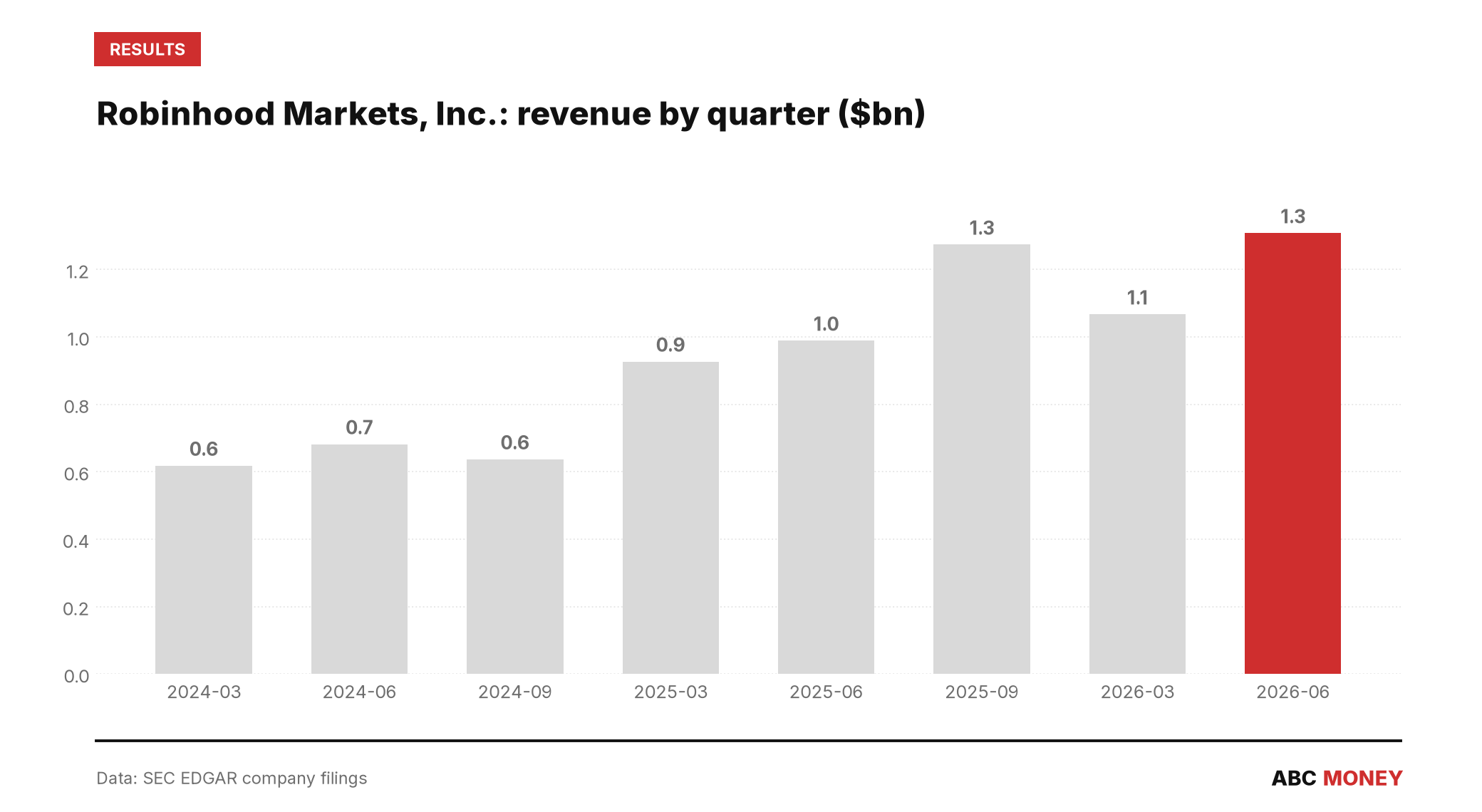
The regulatory tailwind arrives on top of a business that has been re-rating on its own fundamentals. Robinhood’s quarterly revenue has more than doubled over roughly two years, from $618m in the first quarter of 2024 to $1,308m in the second quarter of 2026, while net income over the same stretch rose from $157m to $561m, according to the company’s 10-Q filings with the SEC. Diluted earnings per share climbed from $0.18 to $0.62 across the same period – a trajectory that has made Robinhood a genuine growth story well before tokenization entered the conversation.
The reaction to the exemption itself was more measured than the price move suggests at first glance. Trading volume around the announcement actually ran below the stock’s 20-day average, and the daily short-sale ratio – the share of trading volume executed by short sellers on a given day – stayed inside a narrow 0.466 to 0.531 band through the fortnight surrounding the news, per FINRA data. There was no sign of a short squeeze forcing bearish traders to cover; this looks like buyers stepping in on the fundamentals of the announcement rather than a technical scramble.
Two Robinhood insiders, Shiv Verma and Baiju Bhatt, filed Form 4 disclosures with the SEC in the days bracketing the announcement, though the filings on the public record do not specify share counts or whether the transactions were purchases or sales.
What happens next
The clock on the tokenized stocks exemption is now running on two fronts: the 30-day window for issuers to object to having their shares tokenized, and the broader five-year sunset during which the SEC has invited public comment before deciding whether to make the framework permanent. How many companies exercise that opt-out, and how Robinhood and its rivals build products around a rulebook that could still change, will likely matter more to the sector’s trajectory than any single day’s share-price move.
This article is for information only and is not investment advice or a recommendation to buy or sell any asset. Markets move quickly; figures are correct as sourced at the time of writing. Always do your own research before making financial decisions.


 Bitcoin
  Ethereum
  Tether
  BNB
BNB  USDC
USDC  XRP
XRP  Solana
  TRON
TRON  Lido Staked Ether
  Cardano
  Gram (prev. Toncoin)
  Avalanche