
Amazon.com (NASDAQ: AMZN) is reportedly in Decart acquisition talks worth around $7bn, according to the Wall Street Journal, which cited people familiar with the discussions. Decart is a two-year-old Israeli-founded startup whose software lets developers shift AI workloads between different makers’ chips – a capability that has turned it into one of the most fought-over assets in the industry’s infrastructure arms race.
The talks are not finalised. The Journal’s sourcing, re-reported independently by Reuters and others, cautions a deal could still collapse or draw a rival bid before signing. That caveat matters here more than usual: Decart has already seen two previous suitors walk away from the table this year.
A prize fought over by four giants
Before Amazon entered the frame, Decart had reportedly been in advanced talks to be acquired by Nvidia (NASDAQ: NVDA), and separately drew interest from SpaceX and Nebius, according to Calcalist. Anthropic then emerged as the frontrunner with an offer of roughly $6bn and reportedly carried out due diligence, per the Times of Israel – talks that fell apart in September. Amazon’s reported $7bn figure would top that collapsed bid and mark the fourth distinct courtship Decart has fielded within roughly half a year.
The valuation trajectory tells its own story. Decart raised $100m at a $3.1bn valuation less than a year after its founding, climbed toward a reported $4bn valuation by May 2026, and is now the subject of a $7bn acquisition conversation – a near-doubling in five months, per Calcalist. That is the kind of compounding typical of AI infrastructure names where hyperscalers are competing less for revenue than for scarce engineering talent and proprietary software.
One commentator, quoted in a post embedded in Benzinga‘s report rather than a formal on-record interview, put the logic bluntly: Amazon is “effectively buying software expertise to improve Trainium utilization.” Whatever the source, the framing captures what is actually changing hands – not a product line, but the ability to make Amazon’s custom silicon sing.
Why chip-agnostic software is the prize
Amazon Web Services gave Decart early access to its custom Trainium3 chip in 2025, and the relationship is already a commercial one: AWS has publicly credited Decart with achieving four-times-faster inference for real-time generative video at half the cost of GPU alternatives on Trainium3, according to an AWS re:Invent release. Trainium is Amazon’s answer to Nvidia’s dominance in AI training and inference hardware, and software that can efficiently shift workloads between chip architectures – Trainium, Nvidia GPUs or otherwise – directly addresses the industry’s biggest bottleneck: not raw compute, but getting full value out of whatever compute is available.
That is the strategic logic behind paying up for a company that, beyond its chip-switching tools, also builds generative-video and “world model” products called Lucy and Oasis, as PYMNTS notes. For Amazon, owning the software layer that makes Trainium more competitive against Nvidia’s ecosystem could be worth more than the $7bn price tag implies on its own.
Amazon has the chequebook for it
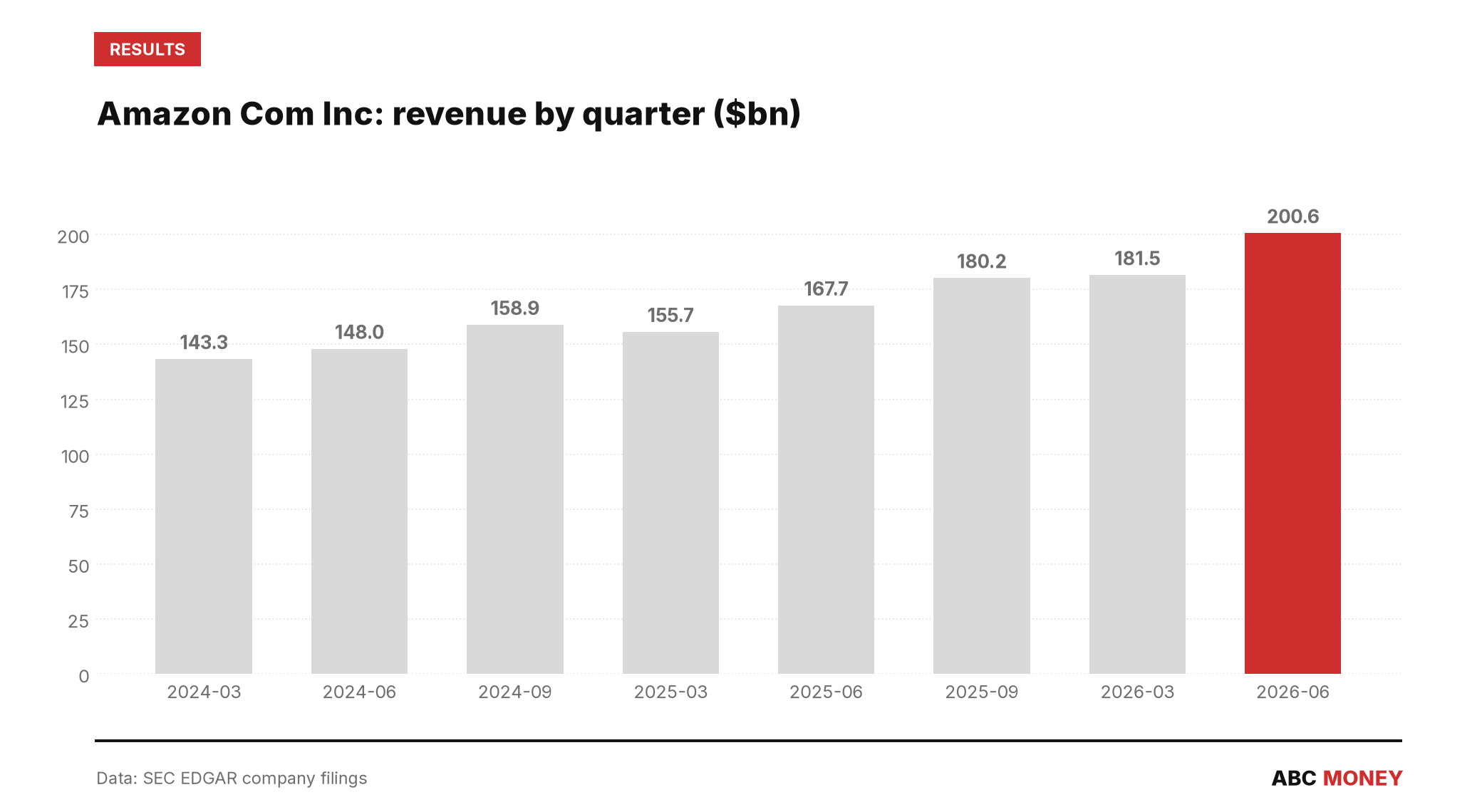
Size-wise, a $7bn deal would be meaningful but not transformative for Amazon’s balance sheet. It would surpass the $6.5bn Amazon paid for MGM in 2022, though it would sit well below the roughly $11bn deal Amazon struck for satellite operator Globalstar earlier in 2026, per PYMNTS. Amazon’s net income reached $62.6bn in the quarter ending 30 June 2026, up sharply from $21.2bn a year earlier, giving the company ample room to absorb an acquisition of this scale without touching its capital markets.
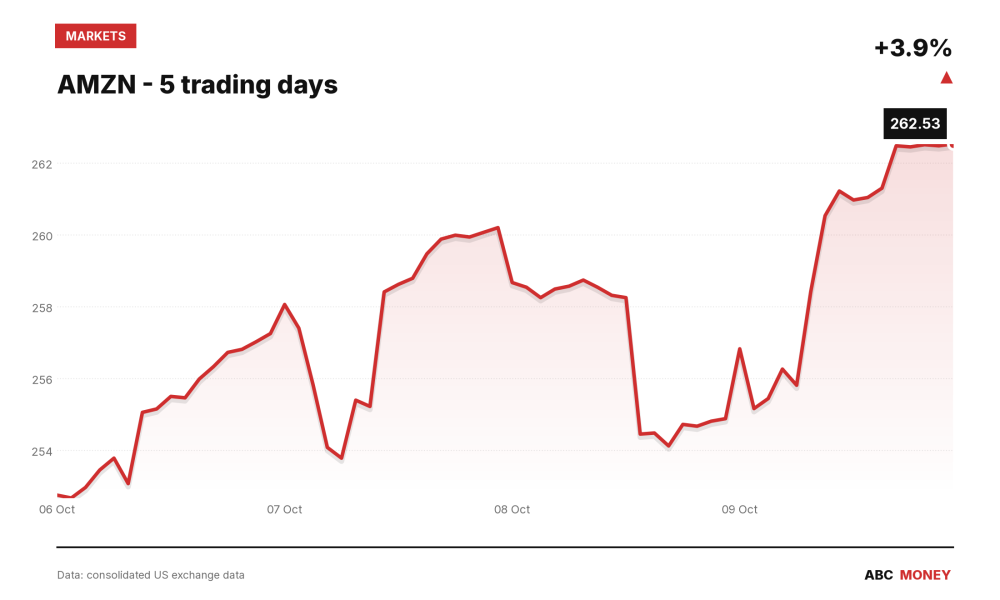
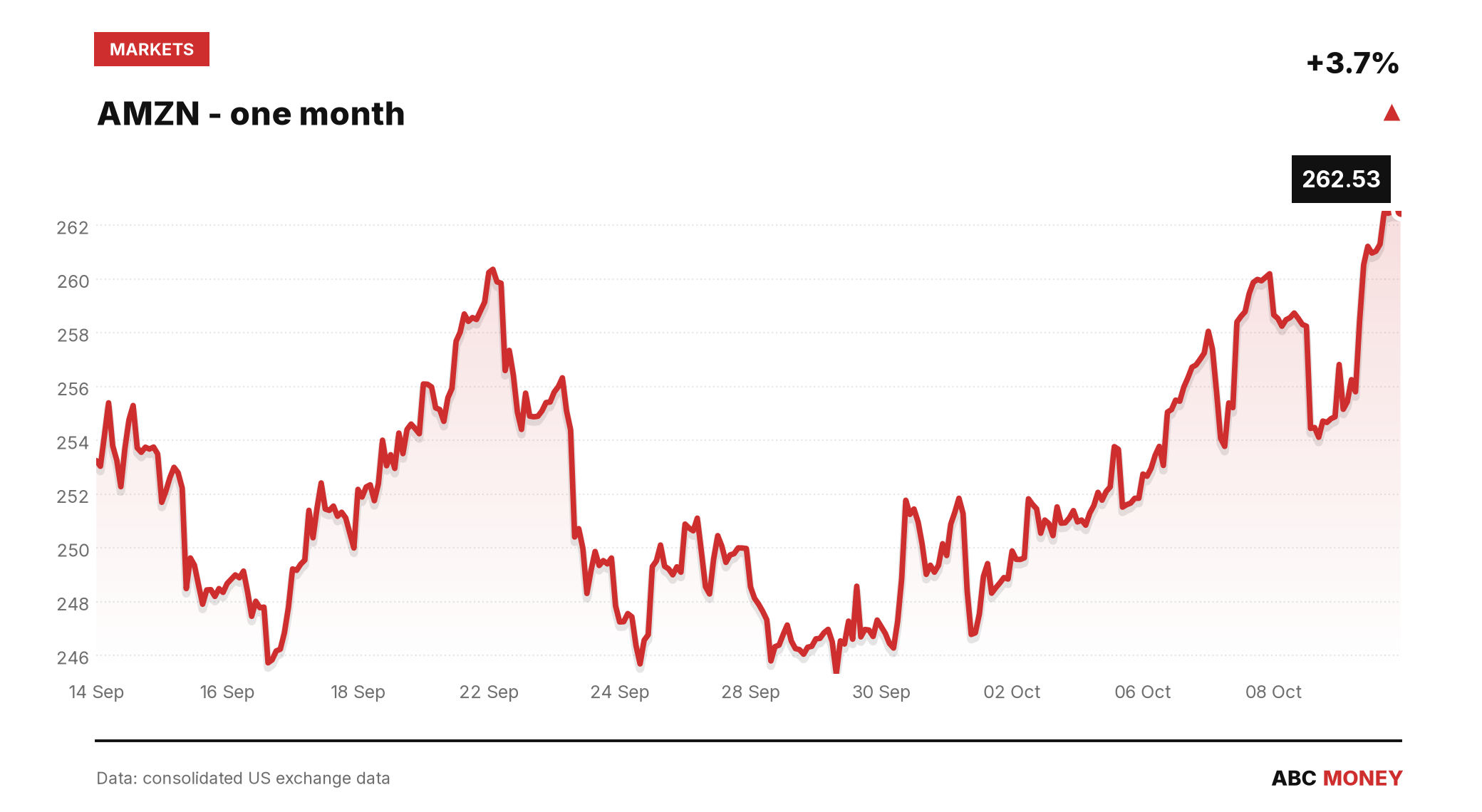
Amazon shares last traded at $262.53, up 0.6% on the day and 2.51% over the preceding 20 trading sessions, with volume running roughly in line with its recent average, according to consolidated exchange data – hardly a market reaction that prices in transformational risk either way, consistent with a deal still being treated as probable but unconfirmed.
What the positioning data shows
Short-sale activity in Amazon stock, tracked daily by FINRA, has stayed in a narrow band through early October, with the short-volume ratio – the share of daily trading volume attributable to short sales, a proxy for bearish positioning – oscillating between roughly 0.24 and 0.34 over the ten sessions to 9 October. That is not the pattern of a stock under sustained bearish pressure, and nothing in the data points to traders bracing for the Decart talks to sour.
Whether the deal closes near $7bn, slips to a rival bidder, or quietly collapses as Anthropic’s did in September, the pattern is now unmistakable: hyperscalers are paying premium prices for software that makes their own chips more useful, not simply to add another AI lab’s logo to the portfolio.
This article is for information only and is not investment advice or a recommendation to buy or sell any asset. Markets move quickly; figures are correct as sourced at the time of writing. Always do your own research before making financial decisions.


 Bitcoin
  Ethereum
  Tether
  BNB
BNB  USDC
USDC  XRP
XRP  Solana
  TRON
TRON  Lido Staked Ether
  Cardano
  Gram (prev. Toncoin)
  Avalanche