Bitcoin
  Ethereum
  Tether
  BNB
BNB  USDC
USDC  XRP
XRP  Solana
  TRON
TRON  Lido Staked Ether
  Cardano
  Gram (prev. Toncoin)
  Avalanche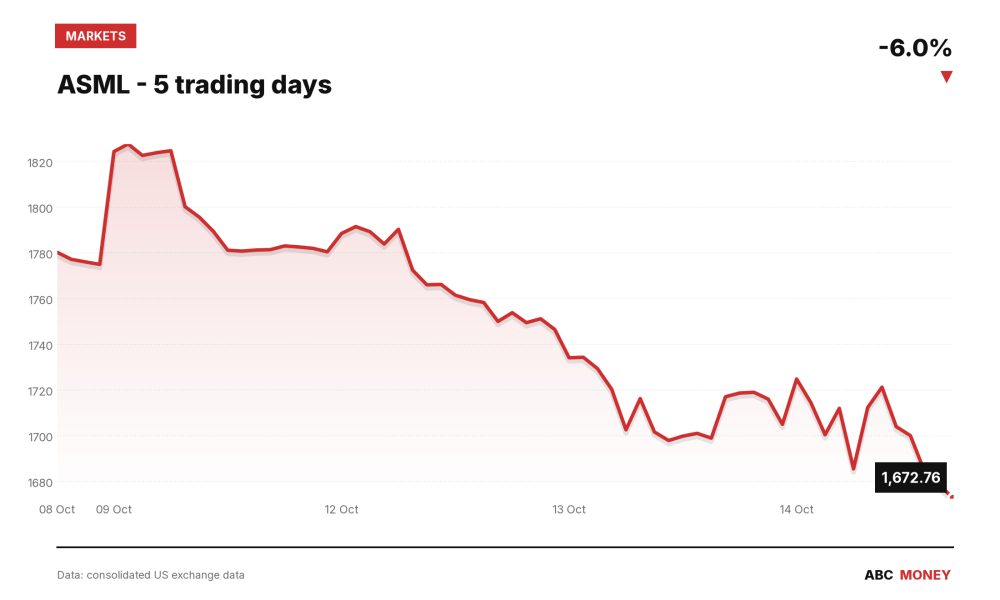
Ahead of its third-quarter results, the options market’s implied move for ASML Holding (ASML) was unusually large for a company of its size: traders were pricing in a 5.12% swing, worth roughly $34.8bn given the chipmaking-equipment giant’s near-$679bn market capitalisation, according to Benzinga data published ahead of the print. It was the biggest dollar figure on a watchlist that also included Bank of America, whose own implied move of 3.35% translated to $12.8bn against its $383bn market cap. What actually happened to ASML shares once the numbers landed tells a more sobering story than the size of that number suggested.
ASML reported Q3 2026 net sales of roughly €11.7bn and net income of about €5.0bn, with diluted earnings per share of €12.93 – a beat of €2.14 against consensus, according to a securities filing cited by GuruFocus. Revenue was up 55.1% year-on-year, a striking growth rate by any industrial standard. But it fell narrowly short of what analysts had pencilled in, and that shortfall – not the profit beat – appears to be what the market chose to trade on.
What the implied move got wrong
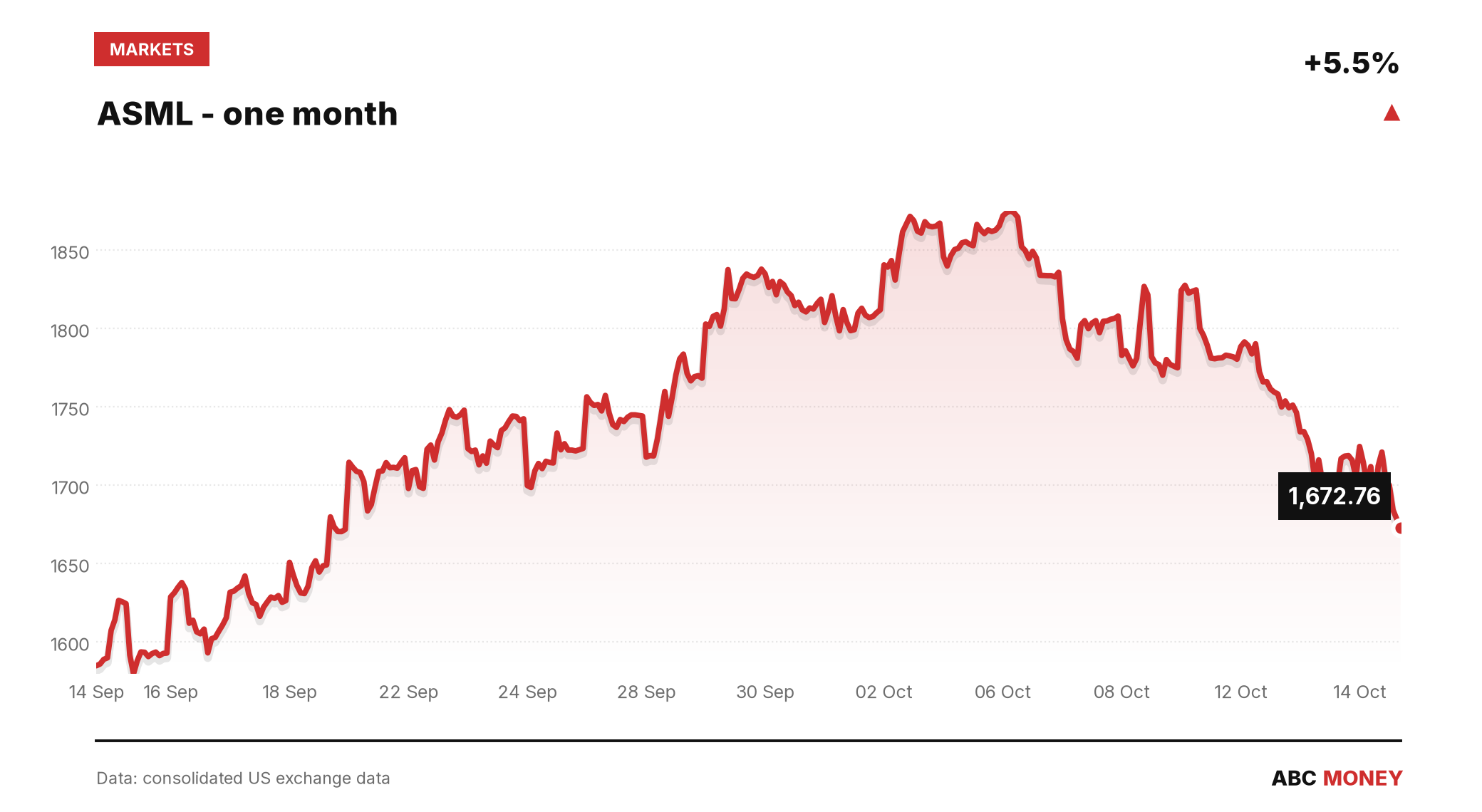
By the close on 14 October, ASML last traded at $1,677.67, down 0.47% on the day and 3.82% over the preceding 20 trading sessions, with that price marking the stock’s 20-day low, according to consolidated US exchange data. That is a far cry from the kind of double-digit lurch a $34.8bn implied swing would suggest. Options pricing captures the market’s expectation of volatility, not its direction or its eventual accuracy – and in this case the realised move was both smaller and the opposite sign from what a “huge beat” framing, echoed elsewhere in earnings coverage that week, implied investors should expect.
It is also worth noting this was not a one-off forecast. Benzinga ran a near-identical feature on ASML earlier in the same earnings week flagging a $42.8bn implied swing at a $707bn market cap, and another in July pegged the figure differently again. These are recurring pre-earnings options features rather than bespoke predictions about any single print, and their dollar figures move around as the underlying market cap and implied volatility shift week to week.
A profit beat that still wasn’t enough
None of this diminishes what ASML actually delivered. Full-year 2026 net sales guidance now sits at €44bn-€45bn, and management told investors on the earnings call that planned lithography supply through 2027-2028 still won’t fully meet customer demand, prompting a look at raising 2028 capacity beyond the already-flagged 30% increase. That is about as bullish a demand signal as a semiconductor-equipment maker can give. It simply wasn’t enough to stop the share-price slide, a reminder that in a market pricing premium multiples on AI-linked capital spending, a narrow revenue miss can outweigh a comfortable profit beat.
The scale of ASML’s business makes the comparison starker. In its last full fiscal year, the company reported total net sales of €32.67bn and net income of €9.61bn, with diluted EPS of €24.71, according to its annual filing with the SEC. A single quarter now running at roughly a third of that full-year revenue underlines just how much weight each print carries for a stock trading on the kind of multiple that leaves little room for disappointment, however marginal.
Positioning tells its own story
One data point argues against reading the drop as a crowded short bet unwinding. FINRA’s daily short-sale data shows ASML’s short-sale ratio – the share of daily trading volume attributable to short sales, where traders borrow stock to sell it in anticipation of a lower price – falling steadily into the print, from 0.548 on 30 September to 0.374 on 13 October. That pattern suggests short-side positioning eased rather than built ahead of earnings, which makes the post-results decline look less like a bearish bet paying off and more like a straightforward repricing once the revenue line came up light.
For investors who take options-implied moves as a guide to expected magnitude, the ASML print is a useful corrective: the number captures how much the market thought shares could move, not whether the move would be up or down, nor whether the result driving it would be read as good news or bad. The next test comes with ASML’s following quarterly update, when the market will find out whether the capacity expansion management flagged on the call translates into bookings that finally outrun the valuation concerns that weighed on the stock this time round.
This article is for information only and is not investment advice or a recommendation to buy or sell any asset. Markets move quickly; figures are correct as sourced at the time of writing. Always do your own research before making financial decisions.