Bitcoin
 Ethereum
 Tether
 BNB
 USDC
 XRP
 Solana
 TRON
 Lido Staked Ether
 Cardano
 Gram (prev. Toncoin)
 Avalanche
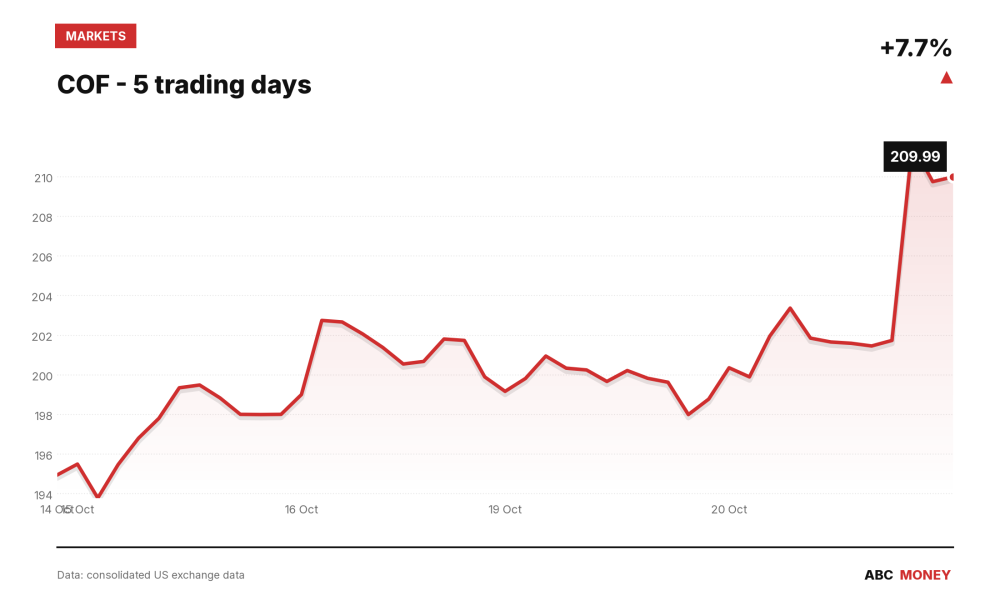
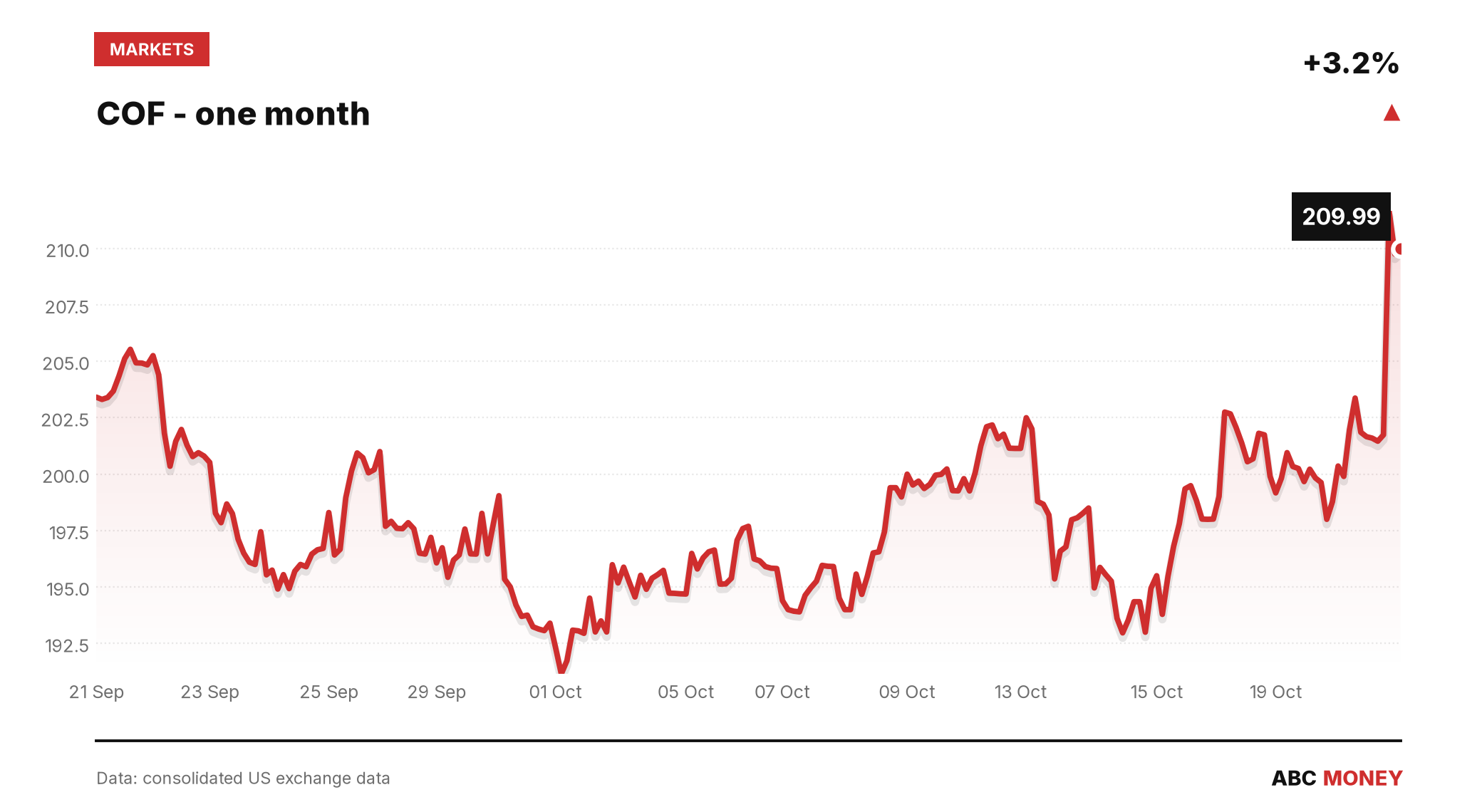
Capital One Financial Corp (NYSE: COF) shares jumped after the credit-card and consumer-banking giant posted third-quarter results that cleared Wall Street’s bar on both profit and revenue, with Capital One Q3 earnings comfortably ahead of what analysts had pencilled in. The stock closed at $209.01, up 3.54% on the day, according to consolidated exchange data, having traded as high as $211.65 over the prior 20 sessions.
The headline numbers were hard to argue with. Capital One reported adjusted earnings per share of $6.69, beating the consensus estimate of $5.50 by nearly 22%, while quarterly revenue of $16.34bn edged past the Street’s $16.26bn forecast, Zacks reported. Other outlets tracking the reaction put the share-price pop at similar levels: Investing.com clocked a roughly 4% jump, while GuruFocus put the move at 4.7%.
A $1.08 gap between the headline and the GAAP number
Here’s the wrinkle worth flagging before anyone extrapolates too much from that 22% beat. The $6.69 figure used to measure Capital One against consensus is an adjusted, non-GAAP number. On a strict GAAP basis – the figure audited and filed with regulators – Capital One earned $3.5bn, or $5.61 per diluted share, according to the company’s earnings release filed with the SEC. That’s a gap of roughly $1.08 a share between the number that beat estimates and the number that actually hit the bank’s balance sheet, driven largely by amortisation and integration costs tied to the Discover Financial acquisition.
None of this makes the beat fictitious – comparing adjusted EPS to adjusted consensus is standard practice across the sector, since analysts typically build their models on the same basis. But for readers used to seeing “beat by 21.64%” and assuming that’s a clean read on profitability, it’s worth knowing the GAAP figure tells a more modest, though still solid, story.
Credit quality is easing, not worsening
Away from the EPS debate, the underlying credit trends in the filing were constructive. Capital One’s provision for credit losses fell $73m quarter-on-quarter to $2.9bn, helped by a $225m release from loan-loss reserves – money set aside in prior quarters that the bank no longer judges necessary to cover expected defaults. Net charge-offs, the loans the bank has given up on collecting, came in at $3.1bn for the quarter. Together, those figures point to a credit book that’s behaving better than the market had braced for, which likely did as much for sentiment as the EPS line itself.
A volatile earnings trail since the Discover deal
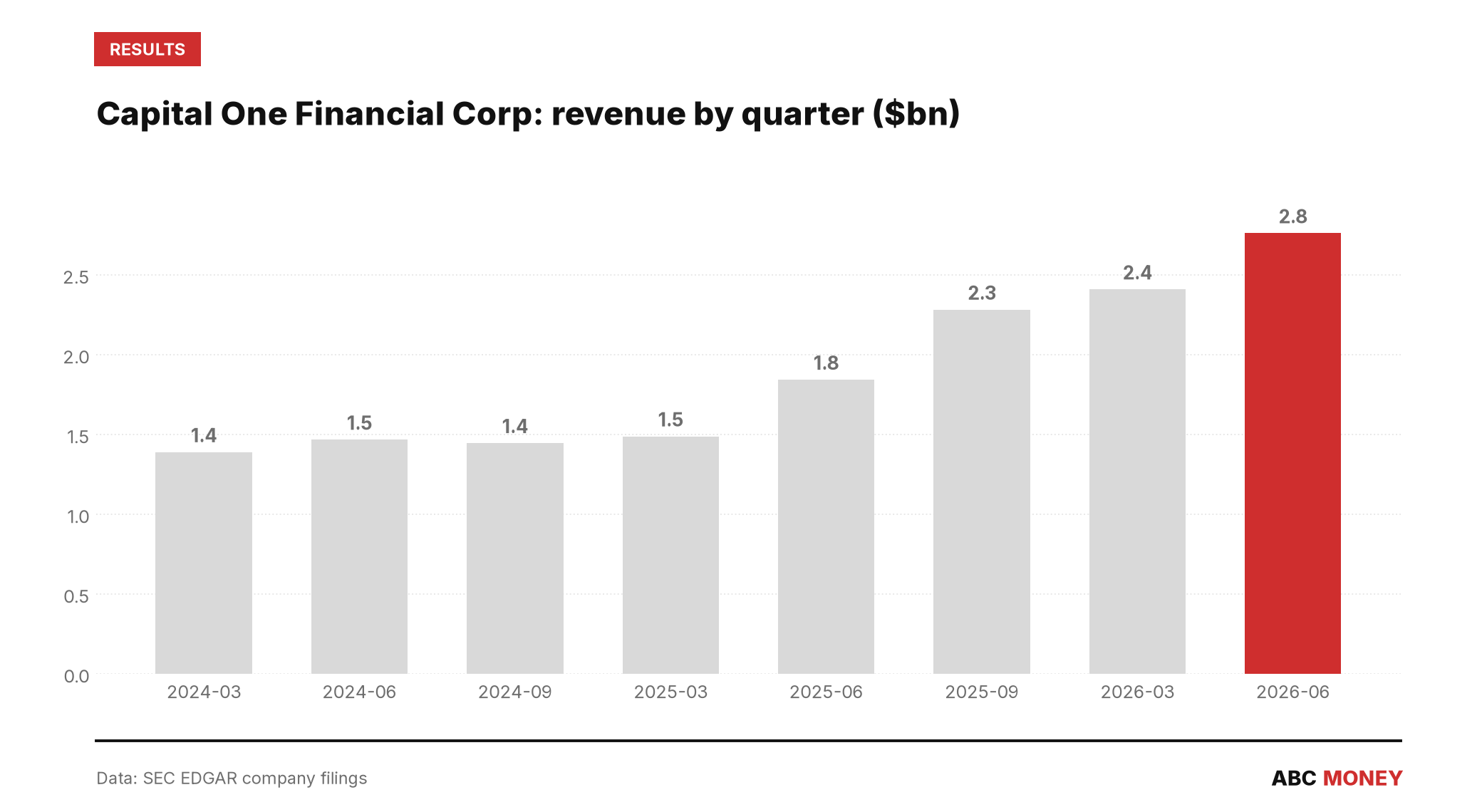
The Q3 print also sits at the end of a choppy run of GAAP results stretching back to the Discover acquisition. Capital One posted a GAAP net loss of $4.277bn, or -$8.58 a share, in the second quarter of 2025 – a one-off tied to acquisition accounting – before rebuilding to $2.174bn ($3.34/share) in the first quarter of 2026 and $3.0bn ($4.73/share) in the second. Set against that run, Q3’s $3.5bn GAAP profit looks like the clearest evidence yet that the integration costs are fading and the combined book is throwing off steadier earnings.
The rates backdrop
The quarter played out against a mildly steepening yield curve: the 10-year Treasury yield stood at 5.09% and the 2-year at 4.74% in mid-October, leaving the spread between them at 0.38 percentage points, per Federal Reserve data. That’s a modestly more favourable environment for net interest margin than the near-flat curves of recent years, since banks typically borrow short and lend long. It’s not the whole explanation for Capital One’s results, but it’s the kind of macro tailwind that tends to show up quietly in consumer-lending margins rather than in any single headline number.
There was no sign of pre-earnings positioning stress either: FINRA’s daily short-sale data showed COF’s short-volume ratio oscillating between roughly 0.18 and 0.46 in the fortnight before the print, consistent with ordinary two-way trading rather than a crowded short bet unwinding into the result.
Capital One’s next scheduled disclosure will be its fourth-quarter results, where investors will be watching whether the gap between adjusted and GAAP earnings continues to narrow as Discover integration costs work their way out of the numbers.
This article is for information only and is not investment advice or a recommendation to buy or sell any asset. Markets move quickly; figures are correct as sourced at the time of writing. Always do your own research before making financial decisions.