

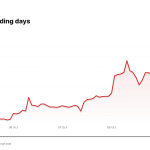
The London Stock Exchange-listed Rolls-Royce share price has gained 35% over the past twelve months, sitting at £14.82 and carrying a market capitalisation of approximately £123bn. That alone would be a strong result in most years. Set against a five-year gain of 1,255%, though, and investors are inevitably asking whether the engine has more to give.
What the Underlying Business Actually Looks Like Now
The honest answer begins with the financials. For the full year 2024, Rolls-Royce reported underlying revenue of £17,848 million, underlying operating profit of £2,464 million, and an underlying operating margin of 13.8%. Free cash flow came in at £2,425 million. Underlying basic earnings per share reached 20.29p, up from 13.75p in 2023. Net cash on a statutory basis swung to £475 million from net debt of £1,952 million the year before.
Those are not the numbers of a company drifting. But the more recent figures are sharper still. In H1 2026, underlying operating profit reached £2.5bn, up 46% from £1.7bn in H1 2025. Underlying operating margin expanded to 22.5% from 19.1%. Free cash flow grew to £2.0bn from £1.6bn. Net cash rose to £2.1bn, with group liquidity of £9.0bn as of 30 June 2026.
The divisional picture reinforces the trend. The Defence division’s underlying operating margin reached 21.0% in H1 2026, against 15.4% in the equivalent period a year earlier. Power Systems hit 20.3%, up from 15.3%. Civil Aerospace was already the highest-margin business at 25.3%, and that held broadly steady. These are margin profiles that were barely imaginable three years ago.
Management has revised its medium-term targets to underlying operating profit of £3.6bn–£3.9bn and free cash flow of £4.2bn–£4.5bn. For the full year 2026, guidance has been raised to £4.7bn–£4.9bn in underlying operating profit and £3.8bn–£4.0bn in free cash flow, even with some disruption from the conflict in the Middle East factored in. Chief executive Tufan Erginbilgic has described the medium-term targets as ‘a milestone, not a destination,’ pointing to strong growth prospects beyond that horizon.
Rolls-Royce Share Price: Where the Maths Gets Difficult
Here is where the arithmetic becomes sobering. Sustaining 35% annual share price growth from a £123bn base would require the market capitalisation to approach roughly £2.5 trillion within a decade. No British-listed company has ever reached that valuation. A handful of American ones have, but they operate in markets with substantially larger addressable revenue pools.
The business momentum is real. Power Systems now expects 25% growth in power generation OE revenues to 2030, upgraded from a previous 20% guidance, driven partly by data-centre demand for backup power and prime power solutions. Defence budgets across NATO member states are rising. Civil aviation wide-body flying hours continue to recover. Rolls-Royce collects long-term service charges tied to engine flying hours, which means top-line visibility is better than most industrials. These are structural tailwinds, not a one-cycle story.
Yet the share already trades at 50 times earnings. At that multiple, any disappointment in the earnings cadence would reprice quickly and sharply. Civil aviation demand is not immune to a consumer confidence downturn. Geopolitical disruption in key flight corridors remains a live risk. At 50 times earnings and a £123bn market cap, the share is pricing in considerable execution over many years.
The company is at least returning capital aggressively. A multi-year share buyback programme of £7bn–£9bn runs from 2026 to 2028, with £2.5bn targeted in 2026 alone. By the time of the H1 2026 results, £1.4bn of that 2026 tranche had already been completed. An interim dividend of 6.0p per share is scheduled for payment in September 2026. Buybacks reduce the share count, which flatters per-share metrics over time and provides a modest floor mechanism. But they do not resolve a valuation question at 50 times earnings.
The investment case for Rolls-Royce is not broken. The operational turnaround has been executed with unusual discipline, the balance sheet is in a structurally better place than it has been for years, and the upgraded guidance range for 2026 suggests the momentum has not stalled. What has changed is the price at which investors are asked to accept all of that. At £14.82 and 50 times earnings, the setup rewards patience only if nothing interrupts the earnings trajectory. The next real test arrives with FY 2026 full-year results, when the market will judge whether guidance of up to £4.9bn in underlying operating profit was prudent or optimistic.

 Bitcoin
  Ethereum
  Tether
  BNB
BNB  USDC
USDC  XRP
XRP  Solana
  TRON
TRON  Lido Staked Ether
  Cardano
  Gram (prev. Toncoin)
  Avalanche