
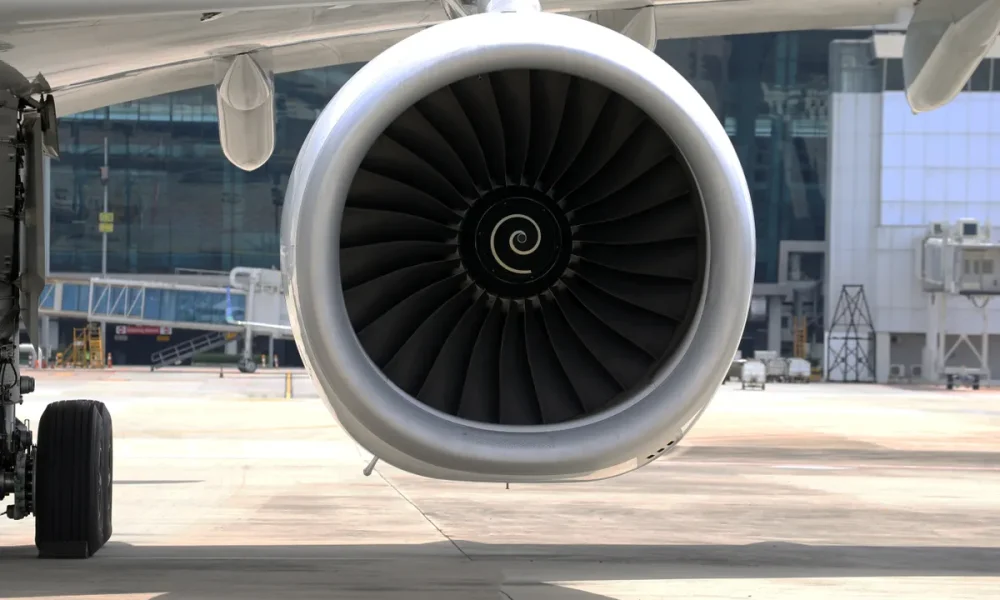
The Rolls-Royce share price has pulled back 6% from its recent peak, sitting at 1,481p — and the question for existing holders is whether the retreat is an exit signal or background noise. On the numbers coming through, it looks closer to the latter.
What the Rolls-Royce Share Price Is Telling Us
Rolls-Royce (RR) delivered full-year 2025 underlying operating profit of £3.46 billion on revenue of £20.1 billion, with civil aerospace up 15%, defence up 8%, and power systems ahead 19% on an organic basis. Free cash flow came in at £3.3 billion for the year. Those are not the numbers of a company approaching a valuation ceiling.
Then came the H1 2026 update. First-half underlying operating profit rose 46% to £2.53 billion, beating analyst consensus of £2.37 billion. Full-year profit guidance was subsequently raised to £4.7 billion to £4.9 billion, up from the prior range of £4.0 billion to £4.2 billion. Management is not guiding cautiously.
Looking further out, the September 2026 analyst consensus (15 submissions) puts FY 2027 EPS at 44.7p and FY 2028 EPS at 52.3p, with underlying EBIT expected to reach £4,848 million and £5,544 million respectively. At 1,481p, the stock trades at roughly 30 times 2027 consensus earnings — a premium, but below US peer GE Aerospace at 34.7 times. For a business that holds an effective duopoly with GE in widebody aircraft engines, some premium is probably justified.
Investor Chronicle consensus data as of 17 September 2026 shows 13 Outperform ratings and 3 Buy ratings against 3 Holds and 1 Sell, with a median price target of 1,730p implying 16.7% upside from current levels. The high target sits at 2,000p.
The Structural Tailwinds Still Running
The investment thesis for RR rests on a well-documented multi-year earnings ramp. Civil aerospace long-term service agreements are the engine of it: 75% of the cash value from renegotiated and higher-margin contracts will be realised after 2028. The business is still in the early innings of that monetisation.
Rolls-Royce’s upgraded 2028 mid-term targets call for civil aerospace margins of 21% to 23% (against 20.5% achieved in 2025), large engine flying hours at 130% to 140% of 2019 levels, and between 1,300 and 1,400 total shop visits. Defence, data centre power, and small modular reactors provide additional growth vectors beyond civil aerospace.
Capital is being returned in size. The Fitch-rated buyback programme runs to £7 billion to £9 billion through 2028, with £2.5 billion committed for 2026 alone. That is a meaningful floor under sentiment for any holder considering whether to reduce.
The genuine risk is valuation compression if growth disappoints. At 30 times forward earnings, any stumble in flying-hour recovery or margin delivery would reprice the stock sharply. That risk has not gone away.
SpaceX: A Different Risk Equation
SpaceX (SPCX) trades at 19.5 times 2027 forecast sales and 37 times 2028 forecast earnings. The barriers to entry argument is compelling — manufacturing scale, launch infrastructure, the Starlink satellite constellation, and Starship’s reusability advantage are not replicated in a decade. Warren Buffett once said of Coca-Cola: ‘If you gave me $100bn and said take away the soft-drink leadership of Coca-Cola in the world, I’d give it back to you and say it can’t be done.’ The logic applies with similar force to SpaceX’s orbital infrastructure.
But SpaceX carries its own financial complexity. An SEC filing from March 2026 discloses a bridge loan of $20,000 million maturing September 2027, with extension options to March 2028. Total scheduled debt maturities as of 30 June 2026 run to $38,433 million — a material obligation for a company still scaling revenue. The planned EchoStar acquisition, expected to close in November 2027, adds integration risk alongside the strategic rationale of expanded spectrum and satellite capacity.
The case for holding both is essentially about duration. RR’s earnings ramp is largely visible and consensus-anchored; SpaceX’s upside is longer, larger, and harder to model. Selling a proven compounder to fund a higher-variance position is a trade that rarely improves risk-adjusted returns.
The next test for Rolls-Royce is whether the second half of 2026 sustains the 46% profit growth seen in H1 and whether management’s upgraded full-year guidance proves conservative. If it does, the 2028 targets start looking modest rather than stretched.


 Bitcoin
  Ethereum
  Tether
  BNB
BNB  USDC
USDC  XRP
XRP  Solana
  TRON
TRON  Lido Staked Ether
  Cardano
  Gram (prev. Toncoin)
  Avalanche