
Tempus (NASDAQ: TEM) has unveiled an expanded, multi-year cancer vaccine collaboration with Moderna (MRNA) and Merck (MRK) to support the potential commercialisation of intismeran autogene, also known as V940 or mRNA-4157, an individualised cancer therapy the companies have been developing together for close to a decade. The deal, announced on 7 October, was independently corroborated by Reuters, which confirmed Tempus is expanding its existing work rather than striking an entirely new arrangement.
Intismeran autogene is being evaluated alongside Merck’s anti-PD-1 therapy Keytruda (pembrolizumab) in patients with completely resected stage IIB-IV melanoma and other solid tumours. The release describes it as a “potential first-in-class individualized neoantigen therapy” – built from a patient’s own tumour mutations to train the immune system to attack cancer cells that share those markers. Financial terms of the expanded arrangement were not disclosed.
What the cancer vaccine collaboration actually adds
According to Benzinga, the expanded scope covers sample collection and next-generation sequencing services – the lab work needed to read a tumour’s genetic profile – for both intismeran autogene and Keytruda, building on groundwork the three companies began roughly a year earlier. It is, in other words, infrastructure plumbing rather than a new scientific partnership: Tempus supplies the sequencing capacity that Merck and Moderna need if regulators eventually clear the vaccine for wider use.
That underlying Merck-Moderna relationship goes back further than most coverage lets on. Moderna’s own filings show the companies signed a Collaboration and License Agreement in June 2016, amended in 2018, with Merck exercising its option to co-commercialise the therapy in September 2022. The announcement this month is best read as the next instalment in a long-running bet rather than a standalone catalyst – which is partly why none of the three stocks moved sharply on the Tempus news itself.
A rally that predates this news
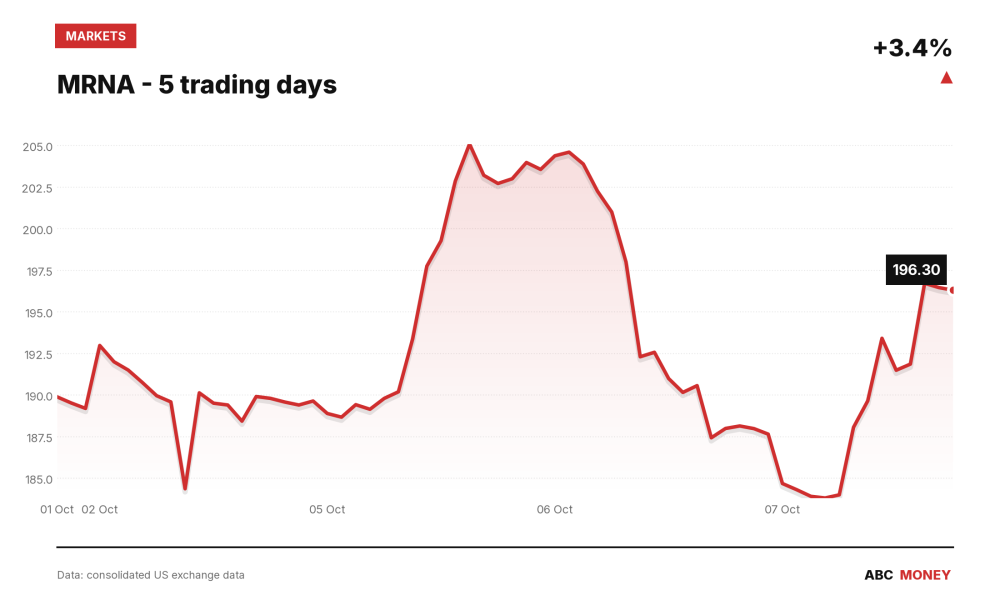
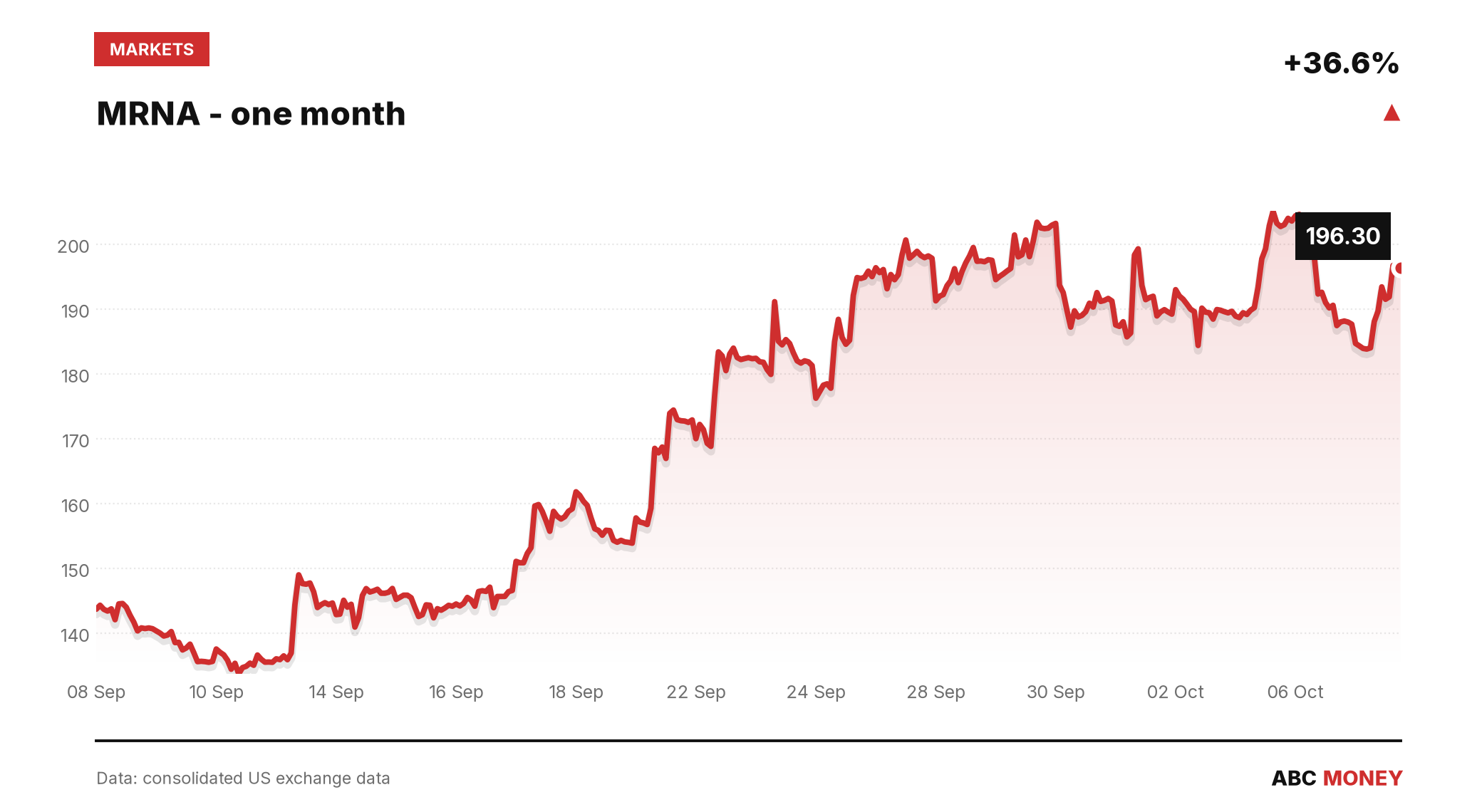
Moderna shares closed at $196.32 on 7 October, up 4.39% on the day and 34.78% over the preceding month, with trading volume running at 1.68 times its 20-day average. But that move has far more to do with earlier events than with the Tempus tie-up: Moderna shares had already climbed roughly 500% during 2026 on optimism around intismeran autogene, after Merck and Moderna’s Phase 3 INTerpath-001 trial met its main goals in resected high-risk melanoma. Full data from that trial are expected at an ESMO oncology conference later in October, a catalyst still ahead of the market rather than behind it.
That run has not gone unchallenged. Citigroup downgraded Moderna to Sell from Neutral on 30 September, setting an $80 price target and arguing that a roughly 590% rally in the stock had run well ahead of what its oncology pipeline could realistically support – a target less than half the price at which the shares were changing hands a week later. Moderna was also reported to be on course for reinstatement to the Nasdaq-100 index, having been dropped from the benchmark in late 2024, a technical flow that can itself draw in buyers regardless of fundamentals.
The fundamentals Citi is weighing
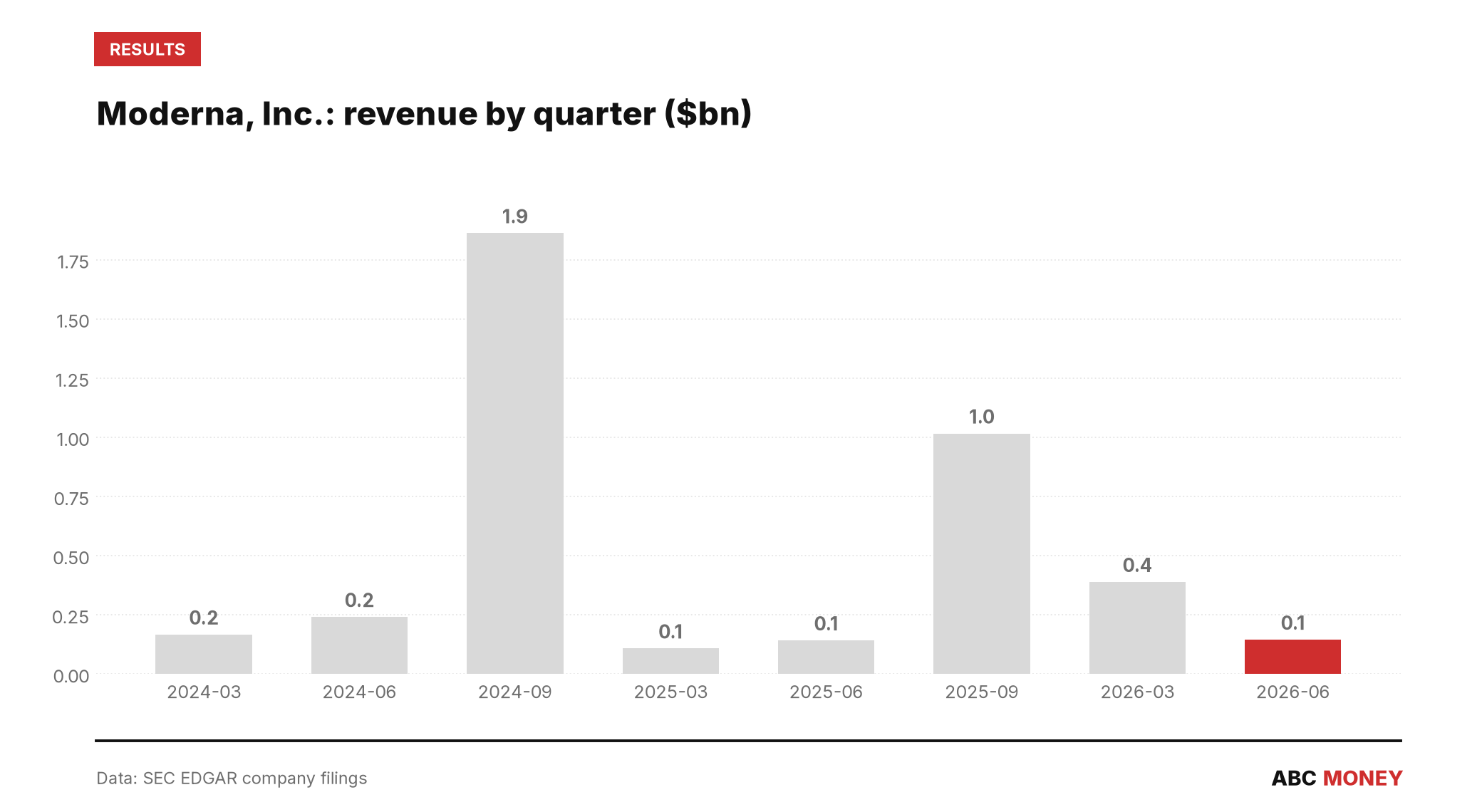
Whatever view one takes of the vaccine’s prospects, Moderna’s accounts still read like those of a company burning cash on research rather than printing profits from it. The group reported a net loss of $1.343bn in the first quarter of 2026 and a further $782m loss in the second quarter, according to its 10-Q filings with the US Securities and Exchange Commission. Those losses follow a pattern stretching back through 2024 and 2025, briefly interrupted by a single profitable quarter in late 2024 when Covid-vaccine revenue spiked. Quarterly product revenue outside that one spike has mostly sat in the low hundreds of millions – a fraction of what would be needed to justify the current valuation on earnings alone, which is precisely the gap Citi’s note highlighted.
Short-sellers, for their part, do not appear to be making an aggressive bet against the stock. FINRA’s daily short-sale volume ratio for Moderna ranged between roughly 0.577 and 0.657 in the fortnight around the announcement, a level that suggests routine market-making activity rather than a build-up of bearish positioning. A Form 4 filing from a Moderna insider was also lodged with the SEC on the same day as the Tempus announcement, though the filing itself discloses no transaction details.
For investors, the collaboration news confirms that the commercial machinery around intismeran autogene is being built out methodically, with Tempus as the sequencing backbone. The bigger question – whether Moderna’s share price has already banked gains that depend on trial data still to come at ESMO – remains unresolved, and is a matter Citi’s analysts have already staked a public position on.
This article is for information only and is not investment advice or a recommendation to buy or sell any asset. Markets move quickly; figures are correct as sourced at the time of writing. Always do your own research before making financial decisions.

 Bitcoin
  Ethereum
  Tether
  BNB
BNB  USDC
USDC  XRP
XRP  Solana
  TRON
TRON  Lido Staked Ether
  Cardano
  Gram (prev. Toncoin)
  Avalanche