Bitcoin
 Ethereum
 Tether
 BNB
 USDC
 XRP
 Solana
 TRON
 Lido Staked Ether
 Cardano
 Gram (prev. Toncoin)
 Avalanche

Did you know, the world market capacity of the Corporate Performance Management industry is over 71,138 companies? Yet of all these companies, only 3% of organizations report their performance as remarkable while 48% say theirs can be better.
Evidently, though CPM is an integral part of business intelligence necessary to optimize business processes, not many companies understand and can leverage its full benefits.
What is CPM?
First coined and defined in 2001 by Gartner —Corporate Performance Management involves the processes, methodologies, or metrics used in monitoring the performance of an organization. It focuses mainly on fundamental operations that include Marketing, Sales, Finance, Supply Chain, Manufacturing, etc.
However, CPM is not a stand-alone strategy. It is more effective with the help of other analytical frameworks, including six sigma, the balanced scorecard, the EFQM (European Foundation for Quality Management) excellence model, MPOs, and Key Performance Indicators (KPIs).
Why is it important to use the Corporate PM?
Like the stars in the universe, corporate performance management offers a plethora of benefits.
The Corporate PM is now a priority for most business leaders, as it aids planning for business activity, sales, marketing, investing for finance, and more to achieve organizational goals. With this data, the company concentrates on the most necessary drivers of revenue growth.
CPM offers you:
- A clearer view of the company’s goals so even your staff understands your desired level of productivity and works towards the objectives.
- Accurate data for budgeting and appropriate allocation of resources to maximize results and reduce costs;
- Improved and automated data collection processes to measure performance, observe skill gaps, and make necessary adjustments;
- Immediate collection and measurement of all the important KPIs, with performance metrics that make decision-making faster and smarter.
CPM is beneficial for all companies seeking to decrease operating expenses. Metrics for CPM or businesses provide information that shows the level of improvement towards achieving its goals.
As it is essential to the C-suite, most businesses now have a dedicated department to work with the project management team – “performance” or “strategy management.”
Often called the Office of Strategy Management (OSM) or Project Management Offices (PMO), they are tasked with handling procedures, recording, communicating, and calculated planning, yet as a breakdown of the CPM.
Performance management is so renowned as a profession that there are currently certification programs for it.
Sources of Information for CPM Key Figures
The information for CPM, like accounts about cash flow, and income, comes from the metrics. However, other investments and inventory information sources include expenses reports, inventory, and revenue.
Here are the five sources of Corporate PM metrics:
- Financial metrics that include all indicators of finances, like sales, expenses, and profits.
- Internal metrics that suggest the quality of regulations of the organization by employees. Staff loyalty and satisfaction have an essential effect on a company’s growth.
- Client metrics because there is no business without customers. Customers’ satisfaction is the primary metric for business prosperity.
- Compliance metrics, as the organization must fulfill regulatory requirements, including environmental, legal, and financial regulations.
- Strategic metrics that discover how well the company has complied with management strategies to achieve immediate goals while pursuing the long-term company’s goals.
There are also some particular metrics to be analyzed like:
- customer retention rate,
- net profit margin,
- gross margin,
- monthly generated leads.
The Business Intelligence and the Corporate PM
Business Intelligence and corporate PM are similar in more ways than one. They are often used interchangeably, but CPM is a subset of BI.
Business intelligence is the technology for gaining, analyzing, and providing the information of actions of a business. It is an enterprise data management solution because it helps you effectively manage your company’s activities.
CPM is reliant on the data from BI to work towards achieving a business’s goal. So, the results of BI systems are the start point of CPMs.
Business Intelligence does not automatically substitute corporate performance management. It instead encourages collaboration.
Let’s now see the difference between CPM and BI and grasp the importance of employing the services of a leading company, Broscorp —where our experts develop a business intelligence systems to give you complete control and improve your work efficiency.
Different aspects between BI and CPM
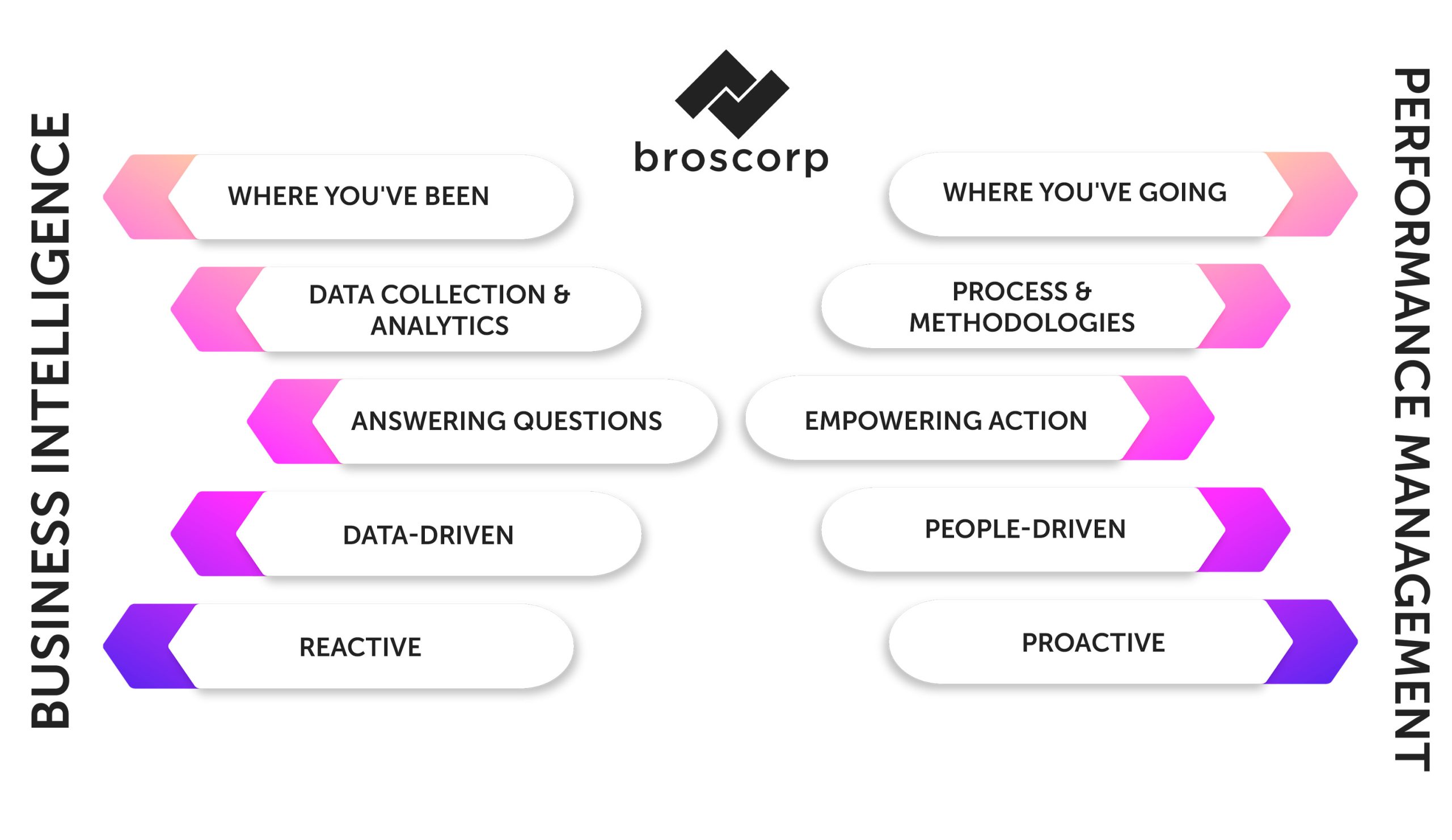
Even though there are similarities between BI and CPM, there are certain aspects where they differ, including:
1. The relevance of the information collected.
BI displays an organization’s historical data that is useful for future decision-making. However, CPM will show historical and real-time information, photographs, and future activity data required to meet your goals.
2. Purpose of data collection.
While BI uses data collection to analyze and evaluate past data, Performance Management uses data collection to assess and improve an organization’s entire processes.
3. The focus of organization work.
CPM measures value concerning an already set goal and actions that affect that goal, while BI enables companies to respond to situations discovered through analytics.
4. Scope of activity.
Business intelligence drives data and information, but performance management drives people.
The fact is that a developed ETL & business intelligence solutions will help businesses deal with massive amounts of data, discover potential trends, and increase profit. So, by implementing a data pipeline, you can beat your competitors with more reliable, comprehensive, and up-to-date insights.
Employ the services of a bespoke software development company Broscrop today. We are a leading programming company with experts who will develop a business intelligence system to give you complete control and efficiency of your work activities!
Also, check our article about the advantages of bespoke software.