
Ethereium is still changing the limits of scalability and performance in the continually developing environment of blockchain technology. A little more than 2 years following the historic upgrade in Shanghai, which saw the unlocking of the staked ether withdrawals and the increased confidence in the network, the Ethereum ecosystem has gone leaps and bounds to unexplored space.
The exquisite scaling schemes, called Layer-2, implemented over the base layer of Ethereum have broken the scales, and they have achieved the highest level of transaction speed, which could be compared to the traditional financial infrastructure.
By late 2025, these innovations will not only be theorised but also physical with actual uses, in fields like decentralised finance as well as in mundane payments, and transaction throughput reaching levels that have previously been considered unattainable.
In April 2023, the Shanghai upgrade was turned on, and it became the first one that allows validators to withdraw their staked ETH, which has injected liquidity and prompted more people to participate in proof-of-stake consensus. This core change preconditioned the aggressive scaling activities, yet the upgrades that followed the core change actually triggered the Layer-2 explosion.
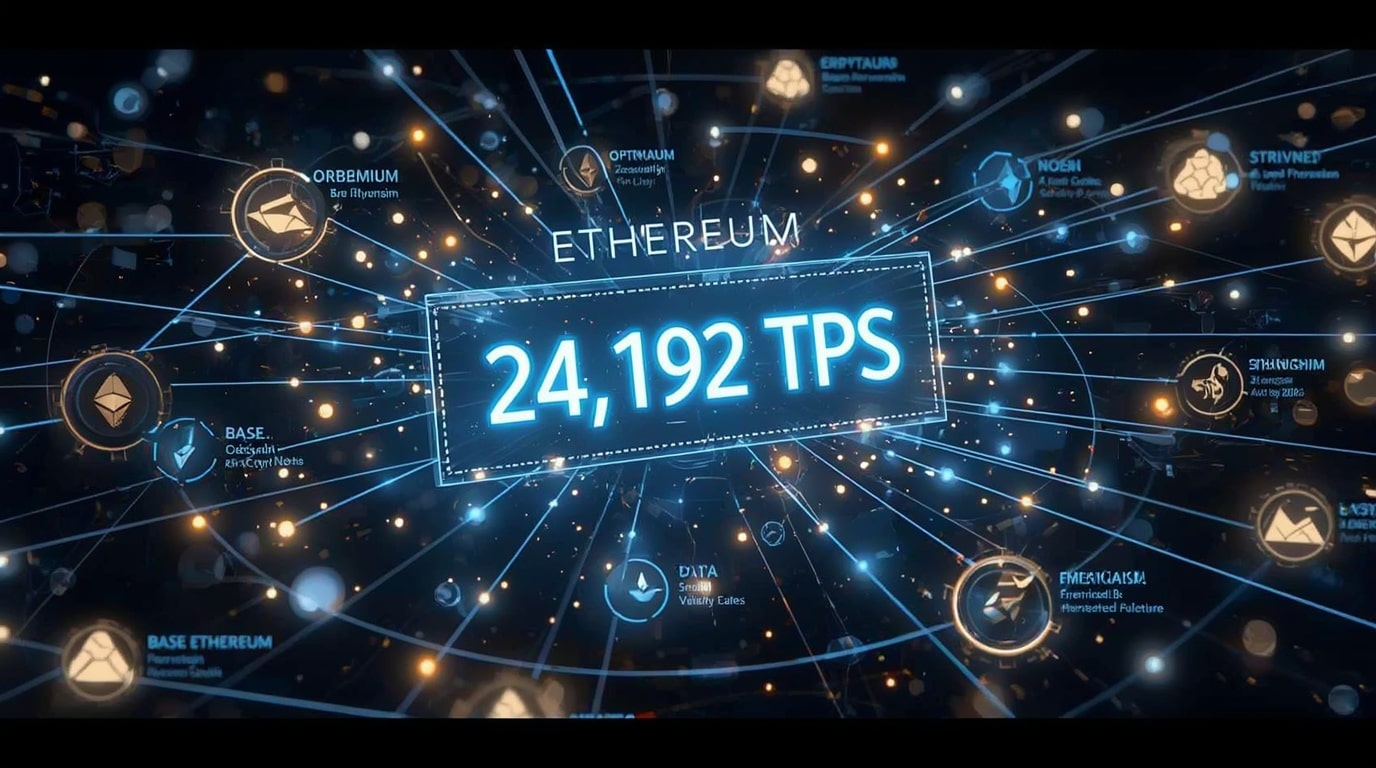
On the eve of the Fusaka hard fork, Ethereum L2 networks are already scaling to over 24,000 transactions per second, which is unbelievable in respect to the humble 15-30 TPS of the base layer. This growth is not an incremental one; it is a seismic shift, which makes Ethereum the foundation of a decentralised economy on the global level.
The Shanghai Catalyst: Vibrating Layer-2 Momentum
The Shanghai upgrade, or Shapella, as it was also called, fixed staking lockups, but it also gave people hope in the viability of Ethereum in the long term. The exit position option reduced illiquidity concerns, and the hat-trick of developer activity was triggered by over 30 million ETH staked before the upgrade.
After the shift to Shanghai, capital returned to the ecosystem and invested in an expansion of Layer-2 projects. Optimistic rollups such as Optimism and Arbitrum, as well as zkSync and Starknet zero-knowledge proofs, started to trade off in cheaper and faster execution but with the same strong security as Ethereum.
This grew further with the Dencun upgrade in early 2024, which brought proto-danksharding with EIP-4844. Compression of data into blobs instead of calldata enables Dencun to reduce Layer-2 fees by up to 90%, thus making high-volume applications viable.
The number of people on L2S increased daily to millions of people as hundreds of thousands of DeFi protocols, NFT marketplaces, and social dApps moved their operations to such platforms.
But these were only foreshadowings of the 2025 symphony of improvements: Pectra in May, which had increased the ability of blobs and their power in validator action, and this time, Fusaka, which came into force a few days ago, December 3, 2025.
Fusaka signifies the realisation of Ethereum modular scaling. It can be reduced to PeerDAS (Peer Data Availability Sampling), which is a breakthrough that enables validators to sample data blobs only in fractions and greatly decrease their bandwidth requirements.
It is an innovation that guarantees a 40-60% reduction in Layer-2 data costs that would allow rollups to add additional transactions to a block without congesting the base layer. Combined with gas limit increments and binary proof-of-efficiency fork optimisations, Fusaka will bring the ecosystem to 100,000 TPS, an order of magnitude higher than Visa’s average 65,000 TPS and maintain decentralisation.
Breaking Speed Barriers: New TPS Milestones
The statistics paint a picture of skyrocketing growth. On-chain analytics show that in November 2025, Ethereum Layer-2 networks recorded the highest number of transactions of 24,192 transactions per second and a 24-hour period.
The unprecedented flow of DeFi and the transfer of stablecoins pushed the average TPS of the seven days to 364.52; L2S recorded a staggering 95.35% of the overall activity. The throughput of gas has also risen, with the highest ever recorded gas rate of 29.64 million gas units per second, showing the efficiency of the recent hard forks.
These do not just spike here and there, but they are a permanent record of developed infrastructure. Billions of values worth billions of Euros are now transacted daily over 101 Layer-2 networks, which were a handful in 2023.
The secured value is dominated by Stablecoins, which have reached an all-time high of more than $50 billion of total value locked, which highlights the true usage over speculation. As opposed to the yield-chasing craze of the 2021 bull run, the L2 boom of this time around is based on production-grade applications: smooth cross-chain bridges, real-time gaming, and micropayments that are immediate.
What fuels this velocity? Aggressive sequencing and batching methods have been developed over time. Optimistic rollups check the transactions off-chain and then verify them on Ethereum, and ZK-rollups are cryptographically succinct in validity.
After Dencun, the space could be expanded by the use of blobs, and continuous optimisations to Pectra made things even smoother. The deal is closed by Fusaka with PeerDAS, which allows the validators to check the data availability with minimum overhead and hence unlocks exponential throughput without reducing the security level.
Trailblazers in the Layer-2 Arena
First is the Base of Coinbase, which dominates 67% of recent gas throughput with its rollup design that targets consumer applications, and which is optimistic. The integration between Base and daily menu items, such as social media wallets and online shopping extensions, has made it democratic and has attracted non-cryptonatives.
In close step is Arbitrum, which has a Nitro upgrade that offers finality of less than a second to high-frequency trading bots in the DeFi world. Polygon is transforming into an aggregator of zk-chains: liquidity is aggregated across systems, and new entrants, such as Scroll and Linea, are pushing the limits of zk-technology with hardware-provable ecosystems.
These networks do not compete in isolation, but they are symbiotic. Standards such as the OP Stack and ERC-7683 are interoperability standards that enable standardisation of bridging to reduce fragmentation.
The composability is gleefully praised by developers: a smart contract in one L2 is able to call assets in another with no high cost. This network of networks has given birth to hybrid apps – consider AI-based yield optimisers that arbitrage chain to chain in milliseconds – pushing institutions that are concerned about Ethereum’s history of network congestion to adopt them.
Greater Effects: User and Innovator Empowerment
To end-users, the post-Shanghai generation is affordable and fast. In the place of Layer-1 gas wars priced in, L2 fees are currently in the low single-digit cents, making all forms of social tipping to tracking a supply chain possible.
Retail traders are performing limit orders at Visa-like speeds, and enterprises are using rollups of compliant data on their own. This growth of stablecoin dominance, as a real payment instrument as opposed to a speculative trade, can be seen as an indicator that Ethereum may soon be infrastructure-focused.
The developers also have a more abundant toolkit. These improvements by Fusaka reduce the barrier to entry and allow the exploration of the account abstraction of gasless wallets and intent-based architectures.
This customer-friendly development solves old-time ills: they are clumsy and too expensive, which slows mass adoption. Scalability combined with a better UX can address trust and accessibility, making billions of users possible, as observed by Hsiao-Wei Wang at ETHShanghai 2025.
The benefits are enormous at the environmental level. Offloading to L2S allows for reducing the energy footprint of Ethereum, which is consistent with the global sustainability agenda. Staking returns are also competitive at approximately 4% which do not fluctuate as much as proof-of-work relics.
Mapping the Horizon: Ethereum in the Next Chapter
With Fusaka coming live, Ethereum is overshadowed by the edge of hyper-scalability. The L2 ecosystem is projected to be able to claim trillions by 2027, and the TPS is regularly being surpassed by 50,000.
Problems remain, such as how to coordinate upgrades between a disjointed set of validators, and how to reduce the risks of sequencer centralisation; however, the trend is positive. Ethereium was conceptualised by Vitalik Buterin as a “settlement layer in the internet; the post-Shanghai developments are bringing the concept to fruition.
Ethereium is not only alive in this extended domain, but it is flourishing, and it is doing better than its competitors in raw performance and the depth of its ecosystem. The Layer-2 records that will be set in 2025 are not just metrics; they represent milestones in a decentralised future where speed and security are met, and accessibility opens the door to innovation. To investors, users and those constructing buildings, the message is obvious: Ethereum is only getting started in growth.



 Bitcoin
  Ethereum
  Tether
  BNB
BNB  XRP
XRP  USDC
USDC  Solana
  TRON
TRON  Lido Staked Ether
  Cardano
  Avalanche
  Toncoin