
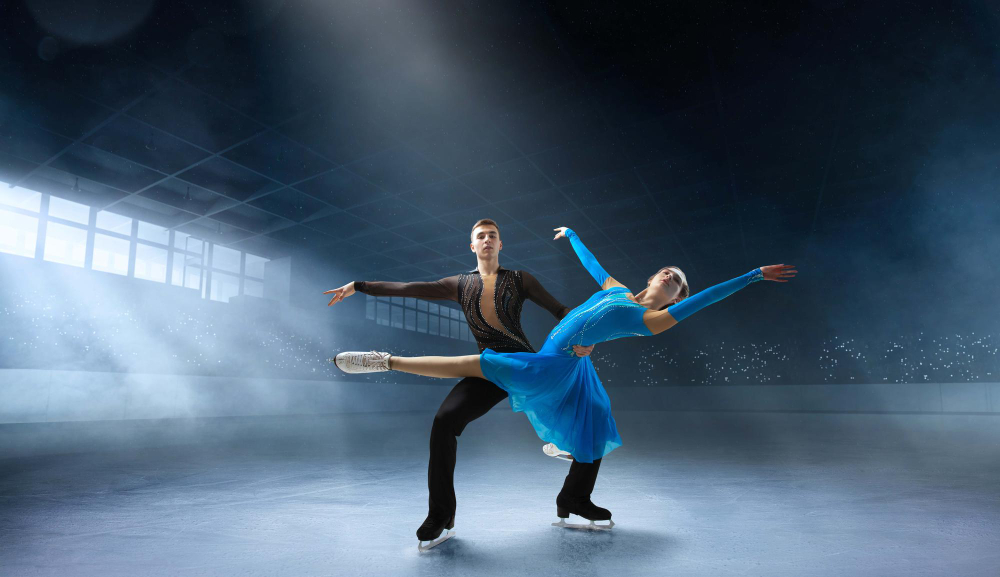
The ice in Milan’s skating arena appeared nearly flawless, reflecting thousands of tiny lights overhead like a mirror. During warmups, skaters skimmed over it, drawing thin white lines that vanished almost as fast as they appeared. There is a sense of covert deceit as you watch them. It appears effortless. It isn’t.
At the Winter Olympics, figure skating has always been a peculiar conflation of emotion and physics, of quantifiable rotations and something completely intangible. With careers soaring and falling in seemingly unfair ways, that tension felt more acute than usual during the Milano Cortina Games.
| Category | Details |
|---|---|
| Event | Winter Olympics Milano Cortina 2026 |
| Venue | Milano Ice Skating Arena, Milan, Italy |
| Sport | Figure Skating |
| Competition Dates | February 6–22, 2026 |
| Major Disciplines | Men’s Singles, Women’s Singles, Pairs, Ice Dance, Team Event |
| Notable Champions | Mikhail Shaidorov (Men’s Gold), Japan (Pairs Gold) |
| Rising Stars | Ami Nakai, Alysa Liu |
| Governing Body | International Skating Union |
| Historic Element | Quadruple jumps and triple Axel defining competition |
| Official Website | https://www.olympics.com |
Consider the instance of American skater Ilia Malinin, also known as the “Quad God,” who went into the men’s competition with expectations that seemed greater than his actual weight. In the past, he had accomplished the seemingly impossible—landing jumps that involved four and a half rotations in midair, going against the logic of human bones and joints. But something changed this evening. He turned his quad into a single. He failed at landing. Later, he knelt down with his hands on his knees and looked down at the ice as though he was trying to find an explanation.
It’s possible that pressure, which is imperceptible but constant, is heavier than gravity.
Mikhail Shaidorov of Kazakhstan, the unexpected winner, didn’t appear to be a man who had recently transformed his life across the arena. As his score flashed, he seemed composed, almost perplexed. He had just remained upright while others fell, making clean jumps and letting consistency triumph over genius. Observing his response, it seems that the best skater may not always win an Olympic medal; rather, the person who makes it through the moment unscathed wins.
The women’s competition had its own subdued tension, particularly in relation to Ami Nakai, the teenage idol of Japan. Even when witnessed live, her triple Axel, which she executed at the age of 17, still seems a little unbelievable. After that, the sound of her blade striking the ice was precise and sharp, reverberating momentarily through the quiet crowd before cheers broke out.
That sound is important. Skaters also hear it.
Figure skating scoring, which is regulated by the technical specifications of the International Skating Union, has an almost surgical quality. Every jump needs to adhere to exacting requirements. If you make a small mistake, the reward will vanish completely. This was painfully learned by American skater Amber Glenn, who performed a jump flawlessly but only completed two rotations rather than three. It received no award from the judges. Nothing.
As you watch that happen, you can’t help but wonder about the sport’s harsh reasoning.
Everything is amplified during the Olympics. The sound. The quiet. the result.
Jordan Cowan, an Olympic cameraman and former skater, is more aware of this than most. He follows athletes off the ice while skating backwards with a camera rig, recording the moments after scores are displayed. They occasionally smile. They break occasionally. He referred to those moments as sacred, and it seems as though he is capturing something delicate by his deliberate movements.
Disappointment and triumph are mere inches apart.
The dominance of Japan in Milan has also sparked more general inquiries about the changing geographic landscape of figure skating. Their skaters move more confidently and with a smoother, faster motion. It’s not yet clear if this is due to improved training programs, cultural discipline, or something else entirely.
There is no doubt that the power dynamics have changed.
As skaters jump, spectators in the stands lean forward while wrapped in scarves. The whole arena seems to take a deep breath. Then let out a breath. Each and every time.
Perhaps because of what the jumps stand for rather than the actual jumps, figure skating continues to be the most emotionally taxing sport at the Winter Olympics. Perfection, for a moment. or momentarily lost.
And sometimes, it takes less than a second to distinguish between gold and nothing at all.
As the Milan Games draw to a close, the ice keeps resetting itself following each performance, erasing any blemishes. There will be new skaters tomorrow. new favorites. fresh letdowns.



 Bitcoin
  Ethereum
  Tether
  BNB
BNB  USDC
USDC  XRP
XRP  Solana
  TRON
TRON  Lido Staked Ether
  Cardano
  Gram (prev. Toncoin)
  Avalanche