
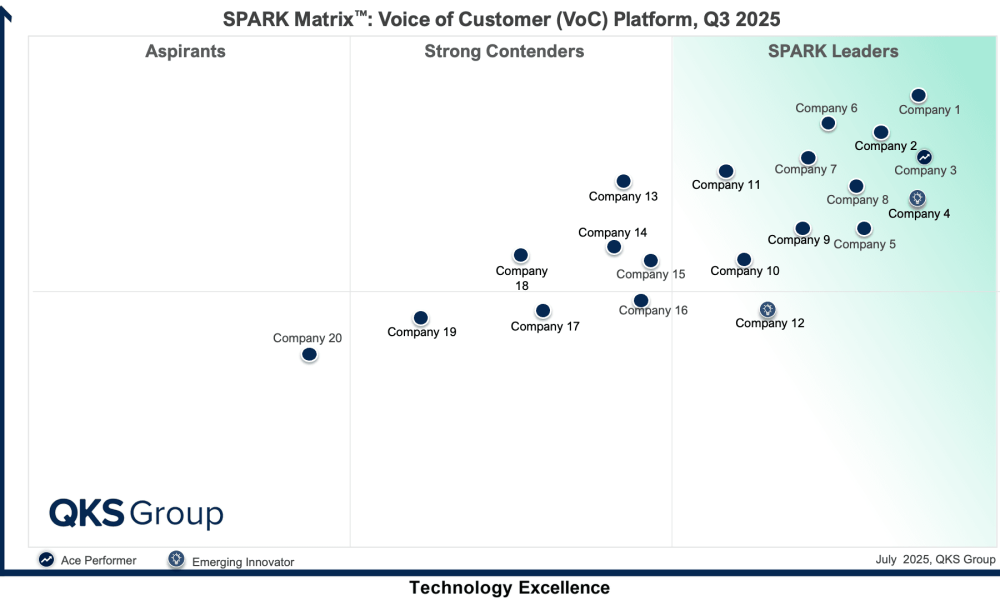
Thousands of enterprises spend millions gathering customer feedback every year. Most of it lands in dashboards nobody checks until the quarterly business review.
That’s the uncomfortable reality facing Voice of Customer programmes across industries.
For years, VoC platforms operated on a simple premise: collect ratings, analyse sentiment, measure satisfaction. The technology delivered visibility into what customers thought. What it rarely delivered was change. Feedback accumulated in reporting systems whilst the operational decisions that shaped customer experience—product roadmaps, support workflows, marketing campaigns—continued largely unaffected by the insights supposedly being captured.
The gap proved expensive.
By the time analysis cycles completed and recommendations filtered through organisational hierarchies, the moments that mattered had passed. A frustrated customer had already churned. A product flaw had already generated dozens more complaints. An opportunity to intervene had already closed.
What’s shifted over the past 18 months is the recognition that feedback without action represents wasted investment. The VoC market is responding with a fundamental architectural change: moving intelligence out of isolated reporting systems and into the operational workflows where decisions actually happen.
Artificial intelligence sits at the centre of this transition—not as an add-on feature but as the core engine. Modern VoC platforms now deploy AI to detect sentiment in real time, identify anomalies before they escalate, predict experience trajectories, and trigger automated responses across customer-facing systems. The technology interprets intent rather than simply cataloguing complaints.
In practice, this means sentiment analysis that flags emerging issues within hours rather than weeks. Predictive models that surface at-risk customers before they contact support. Workflow automation that routes critical feedback directly to product teams with context already attached. Recommendation systems that personalise engagement based on expressed frustration or satisfaction patterns detected across channels.
The promise is compelling. Execution remains inconsistent.
Technology vendors have rushed to embed AI capabilities into VoC platforms, but integration with existing enterprise systems—the CRM, the service desk, the marketing automation stack—frequently proves more complex than sales presentations suggested. Cross-functional collaboration, essential for translating customer signals into coordinated action, often founders on organisational silos that technology alone cannot dissolve.
Companies consolidating their customer experience technology stacks are embedding VoC capabilities within broader unified platforms. The convergence makes sense architecturally. Yet platform unification doesn’t guarantee that marketing will act on product feedback or that support teams will adjust processes based on sentiment trends detected in sales conversations. The workflow integration exists. The cultural execution frequently doesn’t.
What separates effective VoC implementations from expensive data collection exercises increasingly comes down to three factors: whether insights arrive in decision-ready formats that don’t require additional analysis, whether interfaces prove intuitive enough for non-technical teams across functions to actually use them, and whether analytics scale without requiring data science resources most organisations lack.
Vendors positioned for long-term relevance distinguish themselves not through feature lists but through measurable improvements in decision speed and customer outcomes that clients can attribute directly to the intelligence provided.
Meanwhile, ethical considerations are reshaping vendor selection criteria.
As AI becomes the primary mechanism for processing customer data, enterprises are scrutinising how that data gets collected, what models do with it, and whether the resulting insights reflect hidden biases that could damage customer relationships or regulatory standing. Explainable AI—systems that can articulate why they flagged a particular interaction or recommended a specific action—has moved from nice-to-have to procurement requirement.
Transparency matters. Governance frameworks matter. Compliance with data privacy regulations matters, particularly as enforcement intensifies and customers grow more aware of how their feedback gets used.
Trust, in this context, functions as both a technical and commercial imperative. Platforms that cannot demonstrate responsible data practices or explain their algorithmic reasoning face growing scepticism from procurement teams burned by earlier AI implementations that promised intelligence but delivered opacity.
The broader trajectory is clear: VoC programmes are evolving from measurement disciplines into continuous intelligence functions. Customer signals increasingly inform product development priorities, shape marketing strategies, determine support resource allocation, and influence retention tactics. The feedback loop tightens. The question is whether organisations can execute quickly enough to capitalise on the intelligence their systems now generate.
Companies succeeding in this environment share common characteristics. They detect experience risks earlier because automated monitoring surfaces anomalies before they compound. They drive faster decision cycles because insights flow directly into operational workflows rather than waiting for analysis meetings. They personalise interactions more effectively because contextual data accompanies every customer engagement. They align customer signals with revenue and retention goals because the VoC platform integrates with the financial and commercial systems where those metrics live.
Those capabilities represent the aspiration. Reality remains more fragmented.
The VoC market is experiencing genuine structural change—the shift from listening to understanding, from reporting to acting, from isolated feedback repositories to enterprise intelligence layers. AI-powered decisioning, cross-functional usability, and ethical data practices now define platform relevance rather than basic sentiment analysis and survey tools.
Whether enterprises can translate that technological capability into operational transformation remains the unresolved tension. The platforms increasingly exist to operationalise customer intelligence at scale. The dashboards full of unread feedback suggest the execution gap persists. Technology has solved for real-time insight generation. Organisational readiness to act on those insights in real time represents the remaining challenge—and the competitive differentiator separating companies that listen from companies that respond.



 Bitcoin
  Ethereum
  Tether
  BNB
BNB  USDC
USDC  XRP
XRP  Solana
  TRON
TRON  Lido Staked Ether
  Cardano
  Gram (prev. Toncoin)
  Avalanche