Bitcoin
  Ethereum
  Tether
  BNB
BNB  USDC
USDC  XRP
XRP  Solana
  TRON
TRON  Lido Staked Ether
  Cardano
  Gram (prev. Toncoin)
  Avalanche
 Reality shows that they need to produce them much faster than traditional production methods allow.
While all of these factors are required by brands to be successful in their respective industries, traditional production models are not capable of producing all three attributes (quantity, speed, and quality) at the same time – they either have to reduce time, increase budgets, or compromise on quality, thus creating a structural conflict that causes many brands to rethink their production methods.
The use of AI video maker will play an important role in developing more effective methods for producing video assets based on meeting these three criteria.
Video Production Rules in a Fast-Paced Era
As the content ecosystem develops, the amount of time that users have available is getting smaller, and the algorithmic preferences of online platforms are placing a premium on stable and consistent content creation. In this environment, video content will no longer be just “thoughtfully designed releases” however, video content assets need to be considered as repeatedly evolving products.
Thus, the production methodology for producing video content will need to transition from being “project-based” to being “systematic”.
The past methodology has focused on the end goal of producing an entire finished video; hence, calls for a significant emphasis on the rate at which output is produced, the efficiency of testing, and the optimisation of videos. Teams that can rapidly produce, test through release, and change course as a result of audience feedback are the teams that are going to produce long-term growth.
There are three levels of significance for speed.
- The first level is responsiveness to the market; changes in current trends, hot topics and user needs occur all the time, and a slow response can close the door on an opportunity.
- The second level is speed of testing and iteration; video provides answers only through data analysis of real-world events. The faster the launch, the faster it will get optimized.
- The third level is speed of internal decision making. Longer timelines of creating content increases the inefficiencies in terms of communication, and increases the uncertainty of success.
As a result, speed is not just about shortening the amount of time; it is also about increasing operational effectiveness in general.
To effectively create continuous video output, brands must eliminate redundant processes and shorten the time from creative concept to created asset, with replicable video production processes.
With an efficient rhythm of creating video content, a brand’s ability to create video content is no longer limited by budget and time, but rather a tool used for creating and scaling growth through frequent testing.
Five Steps to Build an Efficient Video Production System
Step 1: Define The Creative Positioning
Productive approaches to video production start out with a well-defined objective. One of the first things you need to do is determine what the basic selling point of the video is, who the target audience is for that video, and what the desired outcome of the video will be (i.e., to increase conversion rates; to increase brand awareness; or to simply test market feedback). In the creative stage, success is based on focus rather than complexity – an unambiguous objective will result in a smoother execution of your video.
Step 2: Design A High-conversion Script
Use your original idea to create a structured script that will last between thirty seconds and one minute. The first part needs to grab the audience’s attention quickly. The second part must contain your main message, and the last part must provide specific information about what the viewer should do next. Short videos are of utmost importance in today’s marketplace because how well you utilize your words (how effectively you express them) will ultimately determine whether or not you will get your message across to the target audience. In addition, creating a well-organized, clearly defined script is the first step toward producing a high-quality product.
Step 3: Utilize AI to Quickly Generate Content
AI-based tools for generating videos change how scripts become visualized. The main benefit is that it greatly reduces the production timeframe and cost associated with producing photographs through traditional methods of filming. Most importantly, once an initial photo has been filmed, it is possible to generate many different variations of the same photo rapidly by applying an AI technique rather than manually filming each version. This capability enables testing of different variations of photos for optimization purposes and therefore increases the probability of producing innovative photographs.
Step 4: Refined Optimization and Adjustment
Upon creation of the video, it will be further modified to meet the standards of the brand’s voice. Examples of voice include: the style of their video clips, their colour selection, the way they have their closed captions, and their tone (i.e., formal vs informal).
Unlike traditional techniques, making these changes do not typically require reshooting or extensive editing, resulting in reduced costs and added flexibility.
Step 5: Optimize Release And Multi-channel Distribution
Eventually, release your video with an appropriate title, keyword tags, and descriptions across all platforms including social media, your Primary Website, or through marketing channels. Publishing does not mean ending the process; it is just the start of the validation process within the data. Content performance can also be improved through the ongoing process of testing and optimizing over time.
Three Creative Application Scenarios Driven by AI
Scalable Personalization
One of AI’s most disruptive capabilities is turning “customization” into “scalability”.
For example:
- Generate different opening screens for users in different cities
- Insert recipient names or industry scenarios into videos
- Automatically adjust the order of selling points based on user profiles
Traditional production methods struggle to achieve this level of mass personalization at low cost, while AI can generate multiple versions within the same script structure. This directly improves click-through rates, conversion rates, and user engagement.
Product Visualization
AI is well-suited for quickly visualizing abstract concepts or key features.
- SaaS Product Feature Demonstration
- App Interface Simulation
- New Feature Preview Animation
- Complex Service Process Explanation
Content that previously required motion graphics designers and editing teams can now be quickly generated into prototype versions using AI, and can even be used directly as official release material.
Educational Automation
Brands are increasingly relying on “educational content” to build trust, for example:
- User Guide
- Operation Guide
- Frequently Asked Questions
- Industry Knowledge Explanation
AI can automatically convert text manuals into narrated video tutorials, and even generate versions in different languages.
This type of content is often voluminous and frequently updated, making AI particularly well-suited for this “high-frequency + standardized” production task.
Key Considerations for Choosing an AI Video Generator
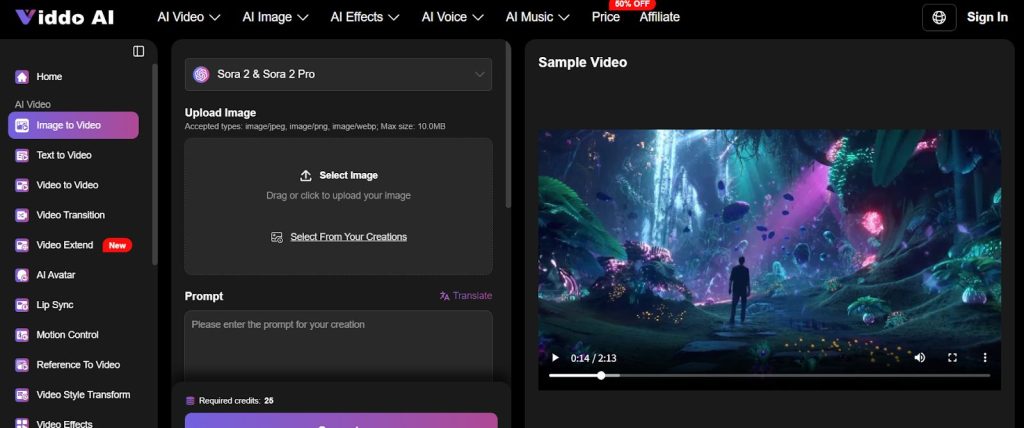
The very first thing to consider in selecting an AI video generator is if the capabilities of the various generation methods fit with your actual requirements. Text to Video, AI Image to Video, and Video to Video are all common forms of generating video content through AI.
- If you primarily generate content directly from scripts, text-to-video conversion is a basic capability.
- If you already have product images or poster materials, image-to-video conversion allows for quick and dynamic processing.
- If you want to restyle existing videos or upgrade their quality, video-to-video conversion capabilities are even more crucial.
Secondly, checking the model being applied and its capabilities is very important. Right now, the most popular models in video generation include newer video generation models like Seedance 2.0. These models have improved image consistency, improved motion smoothness, improved lighting/shadow effects, and better style control over previous generation models. The quality of the generated video will be determined by how well the model functions.
Thirdly, the quality and control of the output must be checked. For example, does the software have the ability to control the length of shots? Can it change the aspect ratio of a shot? Can it optimize the style of cues to fit a character? When it comes to brand videos, the item called “controllability” is typically much more important than “flashy effects” as brand videos need to maintain a consistent visual standard.
Likewise, the speed of generation, the cost structure of the service and the copyrights of the generated video must be considered as well. Some platforms restrict the time required to render video or commercial license their products, impacting long-term stability.
In conclusion, when you choose an AI video generator, you’re not just comparing the “most popular,” but choosing an efficient and long-lasting solution that will support your content type, frequency of output, and brand assets.
Achieving A Balance Between Efficiency And Quality
When selecting an AI video generator you should not only consider the models which are currently trending, but you should also be considering your own requirements and how quickly you will create your content. The tool should increase production efficiency without sacrificing quality and it should enable you to produce consistent and long-term output of content.
Until technology makes it easy to manage production and gives you greater control over the final product, AI cannot be the driver of sustainability for your brand’s video production.