
Data scattered across three cloud providers, two data warehouses, 47 SaaS applications, and countless operational systems. That’s the reality confronting enterprises trying to scale AI initiatives in 2025—and it’s stalling projects before they begin.
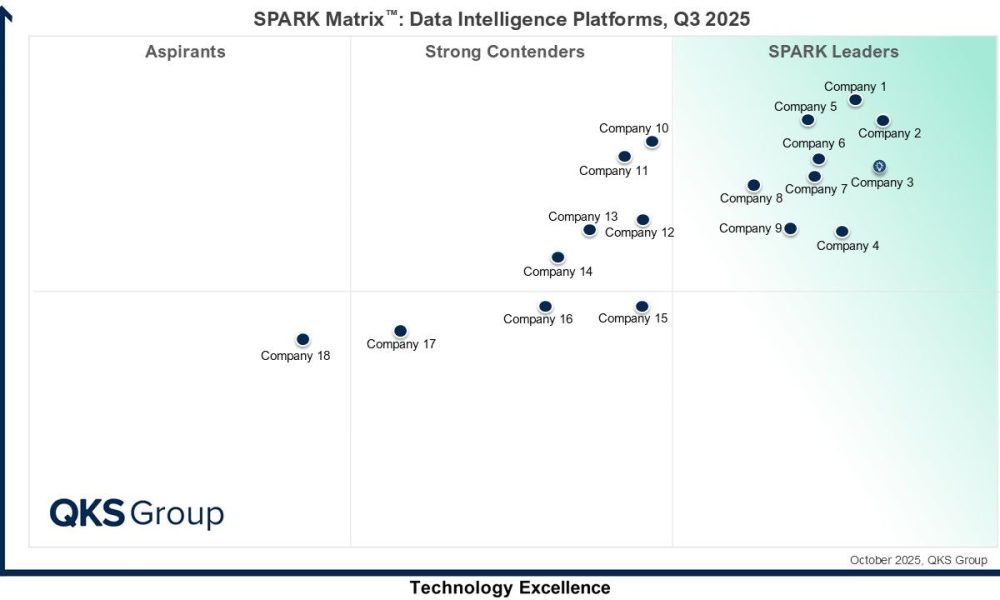
QKS Group released its Q4 2025 SPARK Matrix analysis this week, evaluating 18 vendors competing in the rapidly expanding Data Intelligence Platforms market. The research arrives as organisations discover that fragmented data assets—once manageable nuisances—have become existential threats to digital transformation.
What exactly are these platforms? According to an analyst at QKS Group, “A Data Intelligence Platform is an end-to-end software foundation that discovers, catalogs, governs, secures, and operationalises data across hybrid and multi-cloud environments.” The platforms promise to transform disconnected data into trusted, actionable intelligence that analytics and AI teams can actually use.
The pressure is mounting. Hybrid and multi-cloud infrastructures have created data environments so complex that governance, visibility, and trust have become nearly impossible to maintain manually. Data sits in warehouses, lakes, and applications with no unified view of what exists, where it lives, or whether it’s accurate enough to feed machine learning models.
Data Intelligence Platforms tackle this by unifying technical, business, and operational metadata into a single foundation. They automate discovery. They catalog assets. They monitor quality, enforce governance policies, and deliver trusted data to the teams that need it.
The capabilities driving enterprise adoption span a wide spectrum. Automated data discovery and intelligent cataloguing form the foundation. Data quality profiling, monitoring, and remediation ensure accuracy. End-to-end lineage and impact analysis reveal how data flows through systems—critical when a single change could break downstream processes.
Policy-driven governance and stewardship workflows let organisations enforce rules at scale. Privacy management and sensitive data controls address regulatory requirements across jurisdictions. Master and reference data management keep core business entities consistent. AI-assisted search, recommendations, and self-service access democratise data without sacrificing control.
Integrating these capabilities into unified platforms rather than cobbling together point solutions cuts time-to-insight dramatically. Compliance readiness improves. Trusted data reaches teams faster.
The market is evolving at pace. QKS Group’s research identifies several converging trends reshaping the landscape. AI and machine learning are automating metadata management and insight discovery—using intelligence to manage intelligence. Data privacy, security, and regulatory compliance dominate purchasing conversations as GDPR, CCPA, and sector-specific regulations tighten globally.
Self-service analytics and data democratisation initiatives are expanding beyond IT departments. Business users demand access without waiting for data engineers to provision datasets. Meanwhile, the market is witnessing convergence—data intelligence merging with data governance, quality management, and integration solutions that previously operated independently.
Cloud-native, scalable architectures have become table stakes. Distributed data demands distributed platforms.
The shift represents a fundamental change in approach. Isolated data management tools that handled single problems—a catalog here, a quality tool there—can’t keep pace. Enterprises need unified, intelligence-driven platforms that treat data as a strategic asset requiring end-to-end orchestration.
QKS Group’s SPARK Matrix methodology evaluates vendors on two dimensions: technology excellence and customer impact. The proprietary framework lets enterprises compare platforms, assess competitive differentiation, and align selection with specific business and technical requirements. For vendors, it provides benchmarking against competitors and identifies gaps in capability or market positioning.
The analysis assessed 18 prominent global vendors. The roster includes Alation, Alteryx, Ataccama, BigID, and Collibra. Data.world, Databricks, DataGalaxy, Denodo, and IBM made the evaluation. So did Informatica, Strategy (formerly MicroStrategy), OvalEdge, Pentaho, and Precisely. Qlik, erwin by Quest, and Securiti rounded out the field.
Each vendor faced assessment on functional breadth, innovation capability, scalability, and enterprise value delivery. The diversity of the vendor landscape reflects the market’s relative youth—no single dominant player has emerged, and approaches vary widely. Some vendors evolved from data catalog roots. Others extended governance platforms. A few built intelligence layers atop existing data infrastructure.
For technology vendors, the research offers actionable intelligence to refine product roadmaps and strengthen go-to-market strategies. Growth opportunities become visible when mapped against competitive positioning. For buyers—CIOs, chief data officers, analytics leaders—the framework provides structure for evaluating platforms against governance maturity, analytics readiness, and compliance requirements specific to their industries.
The analyst noted that by unifying metadata and enabling AI-assisted discovery with self-service access, these platforms help organisations turn data into measurable business value. The emphasis on “measurable” matters. Too many data initiatives struggle to demonstrate ROI.
What’s driving urgency? Data volumes continue accelerating. AI adoption is no longer experimental—it’s operational. Generative AI applications in particular demand trusted, well-governed data at scale. Feed an AI model unreliable data and the output becomes liability rather than asset.
Organisations that invest in integrated, intelligent, and scalable data intelligence solutions position themselves to improve decision-making velocity. Compliance becomes proactive rather than reactive. Sustainable growth in data-driven economies requires data foundations that can scale without fracturing.
The research equips decision-makers with comparative insights to navigate vendor selection in a dynamic market. As platforms mature and consolidation inevitably occurs, early strategic choices will shape data architecture for years.
For now, the market remains wide open. Eighteen vendors. Dozens of capability variations. Hundreds of enterprises trying to determine which platform matches their hybrid cloud complexity, regulatory requirements, and AI ambitions. The challenge isn’t whether to adopt Data Intelligence Platforms—it’s which one will still be standing when the market matures.



 Bitcoin
  Ethereum
  Tether
  BNB
BNB  USDC
USDC  XRP
XRP  Solana
  TRON
TRON  Lido Staked Ether
  Cardano
  Gram (prev. Toncoin)
  Avalanche