
Real estate agent Jason Sung has been observing an increase in apartment prices in Taipei’s Neihu Technology Park with the quiet assurance that only comes from knowing something significant is going to happen nearby. The reason is that Nvidia is constructing a new headquarters in Taiwan right next door. The CEO of Nvidia, Jensen Huang, refers to Taiwan as the “center of the world’s computer ecosystem.” That isn’t language used in marketing. Markets, boardrooms, and defense analysts have all been unnerved by Washington’s tariff threats against Taiwanese semiconductors because of this nearly geological fact.
It’s hard to fully understand the numbers underlying Taiwan’s chip dominance. More than 90% of the most sophisticated chips in the world are made by Taiwan Semiconductor Manufacturing Company, or TSMC. These chips power Nvidia’s AI accelerators, run iPhones, and are found inside the data centers that corporations like Google and Microsoft are investing hundreds of billions of dollars to construct. Driven primarily by AI-related demand, Taiwan’s exports to the U.S. increased by 78% in 2025 alone, propelling the island’s economy to an 8.6% annual growth rate, which would be impressive for a sizable emerging market, let alone one the size of Maryland.
| Category | Details |
|---|---|
| Core Issue | U.S. tariff threats on Taiwan semiconductor imports risk disrupting AI chip supply chains |
| Key Company | Taiwan Semiconductor Manufacturing Company (TSMC) |
| TSMC Market Position | Manufactures over 90% of the world’s most advanced chips |
| TSMC Investment in U.S. | Committed $165 billion cumulative investment in U.S. tech sector; building factories in Arizona |
| Proposed Tariff Range | 25% to as high as 100% on semiconductor imports (Trump, Jan 2025) |
| Taiwan’s Economy Growth | 8.6% annual GDP growth in 2025; exports to U.S. surged 78% |
| Final Trade Deal | U.S.-Taiwan deal cut tariffs to 15% from 20% (Jan 2026) |
| Key AI Player Affected | Nvidia — TSMC’s largest customer, lost ~$589B market value in single-day DeepSeek selloff |
| Atlantic Council Warning | Tariffs on AI hardware from allies would raise costs for U.S. firms, lower costs for Chinese rivals |
| Reference Website | Atlantic Council — Why Tariffs on AI Hardware Could Undermine U.S. Competitiveness |
In light of this, President Trump’s repeated threats to impose semiconductor tariffs—which he floated in early 2025 and ranged from 25% to an eye-catching 100%—landed like a policy grenade in an otherwise packed room. Nvidia’s stock fluctuated. TSMC’s stock fluctuated. Investors spent days attempting to figure out the practical implications of a 25% tax on the most crucial part of the AI supply chain. Since nothing like this has ever been tried at this scale and with this much riding on it, the truth is that nobody really knows, which most industry insiders were hesitant to state in public.
Observing the tariff debate gives the impression that Washington is both conscious of its reliance on Taiwan and somewhat taken aback by the consequences of that reliance. In a speech in January 2025, Trump claimed that Taiwan had “taken our chip business away,” and there is some truth to that complaint. America leads the world in chip design. Chip manufacturing in the United States is not. Regulatory obstacles and what industry observers carefully characterize as a “lack of local expertise” have caused TSMC’s Arizona facility, which received up to $6.6 billion in Biden-era CHIPS Act support, to be repeatedly delayed. Measured in years of specialized workforce development and billions of dollars in precision equipment, there is a huge gap between designing a cutting-edge chip and actually producing one.
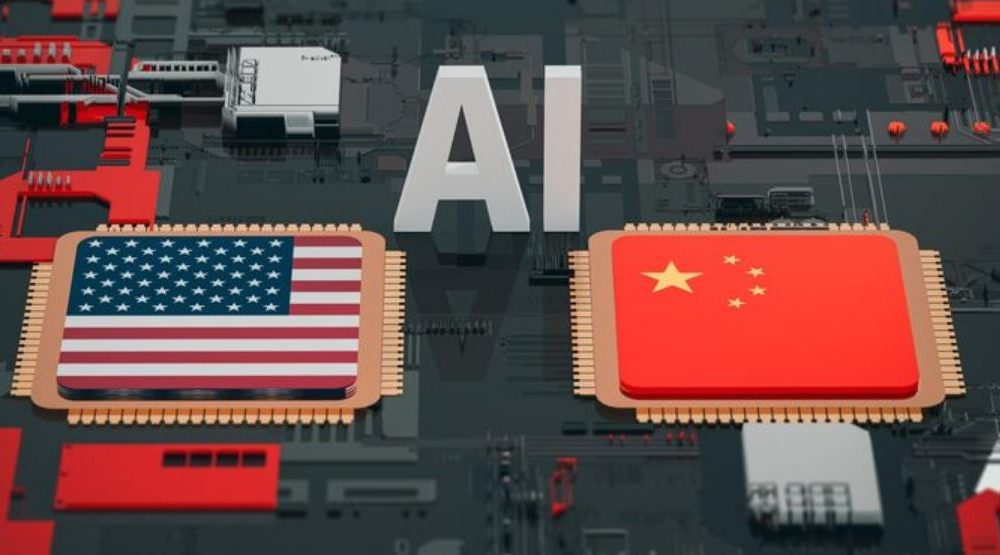
The strategic paradox is as follows, according to analysts at the Atlantic Council: tariffs on AI hardware from friendly partners would increase costs for American businesses while lowering relative costs for Chinese rivals. It’s an odd strategy for winning a race in technology. The rate at which American AI companies can develop and implement the systems they are competing with Chinese counterparts is also impacted if Nvidia’s input costs increase due to TSMC’s chips suddenly carrying a 25% import levy. Meanwhile, tariff-free purchases of the same chips are made by AI labs in France, Japan, and other countries. PwC’s Scott Almassy stated bluntly, “It does probably hamstring American companies a little bit,” adding that if you’re the leader and your costs increase, you stand to lose more than someone who is still catching up.
C.C. Wei, the chairman of TSMC, has been remarkably open about the challenges the business is facing. He made the startling admission that he was “very nervous” about the potential for an AI bubble during an earnings call in early 2025. The company’s CEO had invested $52 to $56 billion in a single year. A mistake, he continued, would be “a big disaster to TSMC.” It felt important to hear someone who is typically measured to the point of blandness use such cautious, even nervous, language. It implied that there is less certainty than the headline growth figures suggest, even at the core of the AI chip economy.
The final trade agreement, which reduced U.S. tariffs on Taiwan from 20% to 15% and was announced in January 2026, provided some respite but did not end the underlying tension. The island’s “technological leadership cannot be replaced,” according to Taiwan’s economy minister, and this is likely to be the case in the near future. There is just no large-scale substitute for what TSMC manufactures. Almassy pointed out that Taiwan has no competitors at the cutting edge of AI, and Taiwanese businesses would probably pass tariff costs on to their direct clients, which would be American tech giants, who would then have to decide what to do with them.
It’s possible that supply chain diversification, which businesses had been delaying since before the pandemic, is accelerated by the tariff pressure. Huang himself informed David Solomon, CEO of Goldman Sachs, that “we should be able to pick up and fab it somewhere else” in the event that Nvidia’s access to Taiwanese components was cut off. However, he was cautious to note that they wouldn’t attain the same level of cost or performance. In a race where everyone is competing on processing speed and training efficiency, that disclaimer is crucial.
It must be somewhat educational to watch all of this from Beijing. For years, China has been observing Taiwan’s position in international chip supply chains, researching the vulnerabilities and leverage it exposes. Regardless of what Washington does in the end regarding semiconductor tariffs, the debate itself has brought to light something that has always been true but seldom discussed: the politics surrounding American artificial intelligence are far more complex than any executive order can address in a single stroke, and the entire trajectory of this technology passes through a 14-mile strait.



 Bitcoin
  Ethereum
  Tether
  BNB
BNB  USDC
USDC  XRP
XRP  Solana
  TRON
TRON  Lido Staked Ether
  Cardano
  Gram (prev. Toncoin)
  Avalanche