
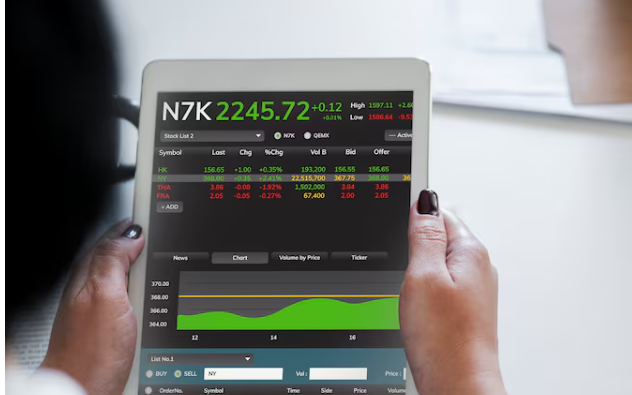
Semiconductor offices have a certain energy that is quiet, concentrated, and even compulsive. Diagrams of chip architectures affixed to walls, engineers hunched over screens, and uninterrupted conversations between software and physics. In that context, Advanced Micro Devices has been constructing a comeback narrative that wasn’t totally guaranteed only a few years ago.
As of April 2026, the price of AMD’s shares is close to the top end of its 52-week range, at about $219. It’s a stance that conveys confidence, or at the very least, persistent interest. With trade volumes remaining strong and occasionally surpassing 30 million shares in a single day, investors appear to be keeping a careful eye on things. Expectations and attention are necessary for such behavior to occur.
Key Information Table
| Category | Details |
|---|---|
| Company | Advanced Micro Devices |
| Stock Symbol | NASDAQ: AMD |
| Current Price (Apr 2026) | ~$219.64 |
| Market Cap | ~$359 Billion |
| 52-Week Range | $76.48 – $267.08 |
| P/E Ratio | ~84 |
| CEO | Lisa Su |
| Key Growth Area | Data Centers, AI Chips |
| Headquarters | Santa Clara, California |
| Reference | https://www.amd.com |
It hasn’t been an easy ascent. The price fluctuated between about $76 and $267 over the course of the last year, a broad range that shows both excitement and caution. It seems as though AMD operates in an environment where optimism might easily give way to uncertainty when one watches those swings on a trading screen, data flickering in real time. This instability might just be the price of working in an industry that is always changing.
Artificial intelligence and data centers account up a large portion of the current momentum. Even in a market used to growth stories, AMD’s data center unit reportedly experienced a roughly 40% year-over-year gain. Those chips are working within big server rooms with rows of computers humming regularly and lights blinking in patterns only engineers fully comprehend. running models, processing data, and providing support for systems that are rarely seen by ordinary people.
There is no avoiding the connection with NVIDIA. A sort of gravitational pull that affects investor mood has been created by NVIDIA’s dominance of headlines, particularly in the AI field. In contrast, AMD seems more subtle. less showy. but possibly more tenacious. It’s yet unclear if that perseverance results in sustained domination.
The issue of valuation is another. AMD’s price-to-earnings ratio is more than 80, so it’s not exactly inexpensive. By placing a wager on future growth rather than just present profitability, investors appear prepared to pay a higher price. In technology equities, this trend is well-known, but there is always a danger. Expectations can grow more quickly than outcomes, and when they do, there may be a significant shift.
AMD’s ticker doesn’t often stick out at first when strolling through a financial district and looking at screens displaying real-time market data. The story isn’t the loudest one of the day. However, it is constantly present, moving, and subtly capturing attention. This type of presence can be deceiving; it’s less striking but frequently more persistent.
It’s interesting to note how much AMD’s story has changed over time. It used to be perceived as a challenger that had trouble keeping up with bigger competitors, but it now has a more balanced role. Not quite in charge, but not disregarded either. That change did not occur suddenly. Product by product, quarter by quarter, it was progressively constructed.
Leadership has contributed to that. The business has placed a strong emphasis on execution under Lisa Su, delivering competitive products, entering new markets, and upholding a degree of consistency that wasn’t always present in prior years. There’s a feeling that strategy has gotten more disciplined, but it’s unclear if this discipline can stay up with the industry’s rapid pace.
Another level of complexity is introduced by the larger semiconductor industry. AI, cloud computing, and gaming are driving the ongoing growth in chip demand. Geopolitical concerns have an impact on where and how chips are made, and supply chains are still delicate. AMD works in that context, taking advantage of demand while also being vulnerable to its uncertainties.
There’s a moment that perfectly sums up the stock’s present mindset. An investor pauses on AMD’s data as they go through earnings releases late at night, balancing growth versus valuation. Although it’s not a significant choice, it does represent a broader trend—people attempting to determine whether this momentum is sustainable.
It’s difficult to ignore how heavily the plot hinges on what happens next. Despite its strength, the current price is a reflection of both reality and expectations. Where the stock goes will depend on a number of variables, including new products, ongoing advancements in AI, and the capacity to successfully compete with bigger competitors.
AMD currently in an intriguing position. Not the underdog, not the market leader. Somewhere in the middle, negotiating an environment that encourages patience and creativity.
And the question is still unanswered as the numbers keep fluctuating—up, down, and so on. Is this the end of the current cycle or is there still more climbing to be done?



 Bitcoin
  Ethereum
  Tether
  BNB
BNB  USDC
USDC  XRP
XRP  Solana
  TRON
TRON  Lido Staked Ether
  Cardano
  Gram (prev. Toncoin)
  Avalanche