
On a Tuesday morning, observe people pulling up to the pump at a Miami gas station, such as the Shell on Biscayne Boulevard, where the price sign reads $4.29, and perform the mental math that has become a kind of daily ritual for millions of Americans. the pause that occurs before the card is inserted. The brief moment of surrender. The tank that fills halfway before stopping. This has been the case since late February, when shipping through the Persian Gulf was hampered by the Iranian conflict, and it hasn’t significantly changed despite a ceasefire announcement that momentarily caused crude prices to plummet 15% in a single session.
There was a cease-fire. The decline in oil prices was genuine. However, as of April 9, the relief from gas prices is still primarily theoretical.
On Wednesday, the national average price for a gallon of regular gas was $4.17, up from $2.98 shortly before the US and Israel attacked Iran on February 28. It surpassed $5 in a few states. Fuel prices were close to $5.93 per gallon in some parts of California, which always has its own unique brand of fuel price misery. Nationwide, diesel averaged about $5.67, a figure that is compounded into almost every product that Americans purchase due to trucking and shipping expenses. The speed at which this occurred—roughly $1.18 added to a gallon of gas in roughly six weeks—serves as a reminder of how quickly, when the supply disruption is severe enough, energy shocks spread throughout an economy.
In reporting on gas price cycles, Tom Kloza, an independent oil analyst who counsels Gulf Oil, uses the phrase “prices go up like a rocket and come down like a feather.” It’s one of those expressions that sounds casual but is quite accurate. The retail fuel market is inherently asymmetrical. Gas station owners squeeze their margins to remain competitive when wholesale prices rise; the national average margin is about 15 cents per gallon. However, they swiftly raise retail prices to shield themselves from additional wholesale increases. Those same owners typically allow the margin to grow before transferring savings to customers when wholesale prices decline. The retail price follows the wholesale price’s decline. There has always been a lag, and it won’t go away.
Key Reference Data: US Gas Prices & Iran War Impact
| Indicator | Detail |
|---|---|
| National Avg Gas Price (Apr 9, 2026) | $4.17/gallon (regular) |
| Pre-War Gas Price (late Feb 2026) | ~$2.98/gallon |
| Price Increase Since War Began | +$1.18–$1.19/gallon |
| Diesel National Average | ~$5.67–$5.69/gallon |
| California Gas Price (peak) | ~$5.93/gallon |
| Lowest State Average | ~$3.48/gallon |
| Short-Term Relief Forecast | 10–20 cents/gallon drop in ~2 weeks (if ceasefire holds) |
| $4/gallon Timeline | ~1–2 weeks (Patrick De Haan, GasBuddy) |
| Diesel Below $5 Timeline | ~6–8 weeks (optimistic scenario) |
| $3.50/gallon Forecast | By end of 2026 (Mark Zandi, Moody’s) |
| Return to Sub-$3 Gas | Months away, possibly not in 2026 |
| WTI Before Ceasefire | ~$113/barrel |
| WTI After Ceasefire Announcement | ~$92–$95/barrel |
| Strait of Hormuz Normal Daily Transits | ~130 ships/day (pre-war) |
| Strait Transits During War (March) | ~6 ships/day |
| Gulf Production Shut Down (March) | ~7.5 million barrels/day |
The most precise short-term prediction was provided by Patrick De Haan of GasBuddy, who monitors gas prices as closely as anyone in the nation: a potential drop of 10 to 20 cents per gallon over the next two weeks, assuming the ceasefire holds and the Strait of Hormuz remains at least partially open. That would raise the national average to about $4, possibly slightly less. This would be a significant improvement, but it would still be more than a dollar higher than it was prior to February 27. Additionally, he cautioned that, in an optimistic scenario, it would probably take six to eight weeks for diesel, which is currently averaging above $5.67, to drop below $5. Because diesel is the fuel that moves goods through the nation’s supply chains, it matters in a way that the regular gas number occasionally obscures. Increased diesel costs eventually show up in grocery shelves and delivery prices.
The announcement of a ceasefire does not eliminate certain complicating factors. Every year, the summer driving season arrives with its own inflationary logic, and things are going to get more difficult. Summer blend gasoline, which is more expensive to produce than winter blend and has a lower volatility formulation mandated by the EPA to lower summer emissions, has already started to replace winter blend gasoline at gas stations across the nation. Regardless of geopolitics, that switchover occurs every year and usually adds a few cents per gallon. When you combine that with the fact that refineries are still finishing up seasonal maintenance, which temporarily reduces throughput, you have a situation where prices are under pressure to decline but there are obstacles in the way.
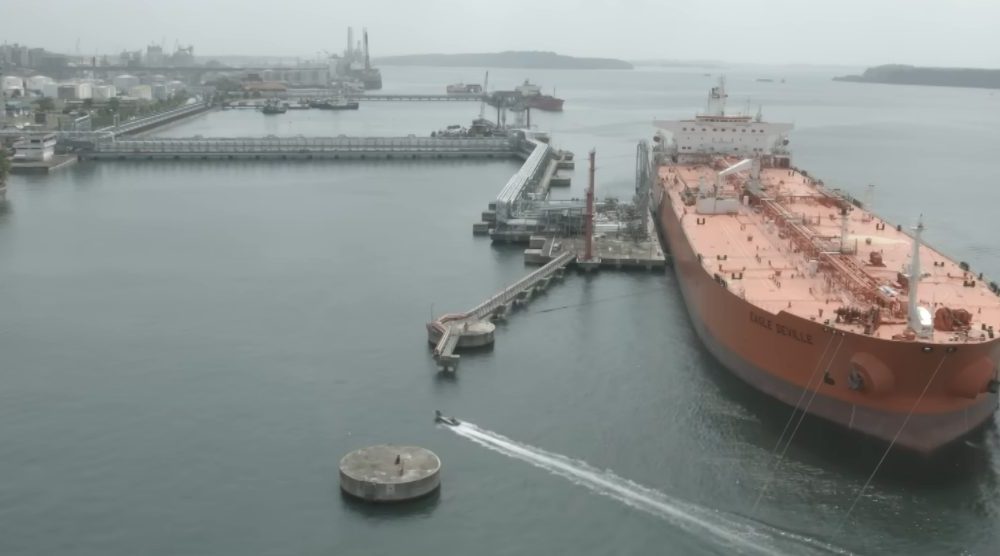
There is still much to be done to resolve the Strait of Hormuz. Approximately 130 ships passed through the strait every day prior to the war. That figure fell to roughly six in March. Shipping companies and their insurers are acting extremely cautiously despite the ceasefire; tanker crews won’t push through a passage that Iran has shown it can control at will, and Lloyd’s and other major underwriters continue to treat the area as high-risk. During the conflict, Saudi Arabia, Kuwait, the United Arab Emirates, Qatar, and Bahrain collectively stopped producing an estimated 7.5 million barrels per day due to a shortage of storage. It takes time to restart that production and get it back on the market, and it takes longer to rebuild trust in the route globally than it does to restart production alone.
According to a reasonable medium-term forecast by Mark Zandi of Moody’s Analytics, gas will settle at $3.75 per gallon if oil stabilizes at $90 per barrel over the coming weeks. He anticipates oil prices close to $80 and pump prices close to $3.50 by the end of 2026. That’s a significant improvement over the current situation, but it’s still 50% better than it was prior to the war. Furthermore, Zandi made a clear warning when he said, “I don’t think there’s any going back to sub-$3 gas for a while.”
Watching all of this unfold in real time gives the impression that Americans are being asked to absorb a shock for which they haven’t yet paid the full price. The news of the ceasefire was truly encouraging. It was celebrated by the oil market. The stock market rose. However, just because two governments stopped shooting at each other for two weeks doesn’t mean that the physical infrastructure of the world’s energy supply—the tankers still anchored, the damaged facilities in Qatar and throughout the Gulf, and the geopolitical risk premium now permanently baked into futures pricing—resets.
Restoring production, maintaining peace, and a market that gradually stops pricing in the possibility that Iran could close the strait again at any time are all necessary to get gas back to $3. That’s a lot of things going well, one after the other, for a long time.
How long that takes is still unknown. The feather is dropping. The exact elevation is unknown.


 Bitcoin
  Ethereum
  Tether
  BNB
BNB  USDC
USDC  XRP
XRP  Solana
  TRON
TRON  Lido Staked Ether
  Cardano
  Gram (prev. Toncoin)
  Avalanche