
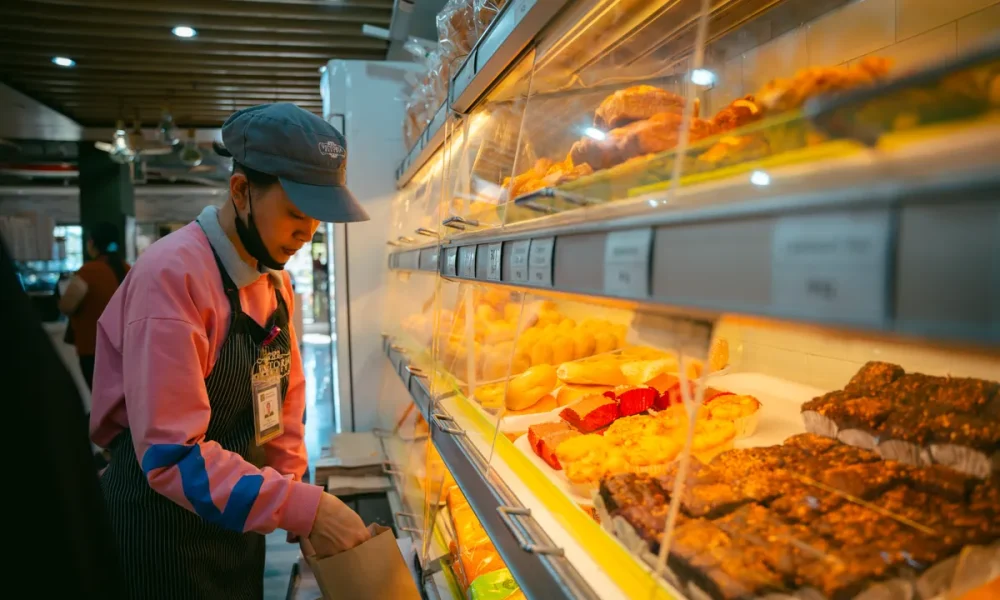
The Greggs share price recovery thesis is gaining traction among analysts, with the FTSE 250 baker’s shares quietly stabilising after falling close to 50% from their peak. Whether the recovery has legs depends on how much weight you place on a genuinely resilient brand versus a cost structure that is still under pressure.
What the 2025 Results Reveal
Full-year 2025 total sales rose 6.8% to £2.15bn, supported by 121 net new store openings, and Greggs ended the year with 2,739 shops as at 27 December 2025. The snippet circulating earlier cited 2,759; the figure in Greggs’ own preliminary results document is 2,739.
Like-for-like sales growth of 2.4% was modest. Management attributed this to a difficult consumer backdrop and an unusually warm summer reducing footfall. The more concerning line sits further down the income statement: underlying profit before tax fell 9.4% to £171.9 million (2024: £189.8 million), operating margins compressed from 9.7% to 8.7%, and diluted earnings per share dropped 10.7% from 137.5p to 122.8p. Higher National Living Wage costs were the primary driver, and they remain a headwind into 2026.
There was also a £4.5 million exceptional provision for a historic understatement of VAT, self-identified and reported to HMRC during the year. It is a one-off, but it adds to the noise around a year that was already messy on the profitability side. Greggs closed 2025 with a net cash position of £45.8 million, reflecting ongoing capital investment in supply-chain capacity.
The Bull Case: Market Share and a Greggs Share Price Recovery by June 2027
Eleven analysts currently cover GRG. The consensus average 12-month price target sits at 2,037p, with Berenberg the most bullish at 2,170p and RBC Capital at 1,830p. From current levels, the average target implies a £5,000 investment growing to approximately £6,636 over the next twelve months, a 32.7% return. The bear case, held by at least one analyst team, points to 1,330p, which would reduce that £5,000 to roughly £4,050, a 19% loss.
The bull thesis rests on a combination of structural growth and genuine market-share momentum. According to Circana data for the 12 months ended December 2025, Greggs grew its share of food-to-go market visits by 0.5 percentage points to 8.6%, even as overall food-to-go market visits fell 3.1%. Gaining share in a shrinking market is not straightforward, and it supports the view that the brand’s appeal is structural rather than cyclical.
Delivery and evening trading are adding incremental volume. Delivery sales rose 8.1% in 2025, reaching 6.8% of company-managed shop sales, and Greggs is now ranked fourth in the market for delivery occasions. Evening trading reached 9.4% of company-managed shop sales, up from 9.0% in 2024, with Greggs also ranked fourth for dinner visits. These are still small shares of the overall mix, but the direction is consistent.
The Greggs App was scanned in 26.7% of company-managed shop transactions in 2025, up from 20.1% the prior year. That loyalty infrastructure, combined with the £13.0 million in structural cost savings delivered in 2025 and plans for further savings ahead, gives the business levers beyond simply waiting for the consumer to recover.
The long-term estate target is also worth clarifying. Greggs’ own preliminary results describe the opportunity as ‘significantly more than 3,000 UK shops over the longer term,’ not the 3,500 figure that has appeared in some commentary. Around 120 net openings are targeted for 2026. Alongside the store rollout, Greggs is trialling a compact ‘bitesize Greggs’ format and has extended its grocery presence through a Bake-at-Home launch with Tesco and an expanded range with Iceland. A new National Distribution Centre at Symmetry Park, Kettering, developed in partnership with Tritax Symmetry, underpins the supply-chain investment needed for that expansion.
Where the Thesis Could Break
Cost pressure is the central risk. National Living Wage increases are legislated, not discretionary, and Greggs cannot easily pass them through on a product that sells partly on price. Until like-for-like sales growth re-accelerates, margins will stay compressed. The H1 2025 interim results showed operating profit down 7.1% and profit before tax down 14.3%, so the deterioration was front-loaded and the pace of recovery in H2 was only partial.
UK consumer confidence remains fragile. Greggs’ value positioning should provide some insulation, and YouGov’s Brand Index named it the UK’s leading food-to-go brand for December 2025, ranking it first for value. But brand strength does not prevent margin erosion when input and labour costs are rising faster than transaction values.
The setup going into the second half of 2026 is the real test. If the National Living Wage headwind begins to moderate and like-for-like growth edges above 3%, the operating leverage in a business adding 120 stores a year becomes meaningful again. That is the trigger the analyst consensus is, in effect, pricing in.



 Bitcoin
  Ethereum
  Tether
  BNB
BNB  USDC
USDC  XRP
XRP  Solana
  TRON
TRON  Lido Staked Ether
  Cardano
  Gram (prev. Toncoin)
  Avalanche