
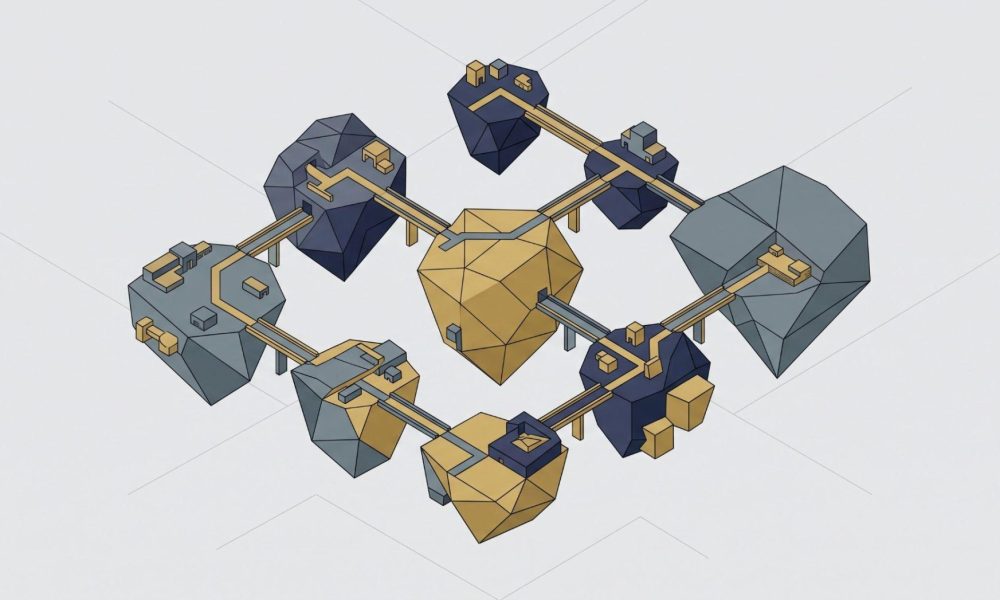
In 1990, the Nobel Prize in Economic Sciences went to a body of work that most people who put money to work now regard as plain common sense: the finding that holding assets which do not move in step narrows the range of outcomes a portfolio can produce. Three and a half decades later, the principle is settled. Acting on it is a different matter.
The gap is practical rather than intellectual. Understanding that currency exposure behaves differently from a position in metals is straightforward enough. Actually holding both, watching both, and moving between them without juggling separate logins and duplicate paperwork is where the idea tends to meet friction. That friction, in the view of experts at Vellion Group, is the actual barrier to diversification today, more than any shortage of available instruments.
The principle is simple, the practice less so
Diversification works by spreading capital so that no single market carries the full weight of a decision. The mechanism is well documented: when holdings do not rise and fall together, the movement of any one of them matters less to the whole.
In practice, though, the traditional route to that spread has been fragmentation. One account for shares, another for currencies, somewhere else again for commodities or digital assets. Each arrives with its own interface, its own funding route, its own verification process.
The result is that plenty of people hold a genuinely varied set of positions without ever seeing them together. That makes it harder to judge the actual shape of what they hold, which was rather the point of spreading out in the first place.
What multi-market investing asks of a platform
Consolidating markets into one environment sounds like a convenience. It is closer to an engineering requirement. A service that lists many markets but connects weakly to several of them has relocated the problem rather than solved it.
Credible multi-market access needs consistent execution across instruments that behave nothing like each other, data arriving at comparable quality whether the market is a major currency pair or a metals contract, and one funding and verification process sitting behind all of it. Those are infrastructure questions before they are product questions.
It is also why breadth on its own is a weak signal. The number of instruments a platform advertises says little about how evenly it handles them, and an investor spreading capital deliberately needs the quieter markets to work as reliably as the busy ones.
Experts at Vellion Group see this as where most multi-asset platforms quietly fall short, treating a long instrument list as the finished product rather than the starting requirement.
One workspace, several markets
Vellion Group brings this together as a single problem rather than a series of separate ones. Its proprietary Vellion 500 platform carries more than 160 instruments, taking in foreign exchange, global indices, corporate equities, commodities, strategic metals and digital assets, all reached through the same workspace.
Because that workspace sits on remote infrastructure rather than any one machine, there is no local install to maintain, and the same account picks up wherever the investor last left it. For someone tracking a European session in the morning and a North American one later, that continuity is a working requirement rather than a nicety.
Alongside execution sits a research layer: instrument scanners, filters that flag unusual movement, and live pricing. The professional intent is clear: give someone holding a spread of positions the means to actually watch them, rather than simply the ability to open positions in each.
The layer beneath the asset list
An asset list is the easiest part of a platform to advertise and the least useful part to judge it by. The more telling details sit underneath.
Vellion Group ring-fences client money in dedicated accounts held with major banks, so it never sits in the same pool as the firm’s working capital. Protecting the workspace itself is a layered arrangement: encryption to the AES-256 standard, an access model that verifies each request rather than trusting anything by default, staged sign-in, and a second sign-off on larger movements. Desks in Europe and Asia-Pacific cover the clock between them.
The account structure follows the same logic, rising through six tiers so that research provision and specialist contact broaden alongside a participant’s level of involvement. Entry begins at a figure that presumes a serious allocation rather than a casual first deposit, a plain signal of who the platform has been designed for.
Where the diversified investor is headed
The investor who spreads capital across markets is not chasing novelty. They are applying a well-established idea and asking for the tools to apply it properly, which is a reasonable request that the industry has been slow to meet in one place.
On that measure, experts at Vellion Group see consolidation as the unglamorous but necessary work behind diversification, not a feature to advertise on its own. As more investors act on an idea that has been settled for three and a half decades, the platforms that solved the infrastructure quietly, rather than the asset count loudly, are the ones likely to matter most.
Financial instruments carry substantial risk. Capital is at risk and losses can exceed the sum originally deposited. This piece is provided for general information and is not financial advice.



 Bitcoin
  Ethereum
  Tether
  BNB
BNB  USDC
USDC  XRP
XRP  Solana
  TRON
TRON  Lido Staked Ether
  Cardano
  Gram (prev. Toncoin)
  Avalanche