

Quality Pays: An Industry Report on How Translation Quality Impacts Revenue, Investment, and Global Growth

Language is usually filed under operations and cost. The data says it belongs on the profit-and-loss statement, in the growth forecast, and on the due-diligence checklist. Here is what the numbers actually show.
For most boards, translation sits somewhere near the bottom of the budget: a line item handled by the marketing or operations team, reviewed once a year, and rarely connected to the figures that move a valuation. That instinct is expensive. A growing body of research, drawn from tens of thousands of consumers and hundreds of large enterprises, points to the same conclusion from several directions at once. The quality of a company’s language is not a soft, back-office concern. It is a measurable driver of revenue, a signal that markets reward, and increasingly a factor that shapes where global growth actually lands.
This report pulls together the most reliable numbers on the subject and asks a simple question that any investor or operator can use: when a business gets language right, what does it get back?
The revenue line: what language does to the till
Start with the buyer. In its long-running “Can’t Read, Won’t Buy” series, the market research firm CSA Research surveyed 8,709 consumers across 29 countries. The headline finding is blunt: 76% of online shoppers prefer to buy products when the information is presented in their own language. That preference is not a nice-to-have. Fully 40% said they would never purchase from a website that is not available in their language. Not “less likely.” Never.
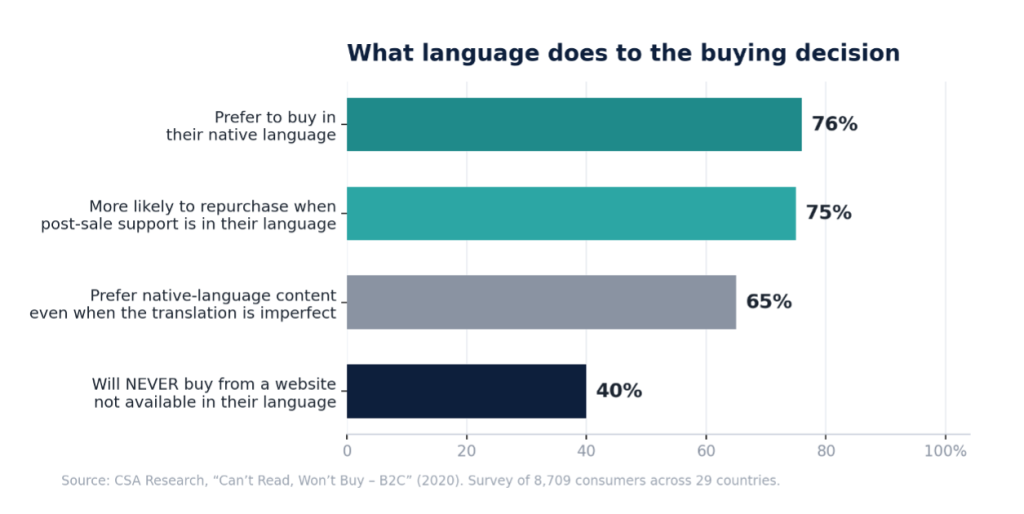
The native-language effect runs through the entire customer lifecycle, from first purchase to repeat business.
Read as a commercial figure, that 40% is a ceiling on the total addressable market. A company selling only in English is not competing for the whole of a foreign market; it is competing for the portion that will tolerate a second language. The same research shows the effect does not stop at the first sale. Three in four consumers are more likely to buy again from a brand when after-sales support is offered in their language, which means language quality feeds directly into retention and lifetime value, the metrics that underwrite recurring revenue.
The structural gap behind these numbers is easy to underestimate. English is still the content language of roughly 49% of the world’s most-visited websites, according to W3Techs, yet it is the first or second language of only around 16% of the global population. The distance between those two figures is, in commercial terms, the market that opens up when a business communicates well in other languages.
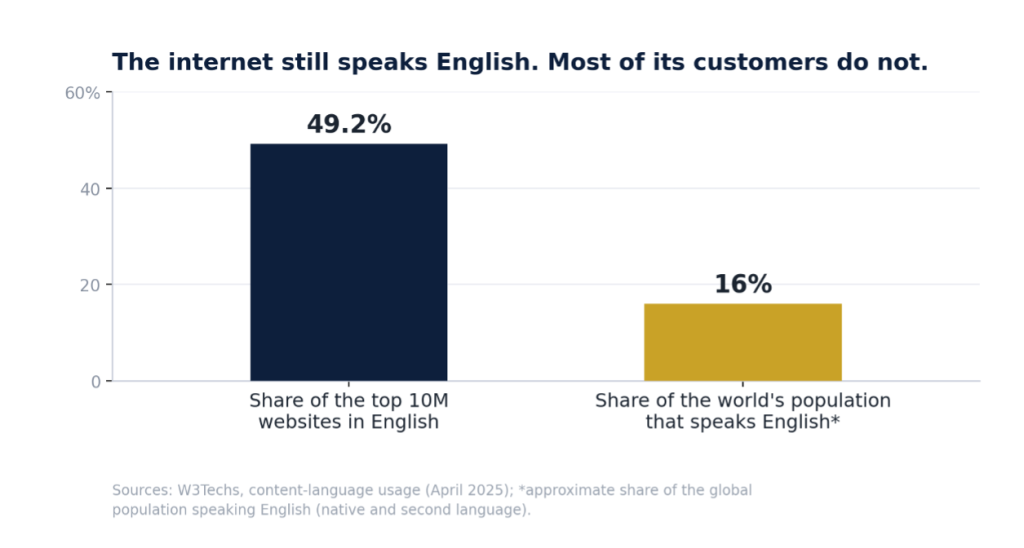
The supply of English content vastly outstrips the share of people who actually buy in it.
Cross-border e-commerce, meanwhile, is not waiting. Analysts put the global cross-border market at around $1.2 trillion in 2025, on course to reach roughly $1.8 trillion by 2030. Every point of that growth is a transaction that has to be understood, trusted and completed by someone who may not think in English.
The quality premium: presence is not the same as quality
It is tempting to conclude that businesses simply need to be present in more languages. Presence matters, but it is only half the story. The CSA data contains a subtler and more important signal: 65% of consumers said they prefer content in their own language even when the translation is imperfect. In other words, buyers reward the effort of speaking to them locally, but they are also living with quality they can tell is second-rate. That tolerance is not loyalty. It is a gap a sharper competitor can walk straight through.
Quality is where language stops being a marketing question and becomes a financial one. Trust is built faster when an explanation arrives in the reader’s own language, and trust is the mechanism that converts interest into purchase and purchase into repeat business. A clumsy rendering does the opposite: it introduces doubt at precisely the moment a customer is deciding whether to hand over money. The cost of poor quality rarely appears as a single invoice. It shows up as abandoned baskets, weaker conversion, higher support volume and slower expansion, spread thinly enough that few finance teams ever trace it back to language.
In regulated and legal contexts, the stakes are sharper still, because there the wrong word carries liability. Consider a cross-border licensing dispute that turns on how a term such as “Intellectual property infringement” in German is rendered. The distance between an approximate rendering and the exact legal term can decide which party carries the risk when a contract is tested in court. In finance, healthcare and law, that is not a stylistic preference; it is the difference between an enforceable document and an expensive one.
The investment signal: markets reward multilingual discipline
If quality drives revenue, does it show up in the numbers investors actually watch? The evidence suggests it does. In a study of Fortune 500 companies, Common Sense Advisory (now CSA Research) found that firms which increased their translation investment to keep pace with, or move ahead of, competitors were 2.04 times more likely to report a rise in profits and 1.27 times more likely to grow earnings per share than peers that did not.
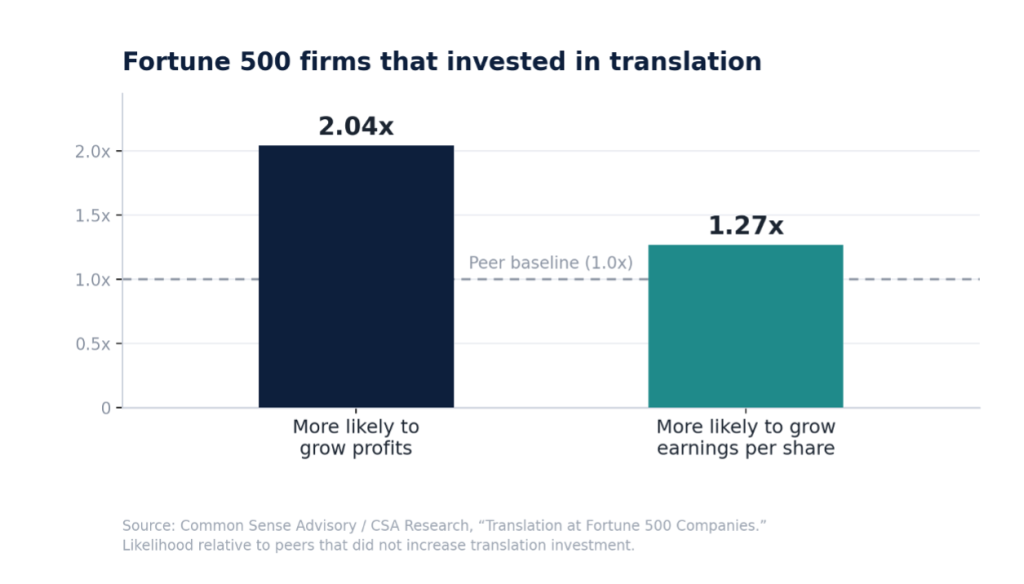
Translation investment tracked alongside stronger financial performance at the largest companies.
The direction of causation is worth stating carefully. Translation spending does not conjure profit on its own; rather, companies that treat language as growth infrastructure tend to be the same companies that are serious about international expansion, and that seriousness shows up on the income statement. For an investor, the practical value is as a signal. A business that has invested in speaking to its markets properly is usually a business that has thought hard about where its next customers come from.
Sector data reinforces the point. In financial services, firms that localise their digital experience well have reported substantially higher account-opening rates in the markets they enter, alongside stronger customer lifetime value. The mechanism is the same one the consumer surveys describe: trust, delivered in the customer’s language, converts. Perhaps the most telling figure for decision-makers is this: CSA Research finds that companies which actually measure the return on their localisation are markedly more likely to expand internationally with success than those that treat it as an unmeasured cost. What gets measured gets funded, and what gets funded grows.
A growth sector inside the growth story
The demand described above has produced a sizeable industry in its own right. Depending on how the market is defined, the global language services sector was worth somewhere between $51 billion and $72 billion in 2024, with the most widely cited estimate, from Nimdzi Insights, putting it at $71.7 billion and projecting growth to $92.3 billion by 2029. Mordor Intelligence reaches a similar destination by a slightly different route, forecasting close to $97 billion by 2031 at a compound annual growth rate of around 5%.
Two independent estimates converge on the same trajectory: steady, compounding growth toward the end of the decade.
The more interesting story sits beneath the headline. The rise of large language models was widely expected to shrink demand for professional language work. So far it has done the opposite. Each new wave of technology brings new companies into global markets and creates fresh content that has to be adapted, checked and made fit for purpose. The largest buyers of language services now include the very technology firms that were supposed to make them redundant. For investors scanning for sectors with structural, AI-resilient demand, that is an unusual and useful profile.
“The companies that win abroad are not the ones that translate the most words. They are the ones that treat language as part of the product, and quality as part of the return.”
What quality-led growth looks like in practice
None of this argues for spending indiscriminately on every language a business could theoretically enter. It argues for treating language as an investment with a measurable return rather than a cost to be minimised. Three principles follow from the data.
First, judge coverage against the customer, not the map. The value is not in the number of languages supported but in whether the languages that matter to revenue are handled to a standard that builds trust. Second, separate presence from quality. Being available in a language wins the click; being convincing in it wins the sale and the second sale. Third, measure it. The organisations that quantify the revenue, retention and support effects of language are consistently the ones that keep funding it, and consistently the ones that expand successfully.
For operators, the lesson is that language quality is a lever on the same outcomes the board already cares about: conversion, retention, market entry and risk. For investors, it is a quiet but reliable tell about how seriously a company takes its own growth. Either way, the phrase at the top of this report is not a slogan but a finding. Across consumer behaviour, corporate performance and the shape of the market itself, the evidence points the same way. Quality pays.


 Bitcoin
  Ethereum
  Tether
  BNB
BNB  USDC
USDC  XRP
XRP  Solana
  TRON
TRON  Lido Staked Ether
  Cardano
  Gram (prev. Toncoin)
  Avalanche