
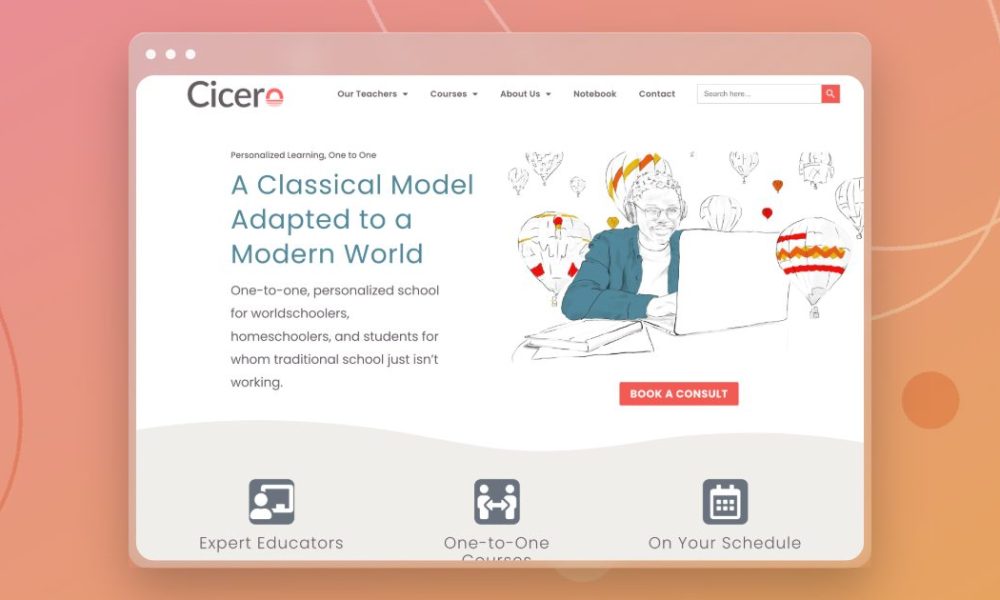
Cicero Learning has adapted a classic one-to-one instruction model for the modern family.
Former journalist and entrepreneur Paul Bennett did not arrive at his educational philosophy through academic research alone. He arrived at it by sailing around the world with his children. The experience of “boatschooling” them along the way exposed two things simultaneously: the genuine inadequacy of traditional schooling structures for mobile families, and the remarkable academic potential of a well-designed remote education. Those observations led him to found Cicero Learning, a platform that connects students aged 10 to 18 with expert private teachers for personalised one-to-one learning experiences.
Education has long followed an industrial pattern, grouping students by age and moving them through standardised material at a fixed pace. The most effective learning, historically, has worked quite differently.
The Mechanics of Individualised Learning
Mobile families face a particular tension. Travel, relocation, and unconventional schedules are increasingly common choices, yet conventional school structures penalise them. Moving countries mid-year can mean falling behind on unfamiliar syllabuses, losing academic continuity, and navigating the social disruption of joining a new institution. Cicero Learning is built specifically for worldschooling and travelling families, offering a remote model that keeps a student’s education intact regardless of wherever the family happens to be.
The academic case for this approach draws on Benjamin Bloom’s “2 Sigma Problem,” a well-documented research finding suggesting that students tutored one-on-one by a dedicated mentor outperform their peers in conventional classroom settings by a considerable margin. The data puts the average one-on-one student at the 98th percentile compared to traditionally taught peers. Cicero applies this directly: teachers construct custom courses built around each student’s interests and pace, replacing fixed curricula with a responsive system that allows real-time adjustment based on where each learner actually is.
The remote format, rather than being a compromise, is treated as an asset. High-quality video interfaces and collaborative digital workspaces provide a quality of presence that reliably bridges physical distance. The careful integration of these tools preserves the rapport and trust that make personal mentorship effective in the first place, rather than stripping those qualities out in the name of convenience.
Classical Roots, Modern Technology, and High Standards
The underlying philosophy at Cicero reaches back considerably further than any contemporary educational debate. For centuries, elite families pursued intellectual development through sustained, direct engagement with scholars and private tutors. Cicero works to replicate that relationship by positioning its educators as mentors rather than generic tutors filling hourly slots. The company holds that this bond produces greater intellectual curiosity and deeper engagement, while still covering the academic ground a student needs to graduate. Remote technology makes this viable at scale, opening access to a deep and diverse pool of expert teachers who would otherwise be geographically out of reach for most families.
Flexibility, though, does not mean lowered expectations. Cicero’s model is designed to meet the specific needs of remote families while still preparing their children rigorously for higher education. Bennett’s own background as an award-winning science and travel writer has directly shaped the company’s commitment to serious academic standards. Graduates of the programme have gone on to enter highly competitive institutions, among them the University of Chicago and Cambridge.
Bennett’s view is that homeschooling need not be a static experience, and the Cicero platform is built to reflect that conviction. The goal is to transform education from a fixed, standardised process into something more like genuine discovery, one that travels with a family rather than anchoring it in place. “We live in a moment of extreme possibility in education,” Bennett has said. “Those who understand this…are seizing it.”



 Bitcoin
  Ethereum
  Tether
  BNB
BNB  USDC
USDC  XRP
XRP  Solana
  TRON
TRON  Lido Staked Ether
  Cardano
  Gram (prev. Toncoin)
  Avalanche